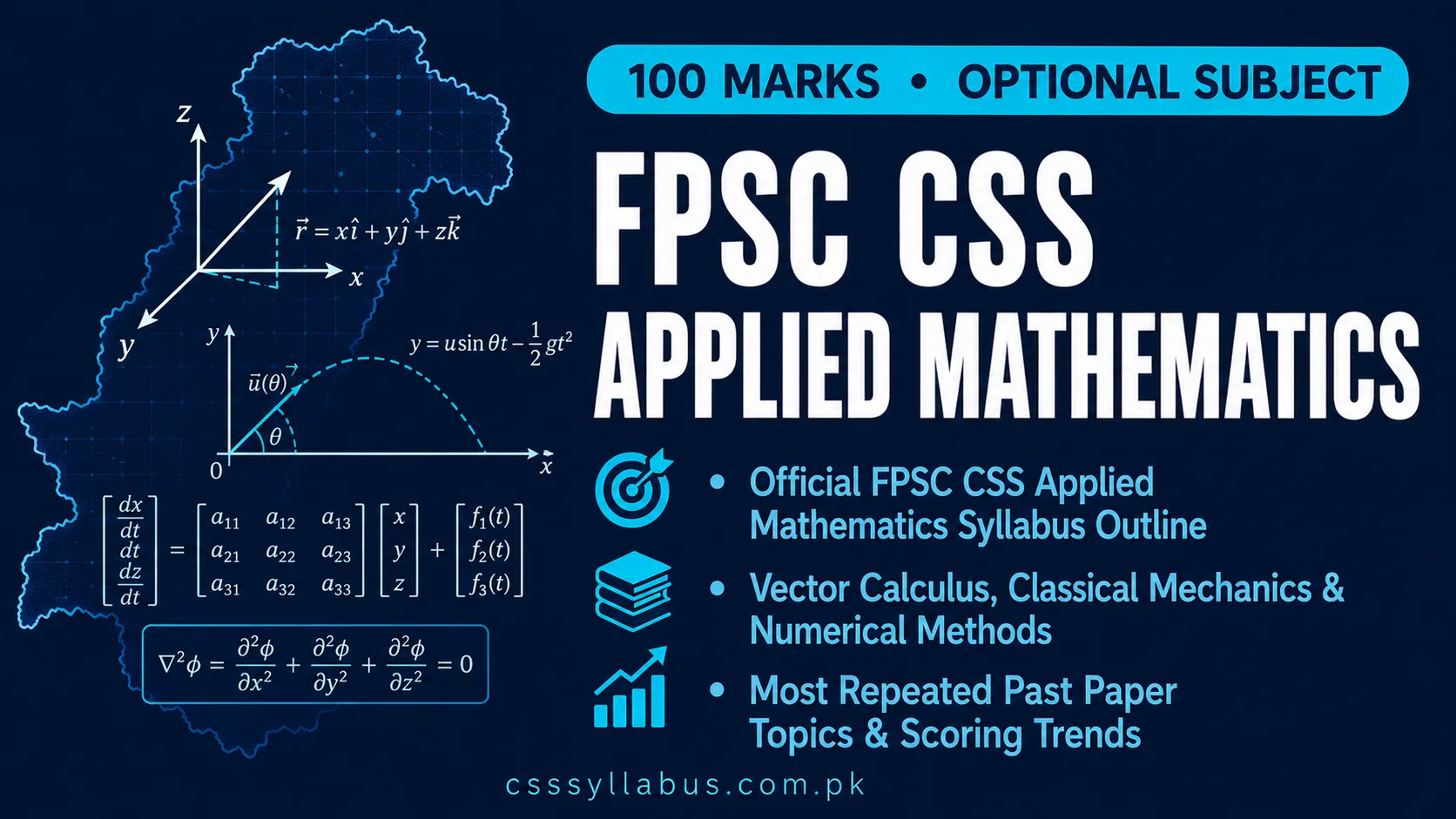
The CSS applied mathematics syllabus carries 100 marks as a Group II optional subjects which includes Geology, Chemistry, Pure Mathematics, Statistics and Physics under the Central Superior Services examination rules set by FPSC. Applied Mathematics is a 100-mark paper — candidates combining it with Pure Mathematics or Statistics reach the required 200-mark Group II total. The CSS applied mathematics syllabus covers calculus, differential equations, numerical methods, linear algebra, mechanics, and mathematical modelling — applied mathematical techniques rather than pure theoretical proofs. Mathematics and engineering graduates choose Applied Mathematics from optional subjects for its problem-solving focus, which rewards candidates who can apply techniques rather than reproduce proofs from memory.
APPLIED MATHEMATICS CSS Syllabus (100 MARKS)
I. Vector Calculus (10%) Vector algebra; scalar and vector products of vectors; gradient divergence and curl of a vector; line, surface and volume integrals; Green’s, Stokes’ and Gauss theorems.
II. Statics (10%) Composition and resolution of forces; parallel forces and couples; equilibrium of a system of coplanar forces; centre of mass of a system of particles and rigid bodies; equilibrium of forces in three dimensions.
III. Dynamics (10%) Motion in a straight line with constant and variable acceleration; simple harmonic motion; conservative forces and principles of energy. Tangential, normal, radial and transverse components of velocity and acceleration; motion under central forces; planetary orbits; Kepler laws;
IV. Ordinary differential equations (20%) Equations of first order; separable equations, exact equations; first order linear equations; orthogonal trajectories; nonlinear equations reducible to linear equations, Bernoulli and Riccati equations. Equations with constant coefficients; homogeneous and inhomogeneous equations; Cauchy-Euler equations; variation of parameters. Ordinary and singular points of a differential equation; solution in series; Bessel and Legendre equations; properties of the Bessel functions and Legendre polynomials.
V. Fourier series and partial differential equations (20%) Trigonometric Fourier series; sine and cosine series; Bessel inequality; summation of infinite series; convergence of the Fourier series. Partial differential equations of first order; classification of partial differential equations of second order; boundary value problems; solution by the method of separation of variables; problems associated with Laplace equation, wave equation and the heat equation in Cartesian coordinates.
VI. Numerical Methods (30%) Solution of nonlinear equations by bisection, secant and Newton-Raphson methods; the fixed- point iterative method; order of convergence of a method. Solution of a system of linear equations; diagonally dominant systems; the Jacobi and Gauss-Seidel methods. Numerical differentiation and integration; trapezoidal rule, Simpson’s rules, Gaussian integration formulas. Numerical solution of an ordinary differential equation; Euler and modified Euler methods; Runge- Kutta methods.
SUGGESTED READINGS
| S.No. | Title | Author |
|---|---|---|
| 1 | An Introduction to Vector Analysis | Khalid Latif, |
| 2 | Introduction to Mechanics | Q.K. Ghori |
| 3 | An Intermediate Course in Theoretical Mechanics | Khalid Latif, |
| 4 | Differential Equations with Boundary Value Problems | D. G. Zill and M. R. Cullen |
| 5 | Elementary Differential Equations | E.D. Rainville, P.E. Bedient and R.E. Bedient |
| 6 | Introduction to Ordinary Differential Equations | A.L.Rabenstein |
| 7 | Advanced Engineering Mathematics | E. Kreyszig |
| 8 | An Introduction to Numerical Analysis | Mohammad Iqbal |
| 9 | Numerical Analysis | R.L Burden and J.D Faires |
| 10 | Elements of Numerical Analysis | F. Ahmad and M.A Rana |
| 11 | Mathematical Methods | S. M. Yousaf, Abdul Majeed and Muhammad Amin |
APPLIED MATHEMATICS Frequency Analysis (2009–2023)
| Syllabus Topic | Number of Questions | Years Appeared | Percentage Weightage | Trend (High / Medium / Low) |
|---|---|---|---|---|
| Vector algebra; scalar and vector products of vectors; gradient divergence and curl of a vector; line, surface and volume integrals; Green’s, Stokes’ and Gauss theorems. | 38 | 2009, 2010, 2011, 2013, 2014, 2015, 2016, 2017, 2018, 2019, 2020, 2022, 2023 | 10.8% | High |
| Composition and resolution of forces; parallel forces and couples; equilibrium of a system of coplanar forces; centre of mass of a system of particles and rigid bodies; equilibrium of forces in three dimensions. | 36 | 2009, 2010, 2011, 2013, 2014, 2015, 2016, 2017, 2018, 2019, 2020, 2022, 2023 | 10.2% | High |
| Motion in a straight line with constant and variable acceleration; simple harmonic motion; conservative forces and principles of energy. | 34 | 2009, 2010, 2011, 2013, 2014, 2015, 2016, 2017, 2018, 2019, 2020, 2022, 2023 | 9.7% | High |
| Tangential, normal, radial and transverse components of velocity and acceleration; motion under central forces; planetary orbits; Kepler laws; | 28 | 2009, 2010, 2011, 2013, 2014, 2015, 2016, 2018, 2020, 2022, 2023 | 8.0% | High |
| Equations of first order; separable equations, exact equations; first order linear equations; orthogonal trajectories; nonlinear equations reducible to linear equations, Bernoulli and Riccati equations. | 36 | 2009, 2010, 2011, 2012, 2013, 2014, 2015, 2016, 2017, 2018, 2019, 2020, 2022, 2023 | 10.2% | High |
| Equations with constant coefficients; homogeneous and inhomogeneous equations; Cauchy-Euler equations; variation of parameters. | 44 | 2009, 2010, 2011, 2012, 2013, 2015, 2016, 2017, 2018, 2019, 2020, 2022, 2023 | 12.5% | High |
| Ordinary and singular points of a differential equation; solution in series; Bessel and Legendre equations; properties of the Bessel functions and Legendre polynomials. | 13 | 2009, 2011, 2012, 2013, 2014, 2015, 2022, 2023 | 3.7% | High |
| Trigonometric Fourier series; sine and cosine series; Bessel inequality; summation of infinite series; convergence of the Fourier series. | 8 | 2012, 2016, 2017, 2018, 2019, 2020, 2023 | 2.3% | High |
| Partial differential equations of first order; classification of partial differential equations of second order; boundary value problems; solution by the method of separation of variables; problems associated with Laplace equation, wave equation and the heat equation in Cartesian coordinates. | 34 | 2009, 2010, 2011, 2012, 2013, 2014, 2015, 2016, 2017, 2018, 2019, 2020, 2022, 2023 | 9.7% | High |
| Solution of nonlinear equations by bisection, secant and Newton-Raphson methods; the fixed- point iterative method; order of convergence of a method. | 36 | 2009, 2011, 2012, 2013, 2014, 2015, 2016, 2017, 2018, 2020, 2022, 2023 | 10.2% | High |
| Solution of a system of linear equations; diagonally dominant systems; the Jacobi and Gauss-Seidel methods. | 15 | 2009, 2010, 2011, 2012, 2013, 2014, 2015, 2016, 2019, 2023 | 4.3% | High |
| Numerical differentiation and integration; trapezoidal rule, Simpson’s rules, Gaussian integration formulas. | 25 | 2009, 2010, 2011, 2012, 2013, 2014, 2015, 2016, 2017, 2018, 2019, 2020, 2022, 2023 | 7.1% | High |
| Numerical solution of an ordinary differential equation; Euler and modified Euler methods; Runge- Kutta methods. | 5 | 2016, 2020, 2022, 2023 | 1.4% | Medium |
APPLIED MATHEMATICS Top 5 Most Repeated Topics (2009–2023)
Composition and resolution of forces; parallel forces and couples; equilibrium of a system of coplanar forces; centre of mass of a system of particles and rigid bodies; equilibrium of forces in three dimensions. (36 Questions)
Equations with constant coefficients; homogeneous and inhomogeneous equations; Cauchy-Euler equations; variation of parameters. (44 Questions)
Vector algebra; scalar and vector products of vectors; gradient divergence and curl of a vector; line, surface and volume integrals; Green’s, Stokes’ and Gauss theorems. (38 Questions)
Equations of first order; separable equations, exact equations; first order linear equations; orthogonal trajectories; nonlinear equations reducible to linear equations, Bernoulli and Riccati equations. (36 Questions)
Solution of nonlinear equations by bisection, secant and Newton-Raphson methods; the fixed- point iterative method; order of convergence of a method. (36 Questions)