CSS Optional Subjects Syllabus 2026 & 2027 — Complete FPSC Guide
CSS optional subjects carry 600 marks across 7 groups. Every candidate must select 6 optional papers totalling exactly 600 marks from at least three different groups — as per FPSC’s official CSS syllabus notification at fpsc.gov.pk.
- What are CSS optional subjects?
- Optional subject combination rules — what FPSC allows
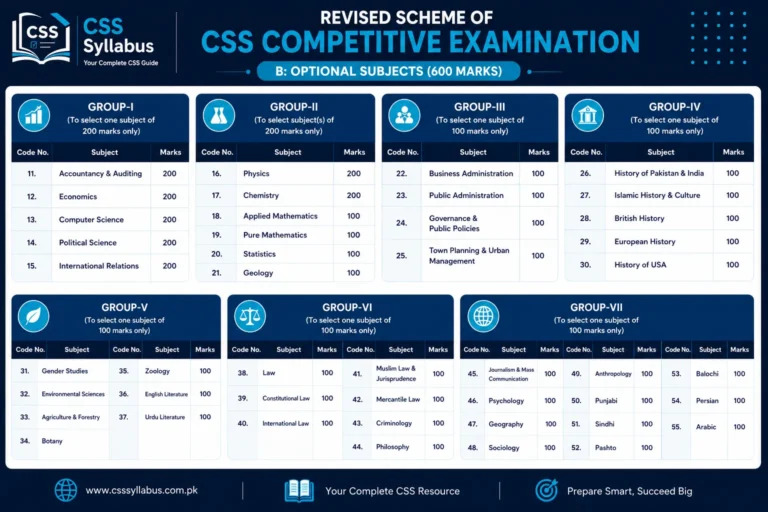
- Complete optional subjects list — all 7 groups
- How to choose CSS optional subjects — a practical framework
- Marks breakdown — 100 vs 200 mark papers
- PDF download — all groups
- What to do if you have a problem with subject selection
- Frequently asked questions
What are CSS optional subjects?
CSS optional subjects are the 6 papers every candidate selects from FPSC’s approved subject list to make up the remaining 600 marks of the CSS written examination. Unlike the 6 compulsory subjects — which every candidate sits regardless of background — optional subjects allow you to choose papers that align with your academic degree, strengths, and preparation capacity. Each optional paper is 3 hours long and follows a topic outline prescribed by FPSC in the official CSS syllabus notification.
The CSS written examination carries 1,200 marks in total — 600 from 6 compulsory papers and 600 from 6 optional papers. Optional subject selection is one of the most consequential decisions in your entire CSS preparation.
CSS optional subject combination rules — what FPSC allows
FPSC sets strict group-wise rules for optional subject selection. Before you finalise your 6 subjects, you must understand these rules — a wrong combination in your application form cannot be corrected after the registration deadline.
Your 6 optional subjects must total exactly 600 marks and must come from at least three different groups. You cannot take all 6 from one group or two groups only.
Here is how marks work group by group, according to FPSC’s official CSS syllabus:
| Group | Subjects | Marks allowed | Rule |
|---|---|---|---|
| Group I | Political Science, Economics, Computer Science, International Relations, Accountancy & Auditing | 200 marks | Select one subject only |
| Group II | Physics, Chemistry, Applied Mathematics, Pure Mathematics (200 marks each); Statistics, Geology (100 marks each) | Up to 200 marks | One 200-mark subject OR two 100-mark subjects |
| Group III | Public Administration, Business Administration, Town Planning & Urban Management, Governance & Public Policies | 100 marks | Select one subject |
| Group IV | History of Pakistan & India, Islamic History & Culture, British History, European History, History of USA | 100 marks | Select one subject |
| Group V | Gender Studies, Environmental Sciences, Agriculture & Forestry, Botany, Zoology, English Literature, Urdu Literature | 100 marks | Select one subject |
| Group VI | Law, Constitutional Law, International Law, Muslim Law & Jurisprudence, Mercantile Law, Criminology, Philosophy | 100 marks | Select one subject |
| Group VII | Psychology, Sociology, Journalism, Geography, Anthropology, Punjabi, Sindhi, Pashto, Balochi, Persian, Arabic | 100 marks | Select one subject |
How many optional subjects can you take from each group?
From Group I, one subject only — worth 200 marks, appearing as two separate exam papers. From Group II, one or two subjects — but their combined marks must not exceed 200. From Groups III through VII, one subject each — worth 100 marks. Your total across all groups must equal exactly 600 marks.
What happens if your combination does not add up to 600 marks?
FPSC will reject your application or flag your subject selection during the verification stage. The most common mistake is selecting a 200-mark Group I subject and then selecting five more 100-mark subjects — this gives 700 marks, not 600. With a 200-mark Group I subject, you only need four more 100-mark subjects from other groups.
Can you change optional subjects after CSS registration?
Changes are only possible during the correction window FPSC opens after initial registration — typically a few days to one week. Once FPSC issues the admit card, optional subjects are final and cannot be changed. Contact FPSC immediately at 051-2255051 if you need to correct your selection before the window closes.
CSS optional subjects list — all 7 groups (2026 & 2027)
The following is the complete FPSC-approved CSS optional subjects list for the 2026 and 2027 examinations. The syllabus framework has remained structurally unchanged since the CE-2016 notification. Any revision will be announced through an official FPSC notification at fpsc.gov.pk — verify against the latest notification before beginning preparation.
Select one subject. The selected subject carries 200 marks examined across two papers of 100 marks each on separate exam days.
- Political Science syllabus
- Economics syllabus
- Computer Science syllabus
- International Relations syllabus
- Accountancy and Auditing syllabus
Select subjects with combined marks not exceeding 200. Physics, Chemistry, Applied Mathematics, and Pure Mathematics each carry 200 marks. Statistics and Geology each carry 100 marks.
- Physics syllabus
- Chemistry syllabus
- Applied Mathematics syllabus
- Pure Mathematics syllabus
- Statistics syllabus
- Geology syllabus
Select one subject. Each subject carries 100 marks examined in one paper.
- Public Administration syllabus
- Business Administration syllabus
- Town Planning and Urban Management syllabus
- Governance and Public Policies syllabus
Select one subject. Each subject carries 100 marks examined in one paper.
- History of Pakistan and India syllabus
- Islamic History and Culture syllabus
- British History syllabus
- European History syllabus
- History of USA syllabus
Select one subject. Each subject carries 100 marks examined in one paper.
- Gender Studies syllabus
- Environmental Sciences syllabus
- Agriculture and Forestry syllabus
- Botany syllabus
- Zoology syllabus
- English Literature syllabus
- Urdu Literature syllabus
Select one subject. Each subject carries 100 marks examined in one paper.
- Law syllabus
- Constitutional Law syllabus
- International Law syllabus
- Muslim Law and Jurisprudence syllabus
- Mercantile Law syllabus
- Criminology syllabus
- Philosophy syllabus
Select one subject. Each subject carries 100 marks examined in one paper.
- Psychology syllabus
- Sociology syllabus
- Journalism and Mass Communication syllabus
- Geography syllabus
- Anthropology syllabus
- Punjabi syllabus
- Sindhi syllabus
- Pashto syllabus
- Balochi syllabus
- Persian syllabus
- Arabic syllabus
How to choose CSS optional subjects — a practical framework
Wrong subject selection has ended more CSS attempts than poor preparation. Six optional subjects, 600 marks, one chance per attempt to get it right. Use this framework before finalising your choices.
Your academic background
Start with your degree subject. An LLB graduate has a head start in Constitutional Law and Mercantile Law. A political science degree carries foundational knowledge for Political Science and International Relations. Starting from zero in a 200-mark subject is significantly heavier than building on a degree you already hold.
Overlap with compulsory papers
Political Science overlaps with Current Affairs and Pakistan Affairs. Gender Studies overlaps with Pakistan Affairs and English Essay. Criminology overlaps with Current Affairs and Essay. Choose subjects that reduce your total preparation load without reducing marks potential.
Past paper pattern
Download three years of past papers for any subject you are considering. If you can see a pattern and feel confident answering, that subject fits your preparation style. If every question looks unfamiliar, that subject will cost you marks regardless of how hard you study.
Scoring trends
Subjects with compact, well-defined syllabuses — Mercantile Law, Applied Mathematics, Zoology, Islamic History and Culture — tend to produce more predictable papers. Subjects with open-ended syllabuses — Political Science, Sociology, European History — require stronger analytical writing skills as FPSC marks them on argument quality.
Which optional subjects are most popular in CSS 2026 and 2027?
Based on current search data and CSS preparation trends, the most searched optional subjects are Political Science, Criminology, Gender Studies, European History, and Sociology. Popularity does not mean easier — it means more candidates sit these papers. A less popular subject with a defined syllabus — Town Planning and Urban Management, Applied Mathematics, Zoology — can give a preparation advantage precisely because fewer candidates take them.
CSS optional subjects marks breakdown — 100 vs 200 mark papers
Understanding the difference between 100-mark and 200-mark optional subjects matters more than most new aspirants realise — not just for marks calculation but for exam day scheduling.
| Subject | Group | Marks | Papers |
|---|---|---|---|
| Political Science | Group I | 200 | 2 papers |
| Economics | Group I | 200 | 2 papers |
| Computer Science | Group I | 200 | 2 papers |
| International Relations | Group I | 200 | 2 papers |
| Accountancy and Auditing | Group I | 200 | 2 papers |
| Physics | Group II | 200 | 2 papers |
| Chemistry | Group II | 200 | 2 papers |
| Applied Mathematics | Group II | 200 | 2 papers |
| Pure Mathematics | Group II | 200 | 2 papers |
| Statistics | Group II | 100 | 1 paper |
| Geology | Group II | 100 | 1 paper |
| All Group III subjects | Group III | 100 | 1 paper |
| All Group IV subjects | Group IV | 100 | 1 paper |
| All Group V subjects | Group V | 100 | 1 paper |
| All Group VI subjects | Group VI | 100 | 1 paper |
| All Group VII subjects | Group VII | 100 | 1 paper |
How does a 200-mark subject affect your exam schedule?
A 200-mark subject means two separate exam papers on two separate days in the CSS examination schedule. If you select Political Science from Group I, you will sit Paper I on one day and Paper II on another day. This doubles your revision requirement for that subject compared to a 100-mark paper. A candidate taking a 200-mark Group I subject alongside four 100-mark subjects is effectively preparing for 6 exam papers — but those 6 papers cover the full 600 optional marks correctly. See the complete CSS compulsory subjects syllabus for the full 12-paper exam structure.
CSS optional subjects PDF download — all groups
The official CSS optional subjects syllabus PDF for 2026 and 2027 is published by FPSC on fpsc.gov.pk. Each subject has its own PDF containing the complete topic outline, paper structure, and marks distribution. Individual subject PDF links are available on each subject’s dedicated syllabus page below.
For the complete combined CSS syllabus PDF covering all compulsory and optional subjects in one document, visit the CSS syllabus homepage or download directly from fpsc.gov.pk.
What to do if you have a problem with optional subject selection
Your combination does not add up to 600 marks
Recount your selection group by group. The most common mistake is selecting a 200-mark Group I subject and then five more 100-mark subjects — giving 700 marks. With a 200-mark Group I subject, you only need four more 100-mark subjects from other groups. Your total must be exactly 600 marks.
The subject you want is in a group you have already used
You cannot take two subjects from Group I or exceed the 200-mark cap from Group II. If both subjects you want are in the same group, choose one and replace the other with a subject from a different group. Download the full FPSC optional subjects list from fpsc.gov.pk and map your choices against the group rules before submitting your application.
You submitted the wrong subjects in your application
Contact FPSC immediately. FPSC allows corrections during a limited window after initial registration. Once the admit card is issued, no changes are possible. Do not wait — contact FPSC on the same day you discover the error.
You are not sure whether your degree qualifies you for a specific subject
FPSC does not restrict optional subject choice by degree subject. Any graduate with an FPSC-recognised degree from an HEC-recognised university may select any optional subject. If you have a borderline degree recognition question, verify with HEC at hec.gov.pk before your application deadline.
For any FPSC registration query, correction request, or eligibility question — contact FPSC directly before the application deadline.
FPSC Helpline: 051-2255051Frequently asked questions — CSS optional subjects