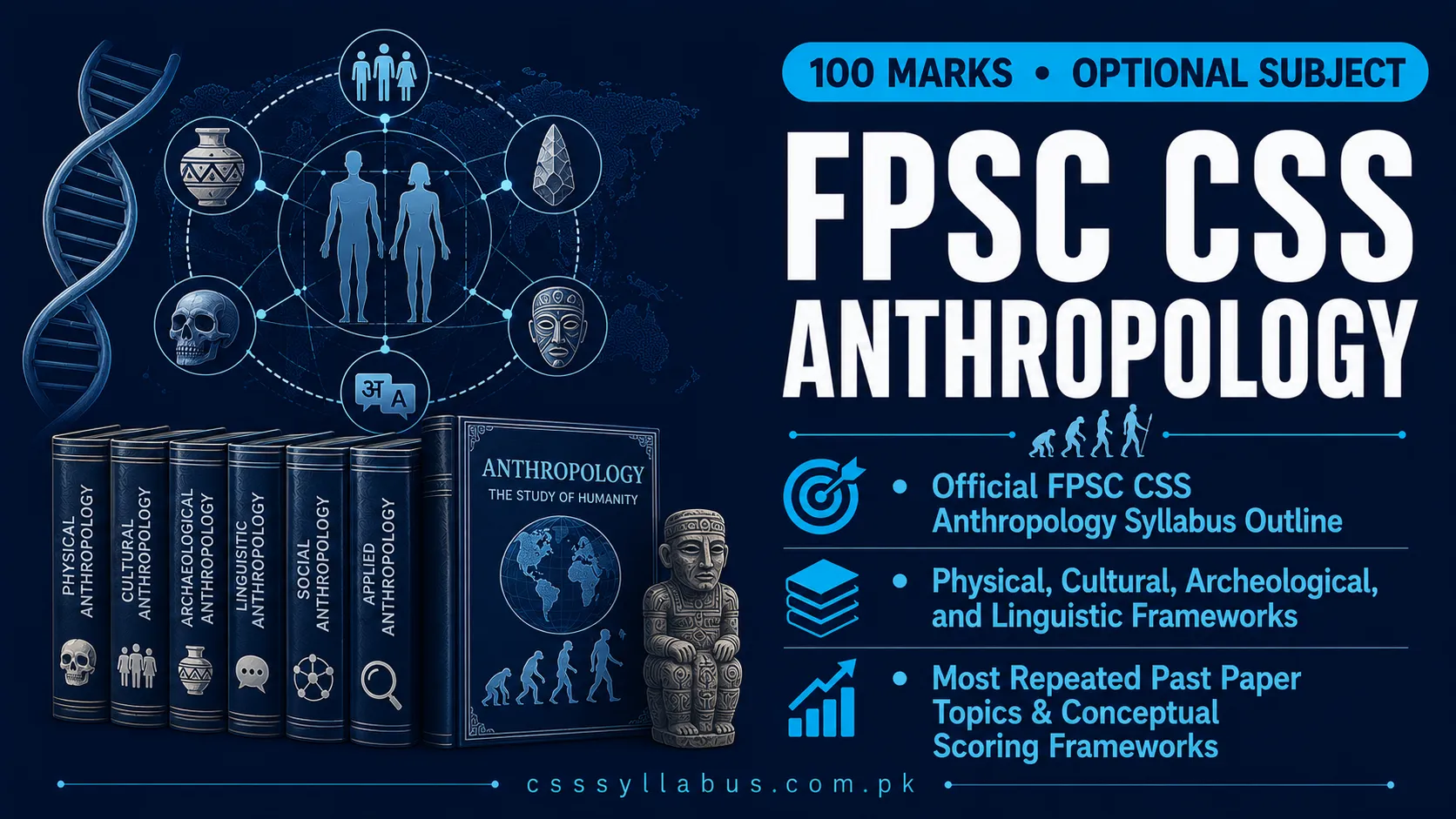
CSS Anthropology is a 100-mark optional paper under Group VII of the CSS optional subjects — Social Sciences and Languages — sitting within a group that includes Arabic, Persian, Balochi, Pashto, Sindhi, Punjabi, Sociology, Geography, Psychology, and Journalism and Mass Communication. FPSC sets the CSS Anthropology syllabus to cover cultural anthropology, social anthropology, physical anthropology, archaeological anthropology, linguistic anthropology, and the anthropology of Pakistan — its peoples, cultures, and social structures. Social sciences, sociology, and history graduates select Anthropology for its interdisciplinary depth and structured paper pattern — Ember and Ember’s Anthropology is the standard recommended text across CSS preparation resources. Review the CSS optional subjects syllabus for combination rules and group requirements before confirming Anthropology as your optional subject choice.
ANTHROPOLOGY CSS Syllabus (100 MARKS)
I. Anthropology Definition of anthropology, its historical development and recent trends
II. Social Anthropology Definition of culture, its characteristics and functions Relationship of anthropology with other social sciences Sub fields of anthropology: a) Biological Anthropology, b) Archaeology, c) Linguistic Anthropology d) Socio-Cultural Anthropology Institution of Family and Marriage (Definitions, types, structures, functions, family organization) Kinship and Social Organization (Definitions, types, functions, kinship terminology etc) Economic Organization: (Definitions, evolution, substantivism versus formalism, reciprocity, production, consumption, distribution, barter and primitive economic systems) Political Organization: (Definitions, evolution of political system, characteristics of (band, tribal, chiefdom and state societies), theories of the origin of state societies (internal conflict theories, external conflict theories, population and irrigation theories, institutionalization of leadership and the emergence of state, system theories), origin of civilization, the politics of identity, ethnicity and ethnic relations, nationalism, modernism, post-modernism etc. Religion: (Definitions, evolution of primitive religions, functions of religion, comparison of devine religions and other world religions such as Hinduism, Buddhism, Jainism etc) Contemporary Human Problems: Poverty, social inequality, political instability, population problems, ethnic violence and terrorism etc.
III. Urban Anthropology Rural-urban migration, expansion of cities, major environmental issues, sanitation problems, urbanization and development, establishment of slums and squatter settlements, refugees, yankees, betties, gypsies, wars and conflict, conversion of power from feudal to industrialists, institutionalization, education system, and change in the mode of production (agriculture to capitalists), poverty (theories and remedies), management of city life (psychological, cultural, economic, political, religious, physical, environmental, ecological, demographical, lingual etc.), Karl Marx and conflict theory, problems created by the mechanization and automation.
IV. Socio-Cultural Change Definitions, difference between social and cultural change, various dimension of cultural change, barriers to cultural change including (culture, psychological and political), internal dynamics for change, external dynamics for change, population increase and change, diffusion of innovations, socio-religious barriers in accepting the innovations and new ideas, media and cultural change, dynamics of change in Pakistan (Trends and prospects)
V. Ethnicity and Race Theories related to ethnicity and race, ethnicity and racism, nations and nationality, ethnic conflict, degree of social variation, rank societies, caste and class societies and social stratification etc.
VI. Anthropological Theories Contributors: (Edward Burnett Taylor, Lewis Henry Morgan, James Frazer, Karl Marx, Edmund Leach, Franz Boas, Margaret Mead, Ruth Benedict, Alfred L. Krobber, Alfred Reginald Radcliffe-Brown, Bronislaw Kasper Malinowski, Clifford Geertz, Talal Asad, Akbar S. Ahamd, Ibn Khaldun, Shah Walliullah) Classical Theories: (Degenerations, Evolutionism, Neo-Evolutionism, Diffusions) Modern Theories: (Functionalism, Structural-functionalism, Class struggle, Structuralism, Historical Particularism, Feminism, Culture and personality) Current Trends in Anthropological Thoughts: (Post Modernism, Romanticism, Poetics and Politics of Ethnography)
VII. Anthropological Research Methods Meaning, definition, types and aims of anthropological research Qualitative and Quantitative research Purpose of research, research question, variables, hypothesis, research objective(s), research design, sampling, field data collection, tools of data collection (questionnaire, interview, participant observation), data classification, data analysis, and reporting.
SUGGESTED READINGS
| S.No. | Title | Author |
|---|---|---|
| 1 | Anthropology | William A Haviland |
| 2 | Cultural Anthropology | Onrad Philip Kottak |
| 3 | Diffusion of Innovation | Evert M. Roger |
| 4 | Socio Cultural Dynamics and impact of Technological Change | G. M. Foster |
| 5 | Pakistani Society | Akber S. Ahmed |
| 6 | Economic Anthropology | Sutti Ortiz |
| 7 | Political Anthropology: An introduction | Ted. C. Lawellen |
| 8 | Pukhtun economy and society | Akber S. Ahmed |
| 9 | Principles of Anthropology | Eliot Dismore Chapple and Carleton Stevens Coon |
| 10 | Anthropology and Modern life | Franz Boas |
| 11 | Anthropology and Contemporary Human Problem | John H. Bodley |
| 12 | Sindh and the Races that inhabit the Valley of the Indus | Richard Burton |
| 13 | The People of Pakistan | Yu. V. Gankorvsky |
| 14 | Anthropology and Development | Jean-Pierre Olivier de Sardan |
| 15 | An Introduction to Theory in Anthropology | Robert Layton |
| 16 | Anthropological Theory | John R. McGee and Richard L. Warms |
| 17 | Anthropology in Pakistan | Stephen Pastner and Louis Flam |
| 18 | Anthropology (13th edition) | Carol R. Ember, Melvin R Ember and Pet N Peregrine |
| 19 | Other Cultures | John Beattie |
| 20 | A Hand Book of Social Science Research | Bevelry R. Dixon, Gary D Bouma and G.B.J. Atiinson |
| 21 | Frontier Perspectives: Essays in Comparative Anthropology | Clarlies Lindholm |
| 22 | Generosity and Jealousy: The Swat Pukhtun of Northern Pakistan | Clarlies Lindholm |
| 23 | Friend by Day and Enemy by Night: Organized Vengeance in a Kohistani Community | Lincoin Keiser |
| 24 | A Punjabi Village in Pakistan | Zekiye Eglar |
| 25 | The social organization of the Marri Baluch | Robert Niel Pehrson |
| 26 | Introducing Anthropology | Park, MA 2007 |
| 27 | Peoples and Cultures of Asia | Scupin, R 2005 |
| 28 | Outlines and Highlights for Anthropology | Scupin, R and Decorse, CR 2010 |
| 29 | Economic Anthropology | Stuart plattner |
| 30 | Economies and Culture | Richard Wilk |
| 31 | Introduction to Anthropology of Religion | Brian Moris |
ANTHROPOLOGY Frequency Analysis (Available Past Papers)
| Syllabus Topic | Number of Questions | Years Appeared | Percentage Weightage | Trend (High / Medium / Low) |
|---|---|---|---|---|
| Definition of anthropology, its historical development and recent trends | 3 | 2017, 2018, 2023 | 6.1% | Medium |
| Definition of culture, its characteristics and functions | 4 | 2016, 2018, 2020, 2022 | 8.2% | High |
| Relationship of anthropology with other social sciences | 0 | None | 0% | Dormant |
| Sub fields of anthropology: a) Biological Anthropology, b) Archaeology, c) Linguistic Anthropology d) Socio-Cultural Anthropology | 4 | 2017, 2018, 2020, 2022 | 8.2% | High |
| Institution of Family and Marriage | 2 | 2017, 2023 | 4.1% | Medium |
| Kinship and Social Organization | 3 | 2018, 2022, 2025 | 6.1% | Medium |
| Economic Organization | 5 | 2017, 2018, 2022, 2023, 2025 | 10.2% | High |
| Political Organization | 1 | 2022 | 2.0% | Low |
| Religion | 6 | 2016, 2017, 2018, 2020, 2023 (x2) | 12.2% | High |
| Contemporary Human Problems | 4 | 2016, 2017, 2023, 2025 | 8.2% | High |
| Urban Anthropology | 2 | 2020, 2025 | 4.1% | Medium |
| Socio-Cultural Change | 3 | 2016 (x2), 2025 | 6.1% | Medium |
| Ethnicity and Race | 3 | 2020, 2022, 2025 | 6.1% | Medium |
| Contributors | 1 | 2020 | 2.0% | Low |
| Classical Theories | 1 | 2016 | 2.0% | Low |
| Modern Theories | 2 | 2022, 2025 | 4.1% | Medium |
| Current Trends in Anthropological Thoughts | 0 | None | 0% | Dormant |
| Meaning, definition, types and aims of anthropological research | 1 | 2018 | 2.0% | Low |
| Qualitative and Quantitative research | 2 | 2016, 2023 | 4.1% | Medium |
| tools of data collection (questionnaire, interview, participant observation) | 2 | 2017, 2020 | 4.1% | Medium |
ANTHROPOLOGY Top 5 Most Repeated Topics (Based on Available Past Papers)
- Religion (6 Appearances)
- Economic Organization (5 Appearances)
- Definition of culture, its characteristics and functions (4 Appearances)
- Contemporary Human Problems (4 Appearances)
- Sub fields of anthropology: a) Biological Anthropology, b) Archaeology, c) Linguistic Anthropology d) Socio-Cultural Anthropology (4 Appearances)