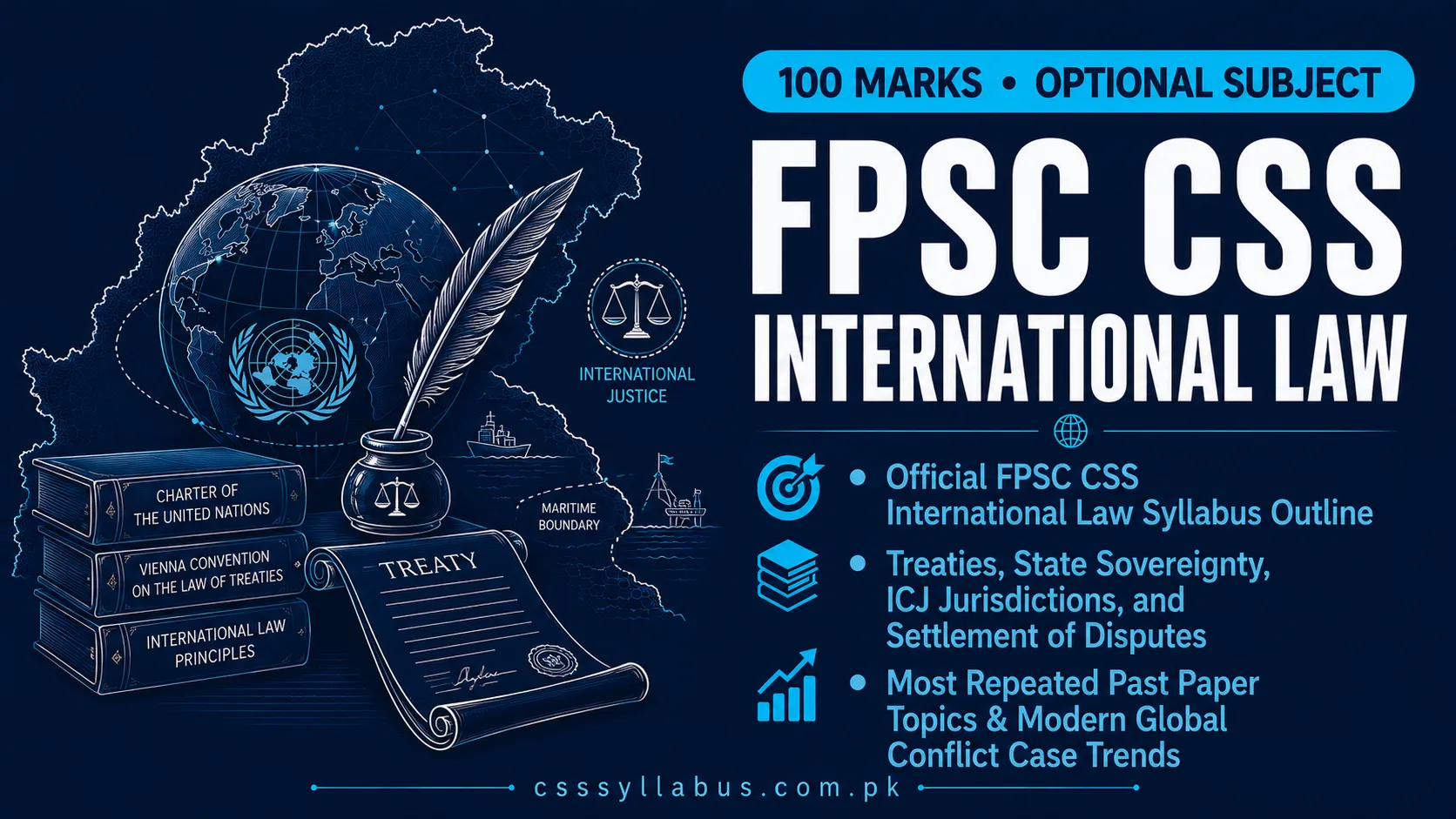
CSS International Law is a 100-mark optional paper under Group VI of the CSS optional subjects — Law and Philosophy — placed within the group alongside Philosophy, Criminology, Mercantile Law, Muslim Law and Jurisprudence, Constitutional Law, and Law. FPSC sets the CSS International Law syllabus to cover state sovereignty, treaties and conventions, international organisations including the United Nations, diplomatic law, law of the sea, human rights law, and the peaceful settlement of disputes. CSS aspirants from International Relations, political science, and law backgrounds select this subject for its consistent overlap with Current Affairs and CSS Essay writing — Malcolm Shaw’s International Law remains the standard recommended text across CSS preparation resources. Review the CSS optional subjects syllabus for combination rules and group requirements before confirming International Law as your optional subject choice.
INTERNATIONAL LAW CSS Syllabus (100 MARKS)
I. Nature, Origin and Basis of International Law. The Emergence of International Law, Early European Authors, The Nation-State System, The Enforcement of International Law, The Effectiveness of International Law, The Weakness of International Law, The Juridical Basis of International law, The Future of International law and Material Sources of International Law.
II. Relation between International Law and State Law. Article 38 of the Statute of International Court of Justice, Primary Sources of International Law, Subsidiary Sources of International Law, International Soft Law
III. State in General and Recognition Personality and Statehood in International Law, The Subjects of International Law, Recognition of State and Government in International Law, Recognition of State and Government in National Law.
IV. The Law and Practice as to Treaties The Vienna Convention on the Law of Treaties
V. The Settlement of International Disputes. Negotiation, Mediation and Good Offices, Inquiry, Settlement by the United Nations, Conciliation, Arbitration, The International Court of Justice.
VI. International Humanitarian Law. International and Non-International Armed Conflicts, Non-International Armed Conflict, ‘Combatant’ and ‘Protected Persons’, Protection of Wounded, Sick and Ship-Wrecked Persons, POWs, Civilians, Limitations on the Conduct of War, Limits on the Choice of Methods and Means of Warfare.
VII. The Use of Force The Law before the UN Charter, The Law after the Charter, The Collective Use of Force, The Right of Self-Defence.
VIII. International Institutions
IX. State Territorial Sovereignty.
X. State Responsibility.
XI. State Jurisdiction.
XII. Succession to Rights and Obligations.
XIII. The State and the Individual.
XIV. The State and the Economic Interest.
XV. Diplomatic Envoys, Counsels and other Representatives.
XVI. War, Armed Conflicts and other Hostilities.
XVII. Neutrality.
SUGGESTED READINGS
| S.No. | Title | Author |
|---|---|---|
| 1 | International Law | Malcolm N. Shaw |
| 2 | Principles of Public International Law | Ian Brownlie |
| 3 | International Law | Dr. S.K. Kapoor |
| 4 | Introduction to International Law | J.G. Starke, QC |
| 5 | International Humanitarian Law | ICRC Pakistan |
| 6 | Extradition Act, 1972 | Nil |
| 7 | The Diplomatic and Consular Privileges Act, 1972 | Nil |
| 8 | Territorial Waters and Maritime Zone Act, 1976 | Nil |
| 9 | U.N. Convention on Law of the Sea, 1984 | Nil |
| 10 | Cases and Materials on International Law | D.J. Harris |
INTERNATIONAL LAW Frequency Analysis (2001–2025)
| Syllabus Topic | Number of Questions | Years Appeared | Percentage Weightage | Trend (High / Medium / Low) |
|---|---|---|---|---|
| I. Nature, Origin and Basis of International Law. | 18 | 2001, 2002, 2005, 2007, 2008, 2009, 2010, 2011, 2013, 2014, 2015, 2016, 2017, 2019, 2022, 2023, 2024, 2025 | 10.5% | High |
| II. Relation between International Law and State Law. | 10 | 2005, 2007, 2013, 2015, 2016, 2017, 2018, 2019, 2020, 2025 | 5.8% | High |
| III. State in General and Recognition | 23 | 2001, 2003, 2004, 2005, 2006, 2007, 2008, 2009, 2010, 2011, 2012, 2013, 2014, 2015, 2016, 2017, 2018, 2019, 2020, 2022, 2023, 2024, 2025 | 13.4% | High |
| IV. The Law and Practice as to Treaties | 8 | 2002, 2003, 2007, 2012, 2015, 2017, 2023, 2024 | 4.7% | Medium |
| V. The Settlement of International Disputes. | 15 | 2001, 2002, 2004, 2005, 2007, 2008, 2010, 2013, 2017, 2018, 2019, 2022, 2023, 2024, 2025 | 8.7% | High |
| VI. International Humanitarian Law. | 6 | 2002, 2004, 2005, 2010, 2020, 2024 | 3.5% | Medium |
| VII. The Use of Force | 9 | 2002, 2004, 2012, 2017, 2019, 2022, 2023, 2024, 2025 | 5.2% | Medium |
| VIII. International Institutions | 11 | 2002, 2003, 2007, 2009, 2011, 2012, 2013, 2014, 2018, 2019, 2025 | 6.4% | High |
| IX. State Territorial Sovereignty. | 15 | 2001, 2002, 2003, 2004, 2005, 2007, 2009, 2010, 2012, 2013, 2014, 2016, 2019, 2023, 2024 | 8.7% | High |
| X. State Responsibility. | 4 | 2004, 2015, 2019, 2023 | 2.3% | Low |
| XI. State Jurisdiction. | 13 | 2001, 2002, 2003, 2004, 2006, 2008, 2009, 2012, 2014, 2016, 2019, 2020, 2024 | 7.6% | High |
| XII. Succession to Rights and Obligations. | 1 | 2015 | 0.6% | Low |
| XIII. The State and the Individual. | 17 | 2001, 2002, 2003, 2005, 2007, 2008, 2009, 2012, 2013, 2015, 2016, 2017, 2020, 2022, 2023, 2024, 2025 | 9.9% | High |
| XIV. The State and the Economic Interest. | 6 | 2001, 2005, 2008, 2013, 2014, 2016 | 3.5% | Medium |
| XV. Diplomatic Envoys, Counsels and other Representatives. | 6 | 2003, 2006, 2009, 2011, 2015, 2020 | 3.5% | Medium |
| XVI. War, Armed Conflicts and other Hostilities. | 4 | 2004, 2006, 2012, 2020 | 2.3% | Low |
| XVII. Neutrality. | 6 | 2001, 2003, 2005, 2007, 2010, 2016 | 3.5% | Medium |
INTERNATIONAL LAW Top 5 Most Repeated Topics (2001–2025)
- III. State in General and Recognition (23 appearances)
- I. Nature, Origin and Basis of International Law. (18 appearances)
- XIII. The State and the Individual. (17 appearances)
- IX. State Territorial Sovereignty. (15 appearances)
- V. The Settlement of International Disputes. (15 appearances)