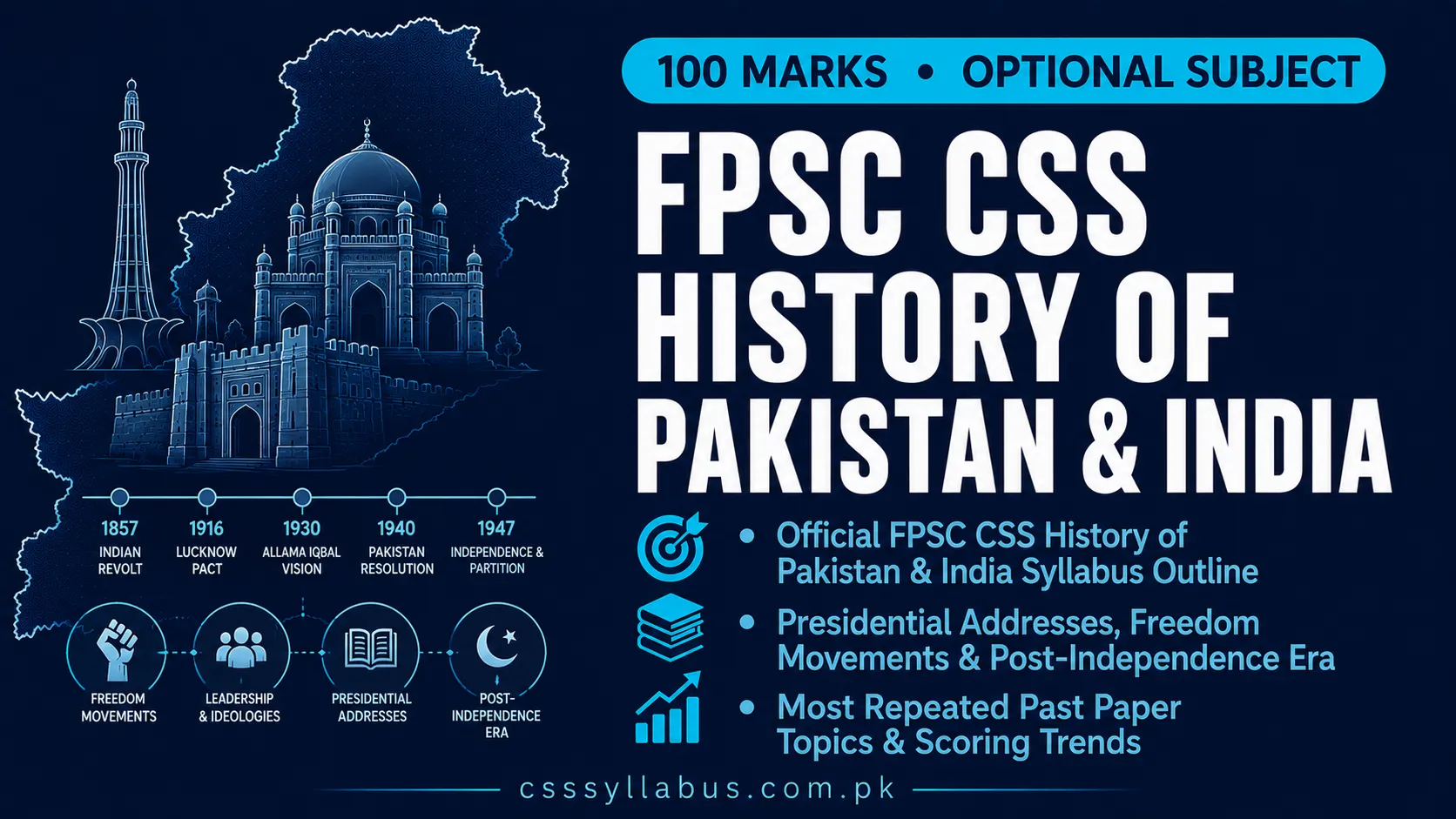
Most candidates prepare this paper backwards. They start at 1947 and rush the six centuries before it. The CSS History of Pakistan and India syllabus carries 100 marks. It covers Muslim rule from 712 to 1857, British rule, and the struggle for independence. Our count of papers from 2000 to 2025 exposes the mistake. Muslim rule and heritage in India drew 65 questions and 33.8% of the total, a full third of the paper. The Muslim struggle for independence drew 42 questions. British rule in India drew only 12 questions and 6.3%. Constitutional and political reforms drew just 5 questions. If your notes start at 1857, you have skipped the heaviest part of this paper. Give the Sultanate and Mughal periods real depth, ruler by ruler and reform by reform. Your Pakistan Affairs preparation helps, but this paper demands period detail, not compulsory-paper summaries. History and political science graduates adapt well here. Partition-only preparation caps your score before you enter the hall.
HISTORY OF PAKISTAN & INDIA CSS Syllabus (100 MARKS)
I. Muslim Rule and Heritage in India (712-1857): Political History Arrival, foundation and consolidation of Muslim rule in India, important rulers of the Slave Dynasty and the Mughals. The Spirit and legacy of Muslim civilization, Art, Architecture and literature, Public Administration under Muslim Rules. Sultans, Kings, Economic, Social, Judicial, Civil and Military system during the Muslim rule, Industry, trade and commerce under the Muslim patronage, Financial Administration.
II. British Rule in India: 1857-1947: British Imperialism, origin and growth of the East India Company, Causes and effects of downfall of the Mughal Empire in India, War of Independence in 1857:Causes and effects.
III. Constitutional and Political Reforms of the British Government (1858-1947) and growth of the Political Parties –Indian Congress
IV. Muslim Struggle for Independence: Role of Shah Wali Ullah, Syed Ahmad Shaheed and Sir Syed Ahmed Khan towards regeneration of the Muslim of South Asia, All India Muslim League, Partition of Bengal, Simla Deputation, Lucknow pact; Khilafat movement. Nahru Report Quaid-i- Azam’s Fourteen Points.
V. Pakistan Movement: Allama Iqal’s Allahabad Address 1930, and Round Table Conference. The Congress Rule in the provinces-1937-1939, Lahore Resolution 1940, various Missions and Plans for the partition of the South Asia. Founders of Pakistan: Quaid-i-Azam, Mohsin-ul-Mulk, Syed Amir Ali, Ali Brothes. Sir Agha Khan, Chaudhry Rahmat Ali, etc.
VI. History of Pakistan (1947- Todate): Pakistan’s early Challenges—Quaid-i-Azam as Governor-General, various attempts at constitution making.
VII. Military in Politics: Ayub Khan, Yahya, Zia–ul–Haq and Pervaiz Musharaf regimes, Civil Military Relationship in Pakistan,
VIII. Separation of East Pakistan: Causes and Effects,
IX. Working of Democracy in Pakistan: Liaquat Ali Khan to Firoz Khan Noon (1947-1958), Zulfiqar Ali Bhutto’s Period,(1971-1977),Benazir, Nawaz Sharif ,Revival of Democracy: 1988-1999, Restoration of Democracy (2008 to date), Role of Major Political Parties and Pressure Groups in the history of Pakistan.
X. Foreign Policy of Pakistan (1947-1999)
SUGGESTED READINGS
| S.No. | TITLE | AUTHOR |
|---|---|---|
| 1 | POLITICAL PARTIES IN PAKISTAN: 1947-1958 | AFZAL, M. RAFIQUE, 1986 |
| 2 | GOVERNMENT & POLITICS IN PAKISTAN | AHMAD, MUSHTAQ, 1970 |
| 3 | PARTY POLITICS IN PAKISTAN: 1947-58 | AZIZ, K.K. 1976 |
| 4 | INDIA’S STRUGGLE FOR INDEPENDENCE | CHANDRE BIPIN, 1989 |
| 5 | CONSTITUTIONAL DEVELOPMENT IN PAKISTAN | CHAUDHARY, G.W. 1959 |
| 6 | WAVELL AND THE DAYS OF THE RAJ: BRITAIN’S PENULTIMATE VICEROY IN INDIA, | CHAWLA, MUHAMMAD IQBAL, 2011 |
| 7 | NATIONALISM AND COMMUNAL POLITICS IN INDIA. | HASSAN, MUSHIRUL 1991 |
| 8 | THE CHARISMATIC LEADER: JINNAH AND THE CREATION OF PAKISTAN | HAYAT, SIKANDAR, 2007 |
| 9 | THE CULTURE OF POWER AND GOVERNANCE OF PAKISTAN 1947-2008 | ILHAN NIAZ, 2011 |
| 10 | MUSLIM CIVILIZATION OF INDO-PAKISTAN. | IKRAM, SHAIKH MUHAMMAD, 1966 |
| 11 | PAKISTAN’S FAILURE IN NATIONAL INTEGRATION | JAHAN, ROUNAQ, 1972 |
| 12 | CONSTITUTIONAL AND POLITICAL HISTORY OF PAKISTAN | KHAN, HAMID, 2005 |
| 13 | THE MUSLIM POLITICS IN PUNJAB | QALB-I-ABID ,S, 1992 |
| 14 | THE MUSLIM COMMUNITY OF THE INDO-PAK | QURESHI ISHTIAQ HUSAIN, 1962 |
| 15 | THE STRUGGLE FOR PAKISTAN | QURESHI, ISHTIAQ HUSAIN, 1965 |
| 16 | PAKISTAN: THE FORMATIVE PHASE | SAYEED, KHALID BIN, 1968 |
| 17 | THE MILITARY AND POLITICS IN PAKISTAN 1947-86 | RIZVI, HASSAN ASKARI |
| 18 | PAKISTAN: A NEW HISTORY | TALBOT, LAN, 1999 |
| 19 | POLITICS AND THE STATE IN PAKISTAN | WASEEM, MOHAMMAD, 1989 |
| 20 | JINNAH OF PAKISTAN | WOLPERT, STANLEY, 1984 |
HISTORY OF PAKISTAN & INDIA Frequency Analysis (2000–2025)
| Syllabus Topic | Number of Questions | Years Appeared | Percentage Weightage | Trend (High / Medium / Low) |
|---|---|---|---|---|
| I. Muslim Rule and Heritage in India (712-1857): Political History Arrival, foundation and consolidation of Muslim rule in India, important rulers of the Slave Dynasty and the Mughals. The Spirit and legacy of Muslim civilization, Art, Architecture and literature, Public Administration under Muslim Rules. Sultans, Kings, Economic, Social, Judicial, Civil and Military system during the Muslim rule, Industry, trade and commerce under the Muslim patronage, Financial Administration. | 65 | 2000, 2001, 2002, 2003, 2004, 2005, 2006, 2007, 2008, 2009, 2010, 2011, 2012, 2013, 2014, 2015, 2016, 2017, 2018, 2019, 2020, 2022, 2023, 2024, 2025 | 33.8% | High |
| II. British Rule in India: 1857-1947: British Imperialism, origin and growth of the East India Company, Causes and effects of downfall of the Mughal Empire in India, War of Independence in 1857:Causes and effects. | 12 | 2002, 2003, 2008, 2010, 2012, 2013, 2014, 2016, 2018, 2023, 2024 | 6.3% | High |
| III. Constitutional and Political Reforms of the British Government (1858-1947) and growth of the Political Parties –Indian Congress | 5 | 2003, 2008, 2023, 2025 | 2.6% | Medium |
| IV. Muslim Struggle for Independence: Role of Shah Wali Ullah, Syed Ahmad Shaheed and Sir Syed Ahmed Khan towards regeneration of the Muslim of South Asia, All India Muslim League, Partition of Bengal, Simla Deputation, Lucknow pact; Khilafat movement. Nahru Report Quaid-i- Azam’s Fourteen Points. | 42 | 2000, 2001, 2002, 2003, 2004, 2005, 2006, 2007, 2008, 2009, 2010, 2011, 2012, 2013, 2014, 2015, 2016, 2017, 2018, 2020, 2023, 2024, 2025 | 21.8% | High |
| V. Pakistan Movement: Allama Iqal’s Allahabad Address 1930, and Round Table Conference. The Congress Rule in the provinces-1937-1939, Lahore Resolution 1940, various Missions and Plans for the partition of the South Asia. Founders of Pakistan: Quaid-i-Azam, Mohsin-ul-Mulk, Syed Amir Ali, Ali Brothes. Sir Agha Khan, Chaudhry Rahmat Ali, etc. | 15 | 2001, 2002, 2004, 2005, 2007, 2009, 2010, 2011, 2013, 2014, 2015, 2016, 2018, 2022, 2023, 2025 | 7.8% | High |
| VI. History of Pakistan (1947- Todate): Pakistan’s early Challenges—Quaid-i-Azam as Governor-General, various attempts at constitution making. | 10 | 2000, 2003, 2007, 2010, 2011, 2012, 2015, 2016, 2020, 2022, 2024 | 5.2% | High |
| VII. Military in Politics: Ayub Khan, Yahya, Zia–ul–Haq and Pervaiz Musharaf regimes, Civil Military Relationship in Pakistan, | 8 | 2010, 2012, 2014, 2016, 2019, 2025 | 4.2% | Medium |
| VIII. Separation of East Pakistan: Causes and Effects, | 9 | 2000, 2002, 2006, 2009, 2011, 2020, 2022, 2023 | 4.7% | Medium |
| IX. Working of Democracy in Pakistan: Liaquat Ali Khan to Firoz Khan Noon (1947-1958), Zulfiqar Ali Bhutto’s Period,(1971-1977),Benazir, Nawaz Sharif ,Revival of Democracy: 1988-1999, Restoration of Democracy (2008 to date), Role of Major Political Parties and Pressure Groups in the history of Pakistan. | 12 | 2001, 2002, 2004, 2009, 2011, 2013, 2014, 2018, 2019, 2020 | 6.3% | High |
| X. Foreign Policy of Pakistan (1947-1999) | 14 | 2000, 2001, 2002, 2003, 2004, 2005, 2006, 2007, 2010, 2011, 2013, 2015, 2017, 2022, 2024, 2025 | 7.3% | High |
HISTORY OF PAKISTAN & INDIA Top 5 Most Repeated Topics (2000–2025)
- I. Muslim Rule and Heritage in India (712-1857): Political History Arrival, foundation and consolidation of Muslim rule in India, important rulers of the Slave Dynasty and the Mughals. The Spirit and legacy of Muslim civilization, Art, Architecture and literature, Public Administration under Muslim Rules. Sultans, Kings, Economic, Social, Judicial, Civil and Military system during the Muslim rule, Industry, trade and commerce under the Muslim patronage, Financial Administration.
- IV. Muslim Struggle for Independence: Role of Shah Wali Ullah, Syed Ahmad Shaheed and Sir Syed Ahmed Khan towards regeneration of the Muslim of South Asia, All India Muslim League, Partition of Bengal, Simla Deputation, Lucknow pact; Khilafat movement. Nahru Report Quaid-i- Azam’s Fourteen Points.
- V. Pakistan Movement: Allama Iqal’s Allahabad Address 1930, and Round Table Conference. The Congress Rule in the provinces-1937-1939, Lahore Resolution 1940, various Missions and Plans for the partition of the South Asia. Founders of Pakistan: Quaid-i-Azam, Mohsin-ul-Mulk, Syed Amir Ali, Ali Brothes. Sir Agha Khan, Chaudhry Rahmat Ali, etc.
- X. Foreign Policy of Pakistan (1947-1999)
- II. British Rule in India: 1857-1947: British Imperialism, origin and growth of the East India Company, Causes and effects of downfall of the Mughal Empire in India, War of Independence in 1857:Causes and effects.