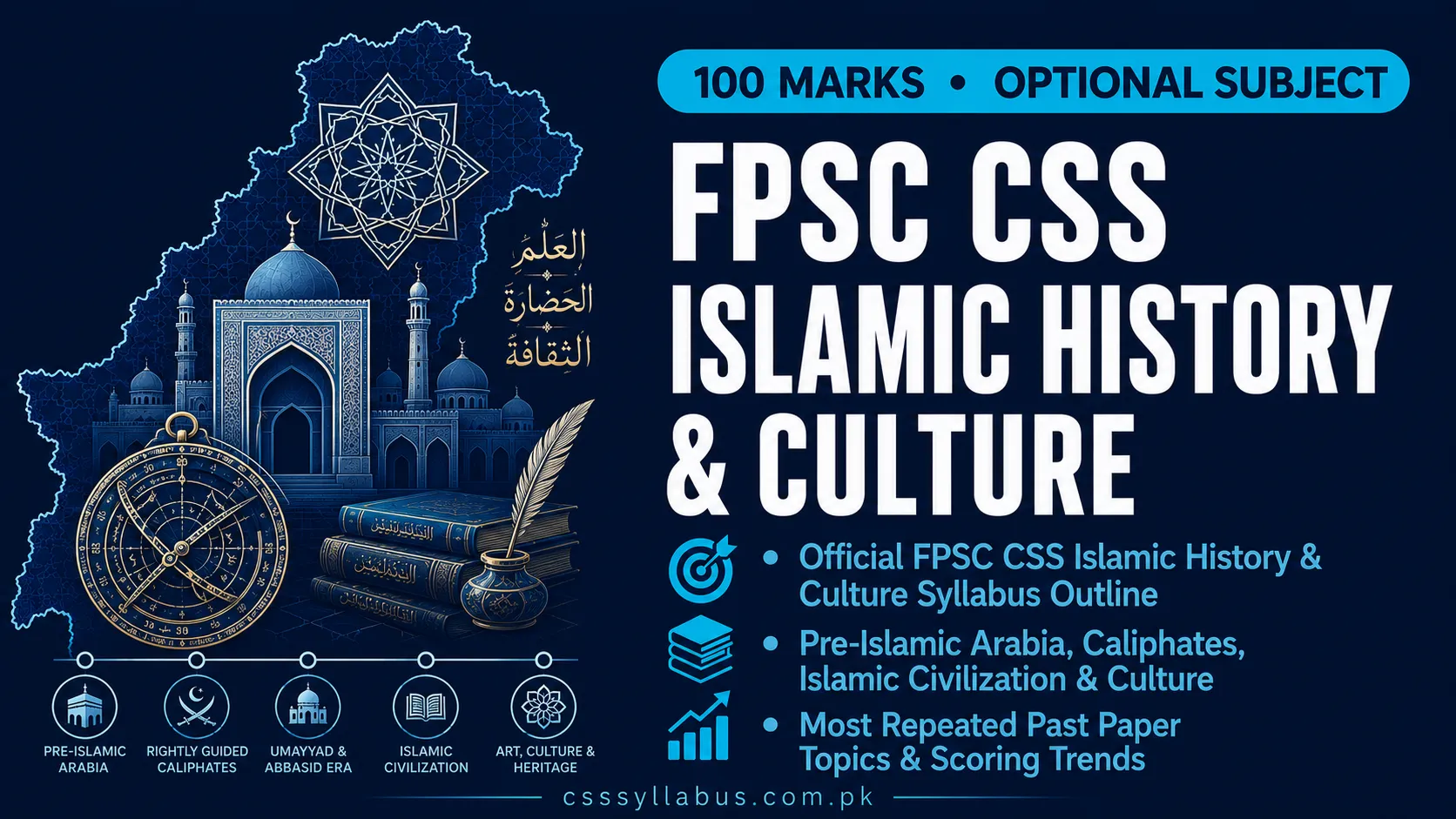
CSS Islamic History and Culture carries 100 marks as part of Group IV of the CSS optional subjects — History — which includes History of Pakistan and India, British History, European History, and History of USA. The CSS Islamic History and Culture syllabus, set by FPSC — Federal Public Service Commission — under the Central Superior Services examination rules, covers early Islamic history from the life of the Holy Prophet (PBUH), the Rightly Guided Caliphs, the Umayyad and Abbasid dynasties, Islamic civilisation and its contributions to science and culture, and the decline of the Muslim world under colonial rule. Group IV requires CSS aspirants to select only one 100-mark subject, making Islamic History and Culture a direct competitor to four other history papers for a single slot in the optional subject combination. CSS aspirants choosing between Group IV history subjects can compare all five options on the full CSS optional subjects syllabus page before finalizing their combination.
ISLAMIC HISTORY & CULTURE CSS Syllabus (100 MARKS)
Part –I (Marks 50)
I. Pre-Islamic Near East: An Overview Political, Social, Cultural, Religious and Economic Conditions in the Near East including Arabia before the dawn of Islam
II. The Dawn of Islam: The Prophetic Age (570-632) Biography of the Prophet Muhammad (PBUH): A Chronology of the Major Events in his Life Prophet Muhammad (PBUH) as a Motivator (Daa’i), Major points of his mission Prophet Muhammad (PBUH) as a Military Leader/Strategist Prophet Muhammad (PBUH) as a Political Leader/Head of the State
III. The Pious Caliphate (632-660) Caliph Abu Bakr (632-34): Apostasy Wars and Consolidation of Islam Caliph Umar b.Khattab (634-44): Establishment of Administrative System and Expansion of Muslim Empire Caliph Uthman b.Affan (644-56): Problems and Issues in the Muslim Community Caliph Ali b.Talib (656-660): Rise of Factionalism Abdication of Imam Hasan and Establishment of Umayyad Dynasty (660)
IV. Political System of Islam under the Prophet (PBUH) and the Pious Caliphate Nature of Islamic State Form of the Government Functions of the Islamic State Sovereignty of God Caliphate or Vicegerency of Man Appointment of Caliph Shura or the Consultative Body and its Role
V. Institutional Development of the Muslim Civilization:The Early Phase (622-660) Development of Law and Judiciary in Early Islam Administration and State Conduct Defense in Early Islam Educational System Propagation of Islam Financial Administration Heritage and Culture
VI. The Umayyads in Power (660-749) Political History of the Umayyad Dynasty Statecraft and Administration under the Umayyads Society and the Development of Arabic Literature. Cultural Achievements
Part –II (Marks 50)
I. The Abbasids of Baghdad (749-1258) The Abbasid Revolution and the Establishment of the Abbasid Dynasty Administrative Structure under the Abbasids Development of Scientific Knowledge under the Abbasids Muslim Philosophy under the Abbasids Cultural Achievements
II. Spain under the Muslim Rule Spain under the rule of the Arabs and Moors (711-1492) Political Fragmentation and the Fall of Granada (1492) Muslim Contribution in the Realm of Culture, Arts and Architecture
III. The Crusades against Islam Major Encounters and Actors (1092-1228) Impact of the Crusades on Muslim-Christian Relations
IV. The Ottoman Empire Rise and Fall of the Ottoman Turks (1299-1923) State, Society and Economy under the Ottomans Treatment with the Religious Minorities Contribution towards Culture, Arts and Architecture
V. Sufism as an Institution of the Muslim Society Origin and Development of Sufism Contribution of the Sufis to the Muslim Civilization Relationship of the Sufis with the State and Political Authorities. A Critical View of Sufism
VI. Islam and Modernity in Contemporary World The Emergence of Islamic Modernism Intellectual, Political, Economic, Social and Educational Aspects of Islamic Modernism Dissemination of Muslim Learning in the West
SUGGESTED READINGS
| S.No. | Titles | Author |
|---|---|---|
| 1 | Discovering Islam—Making Sense of Muslim History and Society | Ahmad, Akbar |
| 2 | Islam: Ideology and Leading Issues | Ali, Anwar. |
| 3 | The Spirit of Islam | Ali, S. Ameer |
| 4 | Aspects of Islamic Civilization: As Depicted in the Original Texts | Arberry, A. J. |
| 5 | The Preaching of Islam—A History of the Propagation of the Muslim Faith | Arnold,T.W. |
| 6 | The History of Philosophy in Islam | De Boer,T. J. |
| 7 | The History of Islamic Peoples | Brockelmann, Carl (ed) |
| 8 | Spanish Islam | Dozy,R. |
| 9 | Studies on the Civilization of Islam | Gibb,Hamilton A.R. |
| 10 | The Religion of Islam, Vol. I & II | Gaqwash,Ahmad A. |
| 11 | Classical Islam:A History 600—1258 | Von Grunebaum, G.E |
| 12 | The Cambridge History of Islam | Holts, P. M., Lewis, Bernard, Ann KS Lambton |
| 13 | Islam Resurgent: The Islamic World Today | Irving,T.B. |
| 14 | Islam: From the Prophet Mohammad to the Capture of Constantinople. | Lewis, Bernard |
| 15 | Islam in History. | Munir, Muhammad |
| 16 | Islam and The Modern World | Nadvi, Abu Hasan Ali. |
| 17 | The Making of the Past: the Spread of Islam | Rogers, Michael |
| 18 | A History of Medieval Islam | Saunders, J.J. |
| 19 | Introduction to Islamic Civilization | Savory, R.M. (ed) |
| 20 | The Legacy of Islam | Schacht, Joseph& Bosworth, C.E (eds) |
| 21 | Islamic History—A New Interpretation AD 750—1055 | Shaban, M.A. |
| 22 | The Abbasid Revolution | Shaban, M.A. |
| 23 | A History of Muslim Philosophy | Sharif, M.M. |
| 24 | Muslim Thought :Its Origin and Achievements | Nadvi Muhammad Hanif |
| 25 | Studies in Islamic History | Siddiqi, Amir Hasan. |
| 26 | The Revolution which Toppled the Umayyads’: Neither Arab nor Abbasid | Agha, Saleh Said |
| 27 | Sirat un Nabi Vol. I & II | Nomani, Shibli |
| 28 | Rasol-e-Akram ki Siasi Zindagi | Hamidullah, Dr. Muhammad |
| 29 | Khilafat-o-Malokiat | Syed Abul Aala Maudoodi |
| 30 | Ahd-e-Nabawi main Riyasat ka Nash o Irtaqa | Ahmad Nisar |
| 31 | Siddiq-e-Akbar | Akbarabadi, Saeed Ahmad |
| 32 | Al-Farooq | Nomani, Shibli |
| 33 | History of Islam | Najeebabadi, Akbar Shah |
| 34 | Painting in Islam | Arnold, Thomas. |
| 35 | Early Islamic Pottery | Lane, Arthur |
| 36 | Muslim Calligraphy | Ziauddin, M. |
| 37 | Islamic Art & Architecture | Kuhnel, E. |
| 38 | Daira Ma’arif e Islamia (relevant articles) | University of Punjab |
| 39 | The Cultural Atlas of Islam | Isma’il Raji al-Faruqi & Lois Lamya’ al-Faruqi |
ISLAMIC HISTORY & CULTURE Frequency Analysis (2001–2025)
| Syllabus Topic | Number of Questions | Years Appeared | Percentage Weightage | Trend (High / Medium / Low) |
|---|---|---|---|---|
| I. Pre-Islamic Near East: An Overview | ||||
| Political, Social, Cultural, Religious and Economic Conditions in the Near East including Arabia before the dawn of Islam | 10 | 2001, 2003, 2004, 2006, 2007, 2010, 2012, 2017, 2018, 2025 | 40% | High |
| II. The Dawn of Islam: The Prophetic Age (570-632) | ||||
| Biography of the Prophet Muhammad (PBUH): A Chronology of the Major Events in his Life | 6 | 2002, 2005, 2009, 2010, 2013, 2018 | 24% | Medium |
| Prophet Muhammad (PBUH) as a Motivator (Daa’i), Major points of his mission | 14 | 2001, 2004, 2005, 2006, 2007, 2009, 2010, 2012, 2013, 2014, 2016, 2020, 2023(S), 2024 | 56% | High |
| Prophet Muhammad (PBUH) as a Military Leader/Strategist | 13 | 2003, 2006, 2007, 2009, 2010, 2012, 2013, 2014, 2015, 2017, 2019, 2020, 2023 | 52% | High |
| Prophet Muhammad (PBUH) as a Political Leader/Head of the State | 3 | 2010, 2017, 2019 | 12% | Low |
| III. The Pious Caliphate (632-660) | ||||
| Caliph Abu Bakr (632-34): Apostasy Wars and Consolidation of Islam | 6 | 2002, 2007, 2013, 2019, 2022, 2025 | 24% | Medium |
| Caliph Umar b.Khattab (634-44): Establishment of Administrative System and Expansion of Muslim Empire | 8 | 2001, 2003, 2005, 2006, 2008, 2011, 2014, 2015 | 32% | Medium |
| Caliph Uthman b.Affan (644-56): Problems and Issues in the Muslim Community | 3 | 2010, 2012, 2023 | 12% | Low |
| Caliph Ali b.Talib (656-660): Rise of Factionalism | 2 | 2020, 2023(S) | 8% | Low |
| Abdication of Imam Hasan and Establishment of Umayyad Dynasty (660) | 2 | 2002, 2023 | 8% | Low |
| IV. Political System of Islam under the Prophet (PBUH) and the Pious Caliphate | ||||
| Nature of Islamic State | 1 | 2012 | 4% | Low |
| Form of the Government | 1 | 2013 | 4% | Low |
| Functions of the Islamic State | 1 | 2010 | 4% | Low |
| Sovereignty of God | 0 | None | 0% | Dormant |
| Caliphate or Vicegerency of Man | 1 | 2017 | 4% | Low |
| Appointment of Caliph | 1 | 2023 | 4% | Low |
| Shura or the Consultative Body and its Role | 3 | 2011, 2022, 2023(S) | 12% | Low |
| V. Institutional Development of the Muslim Civilization: The Early Phase (622-660) | ||||
| Development of Law and Judiciary in Early Islam | 8 | 2004, 2006, 2008, 2013, 2014, 2015, 2016, 2024 | 32% | Medium |
| Administration and State Conduct | 7 | 2001, 2003, 2005, 2006, 2011, 2014, 2023(S) | 28% | Medium |
| Defense in Early Islam | 1 | 2012 | 4% | Low |
| Educational System | 1 | 2017 | 4% | Low |
| Propagation of Islam | 3 | 2004, 2015, 2022 | 12% | Low |
| Financial Administration | 6 | 2008, 2011, 2018, 2020, 2023(S), 2025 | 24% | Medium |
| Heritage and Culture | 4 | 2008, 2013, 2016, 2023 | 16% | Low |
| VI. The Umayyads in Power (660-749) | ||||
| Political History of the Umayyad Dynasty | 9 | 2001, 2003, 2006, 2014, 2019, 2020, 2023, 2023(S), 2024 | 36% | Medium |
| Statecraft and Administration under the Umayyads | 4 | 2005, 2011, 2012, 2017 | 16% | Low |
| Society and the Development of Arabic Literature. | 2 | 2011, 2019 | 8% | Low |
| Cultural Achievements | 1 | 2019 | 4% | Low |
| Part –II | ||||
| I. The Abbasids of Baghdad (749-1258) | ||||
| The Abbasid Revolution and the Establishment of the Abbasid Dynasty | 2 | 2019, 2023 | 8% | Low |
| Administrative Structure under the Abbasids | 4 | 2008, 2011, 2014, 2023 | 16% | Low |
| Development of Scientific Knowledge under the Abbasids | 12 | 2001, 2004, 2005, 2007, 2009, 2012, 2014, 2015, 2017, 2018, 2020, 2023(S) | 48% | High |
| Muslim Philosophy under the Abbasids | 9 | 2002, 2005, 2009, 2010, 2012, 2017, 2018, 2022, 2023(S) | 36% | Medium |
| Cultural Achievements | 9 | 2001, 2003, 2006, 2009, 2010, 2011, 2013, 2015, 2018 | 36% | Medium |
| II. Spain under the Muslim Rule | ||||
| Spain under the rule of the Arabs and Moors (711-1492) | 10 | 2001, 2004, 2006, 2007, 2008, 2009, 2010, 2014, 2016, 2025 | 40% | High |
| Political Fragmentation and the Fall of Granada (1492) | 8 | 2001, 2003, 2005, 2008, 2011, 2014, 2023, 2025 | 32% | Medium |
| Muslim Contribution in the Realm of Culture, Arts and Architecture | 20 | 2002, 2003, 2004, 2005, 2006, 2007, 2008, 2009, 2010, 2011, 2012, 2013, 2014, 2015, 2016, 2017, 2018, 2022, 2024, 2025 | 80% | High |
| III. The Crusades against Islam | ||||
| Major Encounters and Actors (1092-1228) | 1 | 2019 | 4% | Low |
| Impact of the Crusades on Muslim-Christian Relations | 2 | 2017, 2020 | 8% | Low |
| IV. The Ottoman Empire | ||||
| Rise and Fall of the Ottoman Turks (1299-1923) | 9 | 2001, 2002, 2003, 2007, 2009, 2011, 2012, 2013, 2016 | 36% | Medium |
| State, Society and Economy under the Ottomans | 4 | 2004, 2012, 2014, 2016 | 16% | Low |
| Treatment with the Religious Minorities | 0 | None | 0% | Dormant |
| Contribution towards Culture, Arts and Architecture | 2 | 2004, 2019 | 8% | Low |
| V. Sufism as an Institution of the Muslim Society | ||||
| Origin and Development of Sufism | 3 | 2019, 2023(S), 2025 | 12% | Low |
| Contribution of the Sufis to the Muslim Civilization | 2 | 2008, 2024 | 8% | Low |
| Relationship of the Sufis with the State and Political Authorities. | 2 | 2016, 2022 | 8% | Low |
| A Critical View of Sufism | 1 | 2025 | 4% | Low |
| VI. Islam and Modernity in Contemporary World | ||||
| The Emergence of Islamic Modernism | 13 | 2001, 2003, 2005, 2006, 2007, 2010, 2012, 2015, 2017, 2018, 2020, 2022, 2023(S) | 52% | High |
| Intellectual, Political, Economic, Social and Educational Aspects of Islamic Modernism | 2 | 2004, 2019 | 8% | Low |
| Dissemination of Muslim Learning in the West | 13 | 2005, 2006, 2007, 2008, 2009, 2010, 2012, 2014, 2015, 2016, 2017, 2022, 2025 | 52% | High |
ISLAMIC HISTORY & CULTURE Top 5 Most Repeated Topics (2001–2025)
- Muslim Contribution in the Realm of Culture, Arts and Architecture (20 Appearances)
- Prophet Muhammad (PBUH) as a Motivator (Daa’i), Major points of his mission (14 Appearances)
- The Emergence of Islamic Modernism (13 Appearances)
- Dissemination of Muslim Learning in the West (13 Appearances)
- Prophet Muhammad (PBUH) as a Military Leader/Strategist (13 Appearances)