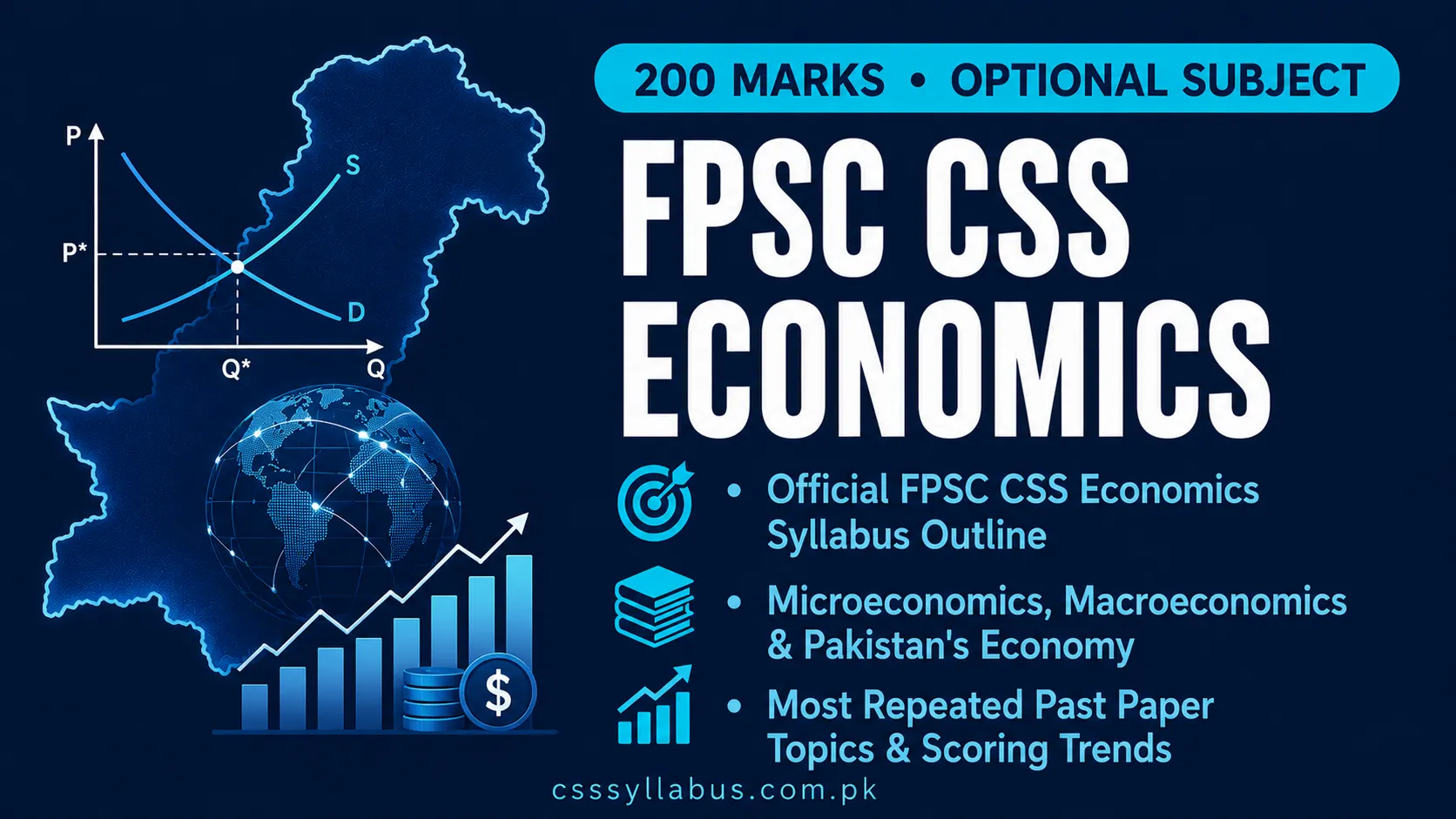
The CSS economics syllabus carries 200 marks and falls under Group 1 of the CSS optional subjects — Commerce and Social Sciences — alongside International Relations, Computer Science, Political Science, and Accountancy and Auditing FPSC sets the economics CSS syllabus to cover microeconomics, macroeconomics, development economics, international trade, monetary policy, and fiscal policy — spanning both theoretical frameworks and applied economic analysis. Candidates choose one subject from Group I only, making Economics one of the most competitive choices given its broad academic overlap with other optional subjects like Political Science and International Relations. Economics graduates and candidates from business or finance backgrounds consistently score well on this paper because the FPSC syllabus aligns closely with standard undergraduate economics curriculum.
ECONOMICS Paper-I (100 Marks) CSS Syllabus
PAPER: ECONOMICS (200 MARKS)
I. Micro Economics Consumer behaviour, Determination of market demand and supply i.e. concept of elasticity of Demand & Supply, Static, Comparative Static Analysis, Distinction between partial and general equilibrium analysis (basic level), theory of the Firm, Producer’s equilibrium, Pricing of the factors of production
II. Macro Economics Basic Economic Concepts, National Income Accounting, Consumption Function, Multiplier, Accelerator, Component of Aggregate Demand, Labour Demand and Supply, Un-Employment, Determination of equilibrium level of income and output (at least with reference to two or three “schools of thought”), Inflation.
III. Money and Banking Functions of Money, Quantity Theory of Money, The Fisher and Cambridge Formulations, Systems of note issue, Credit Creation, Functions of Central Banks, Instruments of Credit Control, Distinction between Goals, Operational & Intermediate Target of Central Banks Policy, Concept of Reserves, Liquidity Premium, Term Structure of Interest Rate, etc; Transmission Mechanisms of Monetary Policy, Theory of Liquidity Preference. TVM, Capital Structure, Capital Restructuring, IS-LM Analysis and The role of Central Bank, Money Demand and Supply.
IV. Public Financing Government expenditure, Sources of Government Revenue, Privatization, Taxes and non-taxes, Incidence of different taxes, Public Debt, Objectives, methods of repayment, Deficit financing, General Equilibrium Analysis, Welfare Economics, Fiscal Policy.
V. International Trade Theories of comparative advantage and Factor Endowments, Trade & Growth, Colonialism, Imperialism and International Trade, Trade Restrictions, Economic Integration, Trade Policy, Balance of Payments, Foreign Exchange, International Monetary system, Custom Unions.
VI. Economic Development Concepts of development, Human development, Historical growth process and Development, Theories of development, structural issues of development, Income distribution and poverty, sectoral (agricultural, Industry, trade and fiancé) issues and development, environment and development.
ECONOMICS Paper-II (100 Marks) CSS Syllabus (Economics of Pakistan)
I. Definition and Measurement of Development: Characteristics of under development, rethinking on the concept of development: Growth vs. Redistributive justice, Absolute and Relative Poverty, Basic Needs Approach, Sustainable Development, Environmental Degradation & other Issues.
II. Planning Experience of Pakistan: A critical evaluation of the strategy of economic planning, governance & Institutions.
III. Agricultural Development in Pakistan: Changes in Agricultural Policies over plan periods, Major Monetary and Fiscal measures to promote Agricultural development, Green Revolution Strategy and its implications for growth and redistribution, Land Reforms and changes in the Tenure System 1950—1980, Cooperative Farming, Rural Development.
IV. Industrial Development in Pakistan: Early industrialization strategy, Creation of Financial and Development Institutions, Major monetary and fiscal measures to promote industrial development, changing role of public sector over the plan periods, Evaluation of Nationalization Policy, Concentration of industrial income and wealth, Evaluation of Import Substitution Policy and Export led Growth Strategy in Pakistan.
V. Role of Foreign Trade and Aid in Economic Development : Trends in Pakistan’s Balance of Payments, Terms of Trade, Changes in direction of trade, Trends in Pakistan’s major exports and imports, Causes of significant changes in the trends, the role of migration and remittances in Pakistan’s economy, costs and benefits of Foreign Aid, Role of Foreign Investment.
VI. Privatization, Denationalization, Deregulation: conceptual and operational aspects. International comparisons. Pakistan Experience of Privatization.
VII. Interest Free Banking in Pakistan
VIII. Energy Policy of Pakistan
IX. Social Sector Development in Pakistan
X. Major Issues in Pakistan Economy: Energy crisis, Corruption, Bad governance, External debt accumulation and dependency, Unemployment, Income inequality, Inflation, Fiscal and trade deficits, Balance of payment issues, Shortage of irrigation water.
SUGGESTED READINGS
| S.No. | Title | Author |
|---|---|---|
| 1 | A Text-book of Economics Theory | Stonier & Hague |
| 2 | Economic Development | Todaro, M.P. |
| 3 | Under Development and Agrarian Structure in Pakistan | Khan, Mahmood Hassan |
| 4 | Economic of Islam | Ahmed, S.M. |
| 5 | Economics | Paul A. Samuleson |
| 6 | Factors in Economic Development | Cairncross, A.K |
| 7 | Foreign Aid Theory and Practice in Southern Asia | Wolf, Jr. DC |
| 8 | Government Finance—An Economic Analysis | Due John, F. |
| 9 | Introduction to International Economics | Snider, D.A, Paul Krugman, Donimich Salvatore |
| 10 | Microeconomic | Ferguson, C.E. & Gould, J.P., Nicholson, Mankiw |
| 11 | Macroeconomics | Rudigar Dorubush and Stanley Fisher Blanchard |
| 12 | Population Problems | Theompson & Lewis |
| 13 | Studies in Economic Development with Special Reference to Pakistan | Ghouse, A. |
| 14 | History of International Trade | Findlay, R and O’ Rourke, K |
| 15 | Colonialism and Modernization | Karl Marx Anchor books |
| 16 | On Colonialism | Karl Marx and Frederick Engels, |
| 17 | Economic Survey of Pakistan | Government Publication |
ECONOMICS Paper-I Frequency Analysis
| Syllabus Topic | Number of Questions | Years Appeared | Percentage Weightage | Trend (High / Medium / Low) |
|---|---|---|---|---|
| I. Micro Economics | 42 | 2007, 2008, 2010, 2011, 2012, 2013, 2014, 2015, 2016, 2017, 2018, 2020, 2021, 2023, 2024 | 26% | High |
| II. Macro Economics | 31 | 2007, 2008, 2010, 2011, 2012, 2013, 2014, 2015, 2016, 2017, 2018, 2020, 2023, 2024 | 19% | High |
| III. Money and Banking | 29 | 2007, 2008, 2010, 2011, 2012, 2013, 2015, 2016, 2017, 2018, 2020, 2023, 2024 | 18% | High |
| IV. Public Financing | 18 | 2007, 2008, 2010, 2011, 2013, 2017, 2018, 2020, 2021, 2023 | 11% | High |
| V. International Trade | 28 | 2007, 2008, 2010, 2011, 2012, 2013, 2014, 2016, 2017, 2018, 2020, 2021, 2023, 2024 | 17% | High |
| VI. Economic Development | 13 | 2016, 2017, 2018, 2020, 2021, 2023, 2024 | 8% | Medium |
ECONOMICS Paper-II Frequency Analysis
| Syllabus Topic | Number of Questions | Years Appeared | Percentage Weightage | Trend (High / Medium / Low) |
|---|---|---|---|---|
| I. Definition and Measurement of Development | 23 | 2007, 2010, 2011, 2012, 2013, 2014, 2015, 2016, 2017, 2018, 2020, 2021, 2023, 2024 | 15% | High |
| II. Planning Experience of Pakistan | 11 | 2007, 2010, 2011, 2012, 2013, 2015, 2017, 2021 | 7% | High |
| III. Agricultural Development in Pakistan | 19 | 2010, 2011, 2012, 2013, 2014, 2015, 2016, 2017, 2018, 2020, 2023, 2024 | 12% | High |
| IV. Industrial Development in Pakistan | 16 | 2007, 2010, 2011, 2012, 2013, 2014, 2015, 2016, 2017, 2018, 2020, 2024 | 11% | High |
| V. Role of Foreign Trade and Aid in Economic Development | 20 | 2007, 2008, 2010, 2011, 2012, 2013, 2014, 2016, 2017, 2018, 2023, 2024 | 13% | High |
| VI. Privatization, Denationalization, Deregulation | 10 | 2010, 2012, 2014, 2015, 2016, 2017, 2018, 2021 | 7% | High |
| VII. Interest Free Banking in Pakistan | 1 | 2016 | 1% | Low |
| VIII. Energy Policy of Pakistan | 2 | 2016, 2018 | 1% | Low |
| IX. Social Sector Development in Pakistan | 3 | 2013, 2020, 2024 | 2% | Low |
| X. Major Issues in Pakistan Economy | 46 | 2007, 2011, 2014, 2015, 2016, 2017, 2018, 2020, 2021, 2023, 2024 | 31% | High |
ECONOMICS Paper-I Top 5 Most Repeated Topics
1. Micro Economics (42 Questions)
2. Macro Economics (31 Questions)
3. Money and Banking (29 Questions)
4. International Trade (28 Questions)
5. Public Financing (18 Questions)
ECONOMICS Paper-II Top 5 Most Repeated Topics
1. Major Issues in Pakistan Economy (46 Questions)
2. Definition and Measurement of Development (23 Questions)
3. Role of Foreign Trade and Aid in Economic Development (20 Questions)
4. Agricultural Development in Pakistan (19 Questions)
5. Industrial Development in Pakistan (16 Questions)