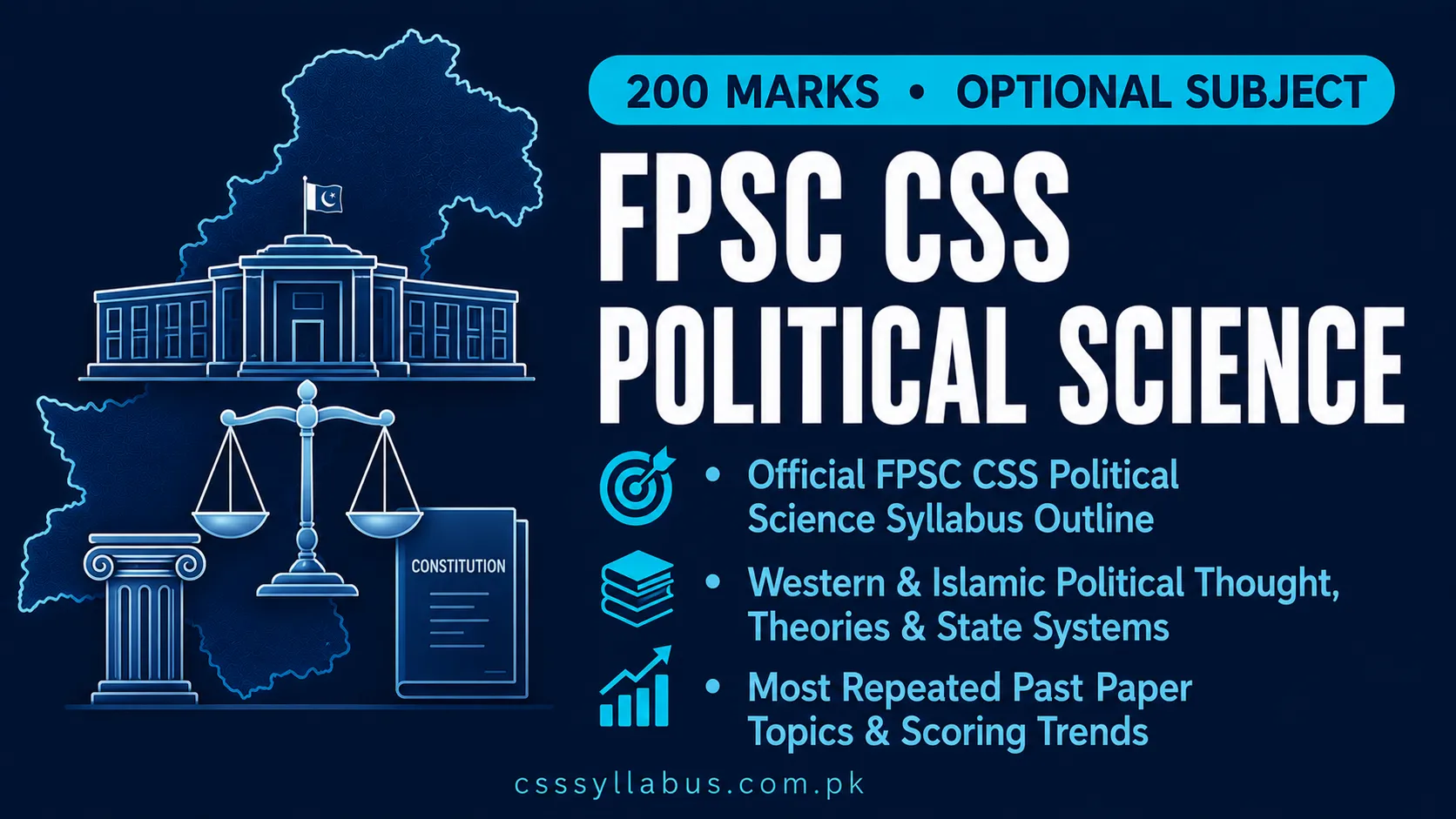
CSS Political Science carries 200 marks and is the most selected optional subject in the CSS examination. It falls under Group 1 of the CSS optional subjects — Commerce and Social Sciences — alongside International Relations, Economics, Computer Science, and Accountancy and Auditing. Most candidates choose Political Science over International Relations because its syllabus scope is more defined, past papers follow repeating question patterns, and scoring trends are consistently higher than comparable optional subjects. The CSS Political Science syllabus, covers political theory, comparative politics, Pakistan’s constitutional development, international relations theory, and contemporary global issues. Candidates selecting their optional papers can review the full CSS optional subjects syllabus to understand combination rules and group requirements before finalizing Political Science as a choice.
POLITICAL SCIENCE PAPER-I Syllabus (200 MARKS)
PAPER-I (Marks: 100)
Part-A (50 Marks)
I. Western Political Thought Plato, Aristotle, Machiavelli, Montesquieu, Hobbes, Locke, Rousseau, Kant, Mill, Bentham, Hegel, Marx, Lenin, Mao, Gramsci, Karl Popper, Pierre Bourdieu, John Rawls, Frances Fukuyama, Foucault, Derrida, Kierkegaard, Jean Paul Sartre, Rene Descartes.
II. Muslim Political Thought Al-Farabi, Al-Mawardi, Ibn Rushd, Imam Ghazali, Ibn Taymiyyah, Nizam-ul-Mulk Tusi, Ibn Khaldun, Shah Waliullah, Allama Muhammad Iqbal, Jamaluddin Afghani, Rashid Rida.
Part-B (50 Marks)
III. State System The nature and emergence of modern nation-state system, Islamic concept of state and Ummah.
IV. Political Concept (Western and Islamic) Sovereignty, Justice, Law, Liberty, Freedom, Equality, Rights and Duties, Human Rights, Political Authority and Power.
V. Comparative Politics Political Socialization, Political Culture, Political Development, Political Recruitment, Social Change, Civil Society, Violence and Terrorism in Politics, Gender and Politics, Women Empowerment.
VI. Political Participation Political Change and Revolution, Elections, Electoral System, Public Opinion, Propaganda, Political Parties, Pressure Groups and Lobbies.
VII. Political Institutions and Role of Government Legislature, Executive, Judiciary, Political Elites, Civil and Military Bureaucracy.
VIII. Forms of Government Monarchy, Democratic, Dictatorship, Totalitarian/Authoritarian, Unitary, Federal, Confederation, Presidential and Parliamentary.
IX. Political Ideologies Capitalism, Marxism, Communism, Socialism, Totalitarianism, Fascism, Nationalism, Islamic Political Ideology.
X. Local Self Government Theory and practice of Local Self-Government with special reference to Pakistan, Comparative analyses of systems of local governance, Public Administration and Public Policy.
POLITICAL SCIENCE PAPER-II (Marks: 100)
Part-A (30 Marks)
I. Comparative and Analytical Study of the Political Systems Political System of U.S.A, U.K, France and Germany.
II. Global and Regional Integration Globalization and Politics, Global Civil Society, Regional politico-economic integration and organizational structure of the European Union, SAARC, ECO, International Financial Regimes IMF and WTO.
Part-B (70 Marks)
III. Comparative and Analytical Study of the Political Systems Political system of Turkey, Iran, Malaysia, India and China.
IV. Political Movements in India (Colonial Period) Rise of Muslim Nationalism in South Asia and Pakistan Movement (with special reference to the role of Sir Syed Ahmed Khan, Allama Muhammad Iqbal and Quaid-i-Azam Mohammad Ali Jinnah).
V. Government and Politics in Pakistan Constitution making from 1947-1956, A comparative and critical analysis of 1956, 1962, 1973 Constitutions of Pakistan, Constitutional Amendments up-to-date, Federal Structure in Pakistan, and Central-Provincial relations after 18th amendment.
Political Culture of Pakistan, Political Developments and the Role of Civil and Military Bureaucracy, Judiciary, Feudalism, Dynastic Politics, Political Parties and Interest Groups, Elections and Voting Behavior, Religion and Politics, Ethnicity and National Integration.
VI. International Relations History of International Relations: Post World War-II (WW-II) Period.
Foreign Policy of Pakistan: National Interests and Major Determinants i-e
- Size/Geography
- Economic Development
- Security
- Advancement in Technology
- National Capacity
- Political Parties/Leadership
- Ideology
- National Interest
- Role of Press/Bureaucracy
- Social Structure
- Public Opinion
- Diplomacy
- Foreign Policy-making Process in Pakistan
Also External Factors like International Power Structure, International Organizations, World Public Opinion and Reaction of other States.
SUGGESTED READINGS
| S. No. | Title | Author |
|---|---|---|
| 1 | Pakistan’s Foreign Policy, 1947-2005 | Abdul Sattar |
| 2 | Democracy and Authoritarianism in South Asia | Ayesha Jalal |
| 3 | Military, Civil Society and Democratization in Pakistan | Akbar Zaidi |
| 4 | The Reconstruction of Religious Thought in Islam | Allama Iqbal |
| 5 | A history of Pakistan and its origins | Christophe Jaffrelot |
| 6 | Greek Political Thought: Plato & Aristotle | Ernest Barker |
| 7 | Political Thought From Plato to Present | Ebenstein |
| 8 | Political Thought in Medieval Islam | Erwin I.J. Rosenthal |
| 9 | Constitutional Developments in Pakistan | G.W. Choudhury |
| 10 | Comparative Politics Today: A Theoretical Framework | Gabriel A. Almond, G. Bingham Powell |
| 11 | Contemporary Political Analysis | Garles Worth James |
| 12 | A History of Political Theory | George Holland Sabine |
| 13 | Studies in Muslim Political Thought and Administration | H.K. Sherwani |
| 14 | Modern Islamic Political Thought | Hamid Enayat |
| 15 | Constitutional and Political History of Pakistan | Hamid Khan |
| 16 | Politics Among Nations: The Struggle for Power and Peace | Hans J. Morgenthau |
| 17 | Military and Politics in Pakistan | Hasan Askari Rizvi |
| 18 | Pakistan Foreign Policy: An Overview 1947-2004 (PILDAT) | Hasan Askari Rizvi |
| 19 | Pakistan and Geostrategic Environment: A Study of Foreign Policy | Hasan Askari Rizvi |
| 20 | International Politics: A Framework for Analysis | Holsti, K.J. |
| 21 | Pakistan: A Modern History | Ian Talbot |
| 22 | 21st Century Political Science: A Reference Handbook | John T. Ishiyama, Marijke Breuning |
| 23 | Political Thought from Plato to Present | Judd Herman |
| 24 | The Political System of Pakistan | K.B. Sayeed |
| 25 | Pakistan: A Political Study | Keith Callard |
| 26 | Pakistan: An Enigma of Political Development | Lawrence Ziring |
| 27 | Pakistan in the Twentieth Century | Lawrence Ziring |
| 28 | Pakistan: At the Crosscurrent of History | Lawrence Ziring |
| 29 | History of Muslim Philosophy | M.M. Sharif |
| 30 | History of Local Government in Pakistan | Masudul Hasan |
| 31 | Nationalism: The Nation-State and Nationalism | Montserrat Guibernau |
| 32 | Politics and the State in Pakistan | Muhammad Waseem |
| 33 | Government and Politics in Pakistan | Mushtaq Ahmad |
| 34 | Making of Pakistan | Noor ul Haq |
| 35 | Pattern of Government | Samuel H. Beer & Adam B. Ulam |
| 36 | Political Thinkers: From Socrates to the Present | Paul Kelly (Ed) |
| 37 | Introduction to Political Science, Islamabad, National Book Foundation | Rodee Anderson etc. |
| 38 | Pakistan’s Foreign Policy: An Historical Analysis | S.M. Burke |
| 39 | State & Society in Pakistan | Shahid Javed Burki |
| 40 | Islami Riyasat | Syed Abul Aala Maudoodi |
| 41 | Khilafat O Malookeyat | Syed Abul Aala Maudoodi |
| 42 | Ethno National Movements of Pakistan | Tahir Amin |
| 43 | Politics, Parties and Pressure Groups | V.O. Key Jr. |
| 44 | Democratization in Pakistan | Waseem, M. |
| 45 | Contemporary Political Philosophy: An Introduction | Will Kymlicka |
| 46 | History of Political Theories (Three Volumes) | William A. Dunning |
| 47 | International Relations: Politics and Economy in the 21st Century | William Nester |
CSS Political Science Paper I – Topic Frequency (2000–2025)
| Syllabus Topic | Number of Questions | Years Appeared | Percentage Weightage | Trend (High / Medium / Low) |
|---|---|---|---|---|
| Plato | 16 | 2001, 2002, 2003, 2004, 2005, 2009, 2010, 2011, 2012, 2014, 2016, 2018, 2020, 2022, 2024, 2025 | 11.4% | High |
| Aristotle | 12 | 2001, 2002, 2004, 2010, 2011, 2012, 2016, 2020, 2021, 2022, 2024, 2025 | 8.6% | High |
| Machiavelli | 6 | 2002, 2010, 2012, 2016, 2024, 2025 | 4.3% | Medium |
| Montesquieu | 7 | 2002, 2004, 2012, 2013, 2020, 2024, 2025 | 5.0% | Medium |
| Hobbes | 11 | 2003, 2004, 2005, 2011, 2013, 2015, 2018, 2020, 2021, 2022, 2025 | 7.9% | High |
| Locke | 11 | 2003, 2004, 2005, 2011, 2013, 2015, 2018, 2020, 2021, 2022, 2025 | 7.9% | High |
| Rousseau | 11 | 2003, 2004, 2005, 2009, 2011, 2012, 2013, 2020, 2021, 2022, 2025 | 7.9% | High |
| Kant | 0 | None | 0.0% | Dormant |
| Mill | 2 | 2004, 2005 | 1.4% | Low |
| Bentham | 3 | 2005, 2015, 2023 | 2.1% | Low |
| Hegel | 3 | 2019, 2020, 2025 | 2.1% | Low |
| Marx | 10 | 2001, 2004, 2011, 2012, 2013, 2015, 2020, 2022, 2024, 2025 | 7.1% | High |
| Lenin | 1 | 2024 | 0.7% | Low |
| Mao | 2 | 2009, 2013 | 1.4% | Low |
| Gramsci | 0 | None | 0.0% | Dormant |
| Karl Popper | 0 | None | 0.0% | Dormant |
| Pierre Bourdieu | 0 | None | 0.0% | Dormant |
| John Rawls | 0 | None | 0.0% | Dormant |
| Frances Fukuyama | 1 | 2016 | 0.7% | Low |
| Foucault | 0 | None | 0.0% | Dormant |
| Derrida | 0 | None | 0.0% | Dormant |
| Kierkegaard | 0 | None | 0.0% | Dormant |
| Jean Paul Sartre | 1 | 2023 | 0.7% | Low |
| Rene Descartes | 1 | 2023 | 0.7% | Low |
| Al-Farabi | 7 | 2001, 2003, 2004, 2010, 2012, 2014, 2022 | 5.0% | Medium |
| Al-Mawardi | 3 | 2004, 2010, 2016 | 2.1% | Low |
| Ibn Rushd | 0 | None | 0.0% | Dormant |
| Imam Ghazali | 3 | 2002, 2011, 2023 | 2.1% | Low |
| Ibn Taymiyyah | 0 | None | 0.0% | Dormant |
| Nizam-ul-Mulk Tusi | 2 | 2009, 2024 | 1.4% | Low |
| Ibn Khaldun | 10 | 2002, 2005, 2012, 2014, 2015, 2018, 2020, 2021, 2024, 2025 | 7.1% | High |
| Shah Waliullah | 2 | 2021, 2022 | 1.4% | Low |
| Allama Muhammad Iqbal | 9 | 2001, 2005, 2010, 2011, 2013, 2014, 2018, 2021, 2023 | 6.4% | High |
| Jamaluddin Afghni | 0 | None | 0.0% | Dormant |
| Rashid Rida | 0 | None | 0.0% | Dormant |
| The nature and emergence of modern nation-state system | 4 | 2002, 2009, 2011, 2022 | 2.9% | Medium |
| Islamic concept of state and Ummah | 5 | 2001, 2003, 2010, 2022, 2023 | 3.6% | Medium |
| Sovereignty | 7 | 2004, 2005, 2010, 2013, 2015, 2020, 2024 | 5.0% | Medium |
| Justice | 2 | 2002, 2014 | 1.4% | Low |
| Law | 2 | 2002, 2020 | 1.4% | Low |
| Liberty | 6 | 2009, 2013, 2014, 2016, 2019, 2024 | 4.3% | Medium |
| Freedom | 0 | None | 0.0% | Dormant |
| Equality | 1 | 2015 | 0.7% | Low |
| Rights and Duties | 3 | 2005, 2011, 2023 | 2.1% | Low |
| Human Rights | 0 | None | 0.0% | Dormant |
| Political Authority and Power | 0 | None | 0.0% | Dormant |
| Political Socialization | 0 | None | 0.0% | Dormant |
| Political Culture | 3 | 2004, 2014, 2022 | 2.1% | Low |
| Political Development | 0 | None | 0.0% | Dormant |
| Political Recruitment | 1 | 2025 | 0.7% | Low |
| Social Change | 1 | 2025 | 0.7% | Low |
| Civil Society | 1 | 2016 | 0.7% | Low |
| Violence and Terrorism in Politics | 0 | None | 0.0% | Dormant |
| Gender and Politics | 0 | None | 0.0% | Dormant |
| Women Empowerment | 1 | 2016 | 0.7% | Low |
| Legislature | 1 | 2013 | 0.7% | Low |
| Executive | 2 | 2004, 2022 | 1.4% | Low |
| Judiciary | 6 | 2005, 2011, 2013, 2018, 2019, 2023 | 4.3% | Medium |
| Political Parties | 7 | 2003, 2005, 2013, 2014, 2016, 2024, 2025 | 5.0% | Medium |
| Interest Groups | 4 | 2001, 2003, 2009, 2015 | 2.9% | Medium |
| Public Opinion | 4 | 2004, 2015, 2016, 2024 | 2.9% | Medium |
| Monarchy | 0 | None | 0.0% | Dormant |
| Democracy | 6 | 2003, 2011, 2014, 2018, 2021, 2025 | 4.3% | Medium |
| Dictatorship | 5 | 2003, 2010, 2015, 2019, 2021 | 3.6% | Medium |
| Unitary and Federal | 7 | 2002, 2009, 2013, 2016, 2019, 2020, 2024 | 5.0% | Medium |
| Parliamentary and Presidential | 4 | 2001, 2012, 2021, 2025 | 2.9% | Medium |
| Capitalism | 3 | 2021, 2024, 2025 | 2.1% | Low |
| Marxism | 0 | None | 0.0% | Dormant |
| Communism | 2 | 2001, 2002 | 1.4% | Low |
| Socialism | 0 | None | 0.0% | Dormant |
| Fascism | 6 | 2004, 2005, 2009, 2016, 2019, 2020 | 4.3% | Medium |
| Nationalism | 2 | 2019, 2024 | 1.4% | Low |
| Islamic Political Ideology | 1 | 2022 | 0.7% | Low |
| Theory and practice of Local Self-Government with special reference to Pakistan | 6 | 2001, 2003, 2011, 2015, 2018, 2022 | 4.3% | Medium |
| Comparative analyses of systems of local governance | 0 | None | 0.0% | Dormant |
| Public Administration and Public Policy | 1 | 2023 | 0.7% | Low |
CSS Political Science Paper II – Topic Frequency (2000–2025)
| Syllabus Topic | Number of Questions | Years Appeared | Percentage Weightage | Trend (High / Medium / Low) |
|---|---|---|---|---|
| Political System of U.S.A | 19 | 2001, 2002, 2003, 2004, 2005, 2009, 2010, 2012, 2013, 2014, 2015, 2016, 2018, 2019, 2020, 2021, 2022, 2024, 2025 | 13.6% | High |
| Political System of U.K | 11 | 2001, 2002, 2003, 2004, 2005, 2009, 2010, 2014, 2015, 2021, 2024 | 7.9% | High |
| Political System of France | 12 | 2001, 2002, 2004, 2005, 2009, 2010, 2011, 2012, 2014, 2016, 2018, 2025 | 8.6% | High |
| Political System of Germany | 3 | 2011, 2019, 2024 | 2.1% | Low |
| Globalization and Politics | 2 | 2019, 2022 | 1.4% | Low |
| Global Civil Society | 1 | 2024 | 0.7% | Low |
| Regional politico-economic integration and organizational structure of the European Union | 5 | 2001, 2016, 2022, 2024, 2025 | 3.6% | Medium |
| SAARC | 6 | 2001, 2016, 2021, 2023, 2024, 2025 | 4.3% | Medium |
| ECO | 1 | 2018 | 0.7% | Low |
| International Financial Regimes IMF and WTO | 5 | 2018, 2022, 2023, 2024, 2025 | 3.6% | Medium |
| Political system of Turkey | 13 | 2002, 2003, 2004, 2005, 2009, 2010, 2011, 2013, 2014, 2015, 2016, 2019, 2025 | 9.3% | High |
| Political system of Iran | 8 | 2001, 2002, 2003, 2004, 2010, 2014, 2018, 2025 | 5.7% | High |
| Political system of Malaysia | 1 | 2021 | 0.7% | Low |
| Political system of India | 7 | 2001, 2003, 2004, 2010, 2011, 2013, 2015 | 5.0% | Medium |
| Political system of China | 11 | 2001, 2002, 2005, 2009, 2010, 2013, 2014, 2015, 2021, 2022, 2024 | 7.9% | High |
| Rise of Muslim Nationalism in South Asia and Pakistan Movement (with special reference to the role of Sir Syed Ahmed Khan, Allama Muhammad Iqbal and Quaid-i-Azam Mohammad Ali Jinnah) | 14 | 2002, 2003, 2005, 2009, 2010, 2011, 2013, 2014, 2015, 2016, 2018, 2019, 2021, 2024 | 10.0% | High |
| Constitution making from 1947 -1956 | 13 | 2001, 2002, 2003, 2004, 2009, 2010, 2011, 2012, 2013, 2015, 2019, 2021, 2022 | 9.3% | High |
| A comparative and critical analysis of 1956, 1962, 1973 Constitutions of Pakistan | 15 | 2002, 2003, 2004, 2005, 2009, 2010, 2011, 2012, 2013, 2015, 2016, 2018, 2020, 2021, 2025 | 10.7% | High |
| Constitutional Amendments up-to-date | 2 | 2020, 2021 | 1.4% | Low |
| Federal Structure in Pakistan, and Central-Provincial relations after 18th amendment | 10 | 2001, 2002, 2010, 2012, 2016, 2018, 2019, 2022, 2023, 2025 | 7.1% | High |
| Political Culture of Pakistan | 4 | 2004, 2011, 2021, 2023 | 2.9% | Medium |
| Political Developments and the Role of Civil and Military Bureaucracy | 8 | 2001, 2011, 2012, 2016, 2019, 2021, 2022, 2023 | 5.7% | High |
| Judiciary | 6 | 2011, 2012, 2016, 2019, 2021, 2023 | 4.3% | Medium |
| Feudalism | 0 | None | 0.0% | Dormant |
| Dynastic Politics | 0 | None | 0.0% | Dormant |
| Political Parties and Interest Groups | 3 | 2004, 2011, 2014 | 2.1% | Low |
| Elections and Voting Behavior | 0 | None | 0.0% | Dormant |
| Religion and Politics | 1 | 2002 | 0.7% | Low |
| Ethnicity and National Integration | 5 | 2011, 2019, 2021, 2022, 2023 | 3.6% | Medium |
| History of International Relations: Post World War-II (WW-II) Period | 3 | 2020, 2022, 2025 | 2.1% | Low |
| Foreign Policy of Pakistan: National Interests and Major Determinants | 8 | 2003, 2012, 2018, 2019, 2021, 2022, 2024, 2025 | 5.7% | High |
| Foreign Policy-making Process in Pakistan | 2 | 2015, 2025 | 1.4% | Low |
| External Factors like International Power Structure, International Organizations, World Public Opinion and Reaction of other States | 4 | 2003, 2011, 2012, 2022 | 2.9% | Medium |
Top 5 Most Repeated Topics Political Science (Paper I)
1. Plato (16 appearances)
2. Aristotle (12 appearances)
3. Hobbes/Locke/Rousseau (Social Contract Theory) (11 appearances each)
4. Marx (10 appearances)
5. Ibn Khaldun (10 appearances)
Top 5 Most Repeated Topics Political Science (Paper II)
1. Political System of U.S.A (19 appearances)
2. A comparative and critical analysis of 1956, 1962, 1973 Constitutions of Pakistan (15 appearances)
3. Rise of Muslim Nationalism in South Asia… (Sir Syed, Iqbal, Jinnah) (14 appearances)
4. Political system of Turkey (13 appearances)
5. Constitution making from 1947 -1956 (13 appearances)