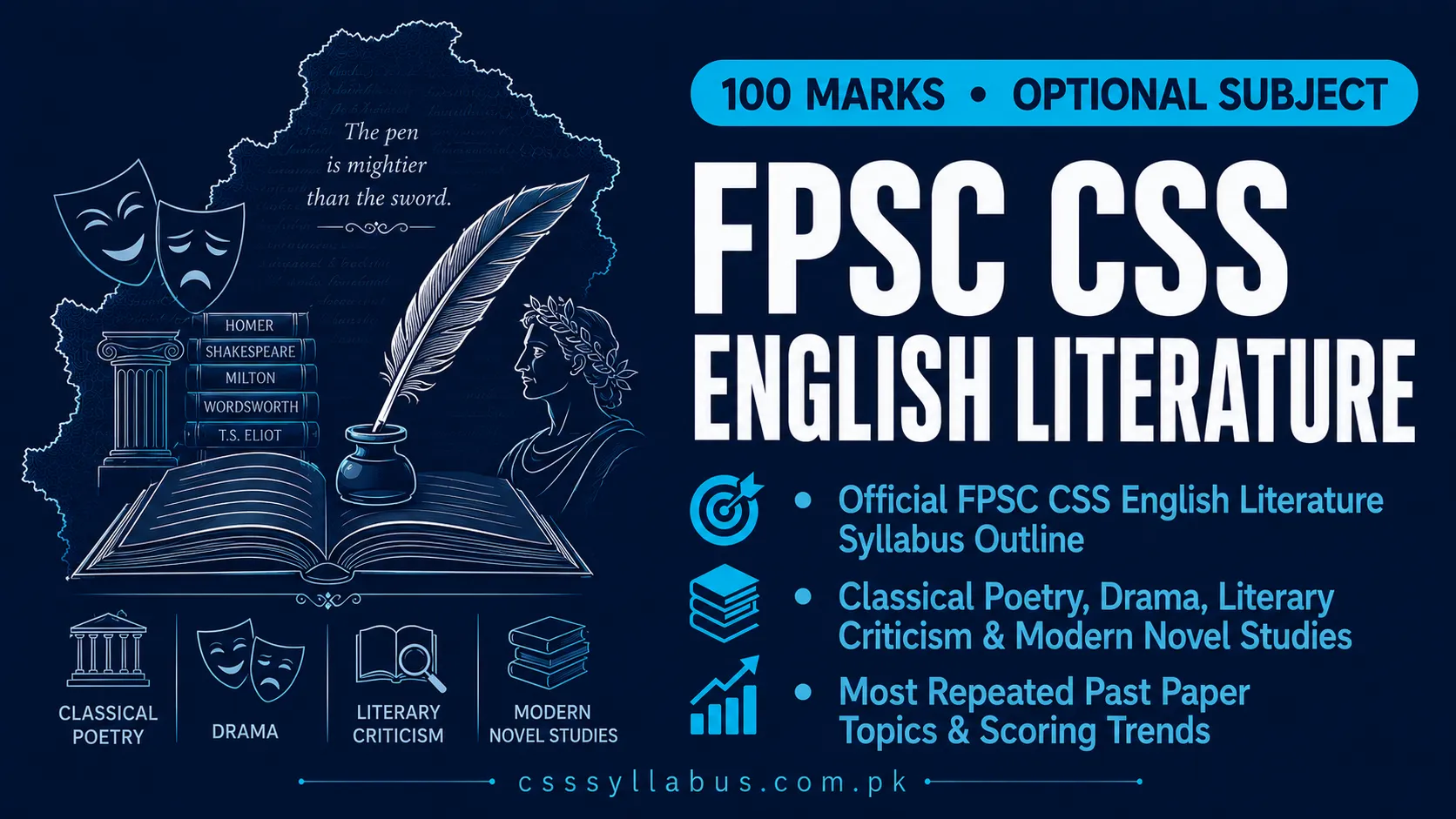
CSS English Literature is a 100-mark optional paper under Group V of the CSS optional subjects — Natural Sciences and Literature — sitting alongside Urdu Literature, Zoology, Botany, Agriculture and Forestry, Environmental Sciences, and Gender Studies. FPSC sets the CSS English Literature syllabus to cover essays, short stories, poetry, drama, novels, and literary theory and criticism — spanning British, American, and postcolonial literature from the Renaissance to the twentieth century. CSS aspirants with an English or humanities background select this subject for its structured paper pattern, though scoring demands close textual knowledge and strong analytical writing across all prescribed periods. Review the full CSS optional subjects syllabus for combination rules and group requirements before confirming English Literature as your optional subject choice.
ENGLISH LITERATURE CSS Syllabus (100 MARKS)
The paper is divided into six components along with the marks allocation for each component.
I. Essays: (10 Marks) Bertrand Russell (The Conquest of Happiness) George Orwell (Politics and the English Language; The Prevention of Literature) Ralph Waldo Emerson (The Transcendentalist; Self-Reliance)
II. Short Stories: (10 Marks) Somerset Maugham (The Lotus-Eater) G.K.Chesterton (A Somewhat Improbable Story) O’Henry (The Gift of the Magi)
III. Poetry: (20 marks) William Wordsworth (Resolution and Independence; Lines Composed Few Miles Above, Tintern Abbey) John Keats (Ode to a Nightingale; Ode to Autumn) Lord Alfred Tennyson (Ulysses; The Lady of Shalott) Yeats (A Dialogue of Self and Soul; The Second Coming) Eliot (The Wasteland; Love Song of J. Alfred Prufrock) Philip Larkin (Maturity; Continuing to Live; The Trees) Wallace Stevens (A Postcard from the Volcano; Continual Conversation with a Silent Man; Dry Loaf) OR Walt Whitman (As I Ponder’d in Silence; Are You the New Person Drawn Toward Me?; This Moment Yearning and Thoughtful)
IV. Drama: (20 marks) Shakespeare (Hamlet; King Lear; Twelfth Night) William Congreve (The Way of the World) Shaw (Pygmalion; Heartbreak House ) Harold Pinter (The Caretaker) Samuel Beckett (Waiting for Godot) Eugene O’Neill (Long Day’s Journey into Night)
V. Novels: (20 marks) Thomas Hardy (Far from the Madding Crowd) D.H. Lawrence (Sons and Lovers) George Orwell (Nineteen Eighty-four) James Joyce (A Portrait of the Artist as a Young Man) Iris Murdoch (Under the Net) Nathaniel Hawthorne (The Scarlet Letter) or William Faulkner (The Sound and the Fury)
VI. Literacy Theory & Criticism (20 Marks) Structuralism Marxism Deconstructionism Psychoanalytic criticism Feminist criticism Postcolonial Criticism
Note: The texts are mentioned in brackets in front of each author’s name. However, for the component on “Literary Theory and Criticism” and for understanding poetry and drama, particularly 20th century poetry and Drama, following readings are suggested:
SUGGESTED READINGS
| S.No. | Title | Author |
|---|---|---|
| 1 | The basics Literary Theory. (Second edition). Routledge. | Bertens, H. (2008). |
| 2 | Literary Theory: An Introduction. (Anniversary Edition). | Eagleton, E. (2008). |
| 3 | A New Handbook of Literary Terms. | Mikics, W. (2007). |
| 4 | A Companion to Twentieth Century Poetry. | Roberts, N. (2003). |
| 5 | A Reader’s Guide to Contemporary Literary Theory. (Fifth edition). | Selden, R., Widdowson, P., & Brooker, P. (2005) |
| 6 | Twentieth Century British Drama. | Smart, J. (2001). |
| 7 | Modern Critical Views & Interpretations, ed: 80’s and 90’s editions. | Harold Bloom (these include all range of authors and their works given above) |
| 8 | A Companion to 20th Century Drama Oxford: Blackwell. | Krasner David. 2005. |