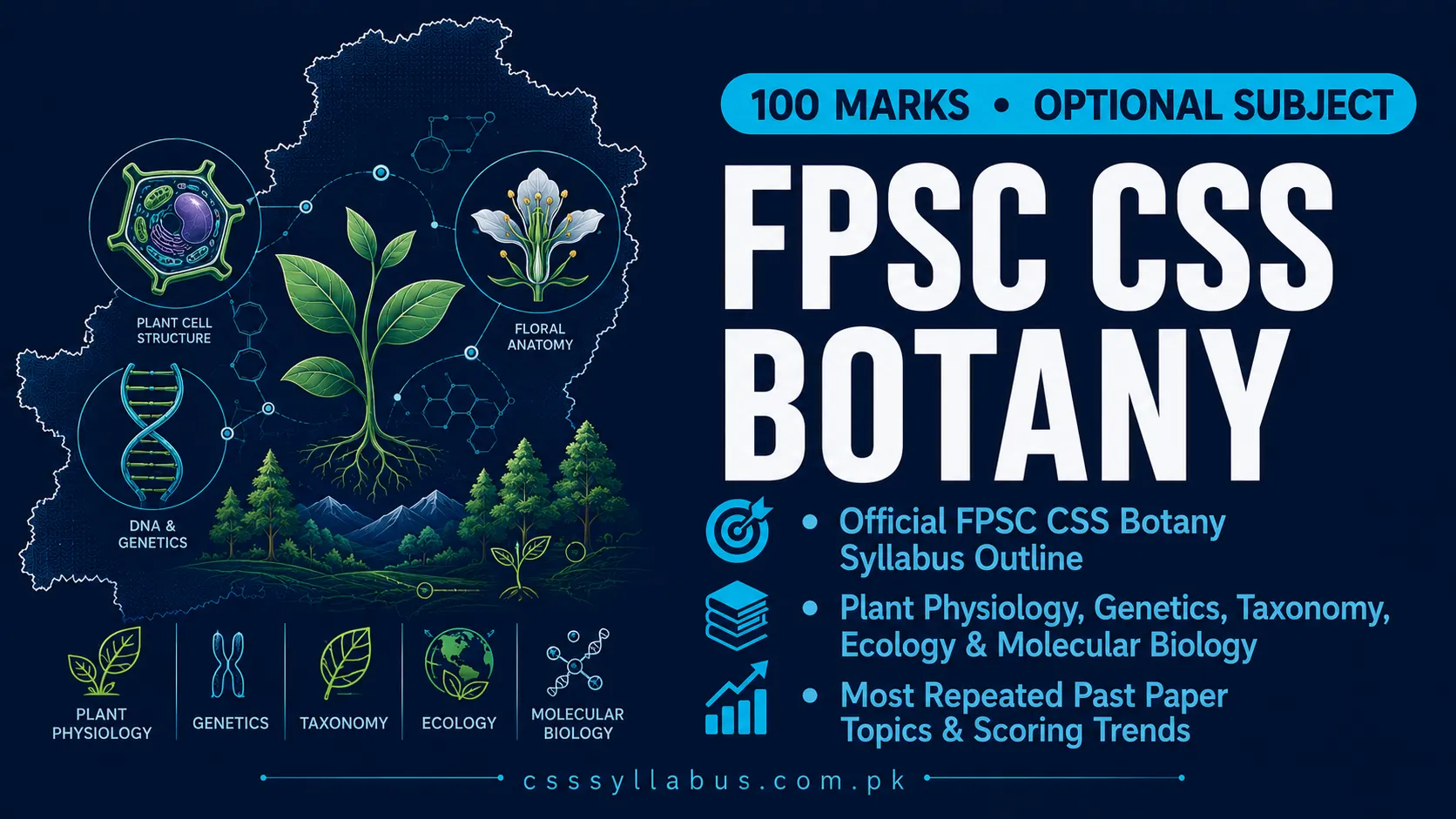
CSS Botany is a 100-mark optional paper under Group V of the CSS optional subjects — Natural Sciences and Literature — sitting alongside Zoology, Agriculture and Forestry, Environmental Sciences, Urdu Literature, English Literature, and Gender Studies. FPSC sets the CSS Botany syllabus to cover algae, pteridophyta, plant anatomy and embryology, taxonomy of angiosperms, plant physiology, ecology, cytology, genetics, evolution, and molecular biology — the full undergraduate scope now condensed into one 100-mark paper. CSS aspirants with a botany degree cover it faster than most optional subjects precisely because the scope remains the same as when Botany carried 200 marks, only compressed. Review the full CSS optional subjects syllabus for combination rules and group requirements before confirming Botany as your optional subject choice.
BOTANY CSS Syllabus (100 MARKS)
I. Algae, Fungi and Bryophytes Phycology: Distribution, Classification, Structure, Life History and Economic importance of the main groups of Algae. Mycology and Plant Pathology: Structure, Reproduction, Classification and Economic importance of the main groups of Fungi. Diseases of economically important crops and general principles of their control Bryology: Structure and reproduction of bryophytes, Evolution of Gametophyte and Sporophyte.
II. Peteridophyta and Gymnosperms General account with special reference to structure, life history and affinities of both Pteridophytes and Gymnosperms. Ontogeny and structure of seed, classification and economic importance of Gymnosperms.
III. Anatomy and Embryology Primary and secondary tissues. Meristems. Secondary growth in dicot stem. Anatomy of leaf, stem and root. Micro and megasporogenesis, pollination mechanism, fertilization, development of Embryo and Endosperm, Seed dispersal.
IV. Taxonomy of Angiosperms Systems of classification. Rules of botanical nomenclature. Concepts of speciation. Introduction to modern trends in plant taxonomy: bio-systematic, chemotaxonomy and numerical taxonomy. General characters and economic importance of common angiosperm families.
V. Plant Physiology Plant water relations, Osmotic Quantities, component potentials of water and their role in transport, water absorption by roots, transpiration. Role of essential mineral elements and their uptake. Plant hormones. Photoperiodism, Vernalization. Dormancy and Seed germination. Enzymes. Photosynthesis: Plant pigments, Light reaction, CO2 fixation, Mechanism of photophosphorylation. Respiration: Glycolysis, Kreb cycle, Mechanism of oxidative phosphorylation.
VI. Ecology Influence of climatic, edaphic and biotic factors on plant growth. Vegetation sampling techniques. Concepts of ecosystems and their productivity, ecological energetics, Pyramids (of numbers, biomass and energy), trophic levels, food chains and food webs. Biogeochemical cycles (Hydrological and Nitrogen). Succession. Causes and reclamation of soil salinity and water logging in Pakistan. Soil erosion, its control and soil conservation methods. Deforestation. Biodiversity conservation. Pollution.
VII. Cytology Cell cycle, cellular morphology, chemistry of cell wall and cell membrane, cell to cell communication, plant tissue and cell culture, cell senescence and cell death. Ultra-structure of various cell organelles: Mitochondria, Golgi bodies, Endoplasmic reticulum, Plastids, Ribosomes, Glyoxysomes, Vaculoes, Nucleus.
VIII. Genetics Mendelian Genetics, Multiple Alleles, Polygenic inheritance, Gene interaction, Epistasis and pleiotropy, Sex-linked inheritance, Chromosomal aberrations, Mutations, DNA repair.
IX. Evolution Introduction of Evolution, Evolutionary history, Evolution of life, Convergent Evolution, Divergent Evolution, Parallel Evolution and Natural selection
X. Molecular Biology Nucleic acids, DNA as hereditary material, DNA replication, Transcription, Genetic code, Protein synthesis, Genetic engineering and its application, Genetically Modified Organisms (GMO).
SUGGESTED READINGS
| S. No. | Title | Author |
|---|---|---|
| 1 | Esau’s Plant Anatormy: Meristems, Cells and Tissues of the Plant Body: Their Structure, Function and Development | Evert, F.F. and S. Hichhorn 2006 |
| 2 | Cryptogamic Botany-Algae and Fungi | Smith, G. M. 2001 |
| 3 | Cryptogamic Botany-Bryophyte and Pteridophyte | Smith, G. M. 2001 |
| 4 | Comparative Morphology of the Vascular Plants | Foster, A.S. and E.H. Gifford. 1989 |
| 5 | Plant and Environment | Daubermine, R, F, 1974 |
| 6 | Plant Taxonomy and Biosystematics | Stac, C. A. 1980 |
| 7 | Plant Physiology | Taiz, L.& E. Zeiger 2006 |
| 8 | Genetics: A Conceptual Approach. 4th edition | Pierce, B. A. 2012 |
| 9 | Molecular Cell Biology | Lodish,H., A. Berk, S.L. Zipursky, P. Matsudaira, D. Baltimore and J. Darnell 2000 |
| 10 | Concepts of Genetics. 10th edition | William S. Klug. 2012 |
| 11 | Ilmi Biomolecules, Cell Biology and Genetics. | Cheema, T.A. and Cheema Z.T. 2009 |
| 12 | Carvan Textbook of Botany Paper “ A” (Morphology of Plants) | Malik, T. A. 2006 |
| 13 | Ecology (Principles and applications). 1st ed. Cambridge University Press UK. | Chapman, J.L. and Reiss, M.J. 1992. |
| 14 | Fundamentals of Ecology | Odum, E.P. and Barrett, G.W. 2004 |
| 15 | Advanced Plant Taxonomy | Mondal, A. K., 2009 |
| 16 | Growth and Differentiation in Plants | Phillips and Wareings |
BOTANY Frequency Analysis (2005–2025)
| Syllabus Topic | Number of Questions | Years Appeared | Percentage Weightage | Trend (High / Medium / Low) |
|---|---|---|---|---|
| I. Algae, Fungi and Bryophytes | ||||
| Phycology: Distribution, Classification, Structure, Life History and Economic importance of the main groups of Algae. | 25 | 2005, 2006, 2007, 2008, 2009, 2010, 2012, 2013, 2014, 2018, 2019, 2022, 2023, 2025 | 6.8% | High |
| Mycology and Plant Pathology: Structure, Reproduction, Classification and Economic importance of the main groups of Fungi. Diseases of economically important crops and general principles of their control | 24 | 2005, 2006, 2007, 2008, 2009, 2010, 2013, 2014, 2017, 2018, 2019, 2020, 2023, 2025 | 6.5% | High |
| Bryology: Structure and reproduction of bryophytes, Evolution of Gametophyte and Sporophyte. | 15 | 2005, 2006, 2007, 2008, 2009, 2010, 2011, 2013, 2014, 2019, 2023 | 4.1% | High |
| II. Peteridophyta and Gymnosperms | ||||
| General account with special reference to structure, life history and affinities of both Pteridophytes and Gymnosperms. Ontogeny and structure of seed, classification and economic importance of Gymnosperms. | 30 | 2005, 2006, 2007, 2008, 2009, 2010, 2011, 2012, 2013, 2014, 2017, 2018, 2020, 2022, 2025 | 8.1% | High |
| III. Anatomy and Embryology | ||||
| Primary and secondary tissues. Meristems. Secondary growth in dicot stem. Anatomy of leaf, stem and root. | 16 | 2005, 2006, 2007, 2008, 2009, 2011, 2012, 2013, 2014, 2019, 2020, 2025 | 4.3% | High |
| Micro and megasporogenesis, pollination mechanism, fertilization, development of Embryo and Endosperm, Seed dispersal. | 18 | 2005, 2006, 2009, 2010, 2011, 2012, 2013, 2019, 2022, 2023, 2025 | 4.9% | High |
| IV. Taxonomy of Angiosperms | ||||
| Systems of classification. Rules of botanical nomenclature. Concepts of speciation. Introduction to modern trends in plant taxonomy: bio-systematic, chemotaxonomy and numerical taxonomy. | 18 | 2005, 2006, 2007, 2009, 2010, 2012, 2013, 2014, 2017, 2018, 2020, 2022, 2023 | 4.9% | High |
| General characters and economic importance of common angiosperm families. | 20 | 2005, 2006, 2007, 2008, 2009, 2010, 2011, 2013, 2014, 2017, 2020, 2022, 2025 | 5.4% | High |
| V. Plant Physiology | ||||
| Plant water relations, Osmotic Quantities, component potentials of water and their role in transport, water absorption by roots, transpiration. Role of essential mineral elements and their uptake. Plant hormones. Photoperiodism, Vernalization. Dormancy and Seed germination. Enzymes. | 35 | 2005, 2006, 2007, 2008, 2009, 2010, 2011, 2012, 2013, 2014, 2018, 2019, 2020, 2022, 2023, 2025 | 9.5% | High |
| Photosynthesis: Plant pigments, Light reaction, CO2 fixation, Mechanism of photophosphorylation. | 18 | 2005, 2006, 2007, 2008, 2009, 2010, 2013, 2017, 2018, 2019, 2023 | 4.9% | High |
| Respiration: Glycolysis, Kreb cycle, Mechanism of oxidative phosphorylation. | 12 | 2005, 2006, 2007, 2008, 2009, 2010, 2014, 2025 | 3.3% | High |
| VI. Ecology | ||||
| Influence of climatic, edaphic and biotic factors on plant growth. Vegetation sampling techniques. Concepts of ecosystems and their productivity, ecological energetics, Pyramids (of numbers, biomass and energy), trophic levels, food chains and food webs. Biogeochemical cycles (Hydrological and Nitrogen). Succession. | 28 | 2005, 2006, 2007, 2008, 2009, 2010, 2011, 2012, 2013, 2014, 2020, 2023 | 7.6% | High |
| Causes and reclamation of soil salinity and water logging in Pakistan. Soil erosion, its control and soil conservation methods. Deforestation. Biodiversity conservation. Pollution. | 26 | 2005, 2006, 2008, 2009, 2010, 2011, 2012, 2013, 2014, 2017, 2018, 2020, 2022, 2023, 2025 | 7.1% | High |
| VII. Cytology | ||||
| Cell cycle, cellular morphology, chemistry of cell wall and cell membrane, cell to cell communication, plant tissue and cell culture, cell senescence and cell death. | 14 | 2005, 2006, 2007, 2010, 2011, 2013, 2017, 2022 | 3.8% | High |
| Ultra-structure of various cell organelles: Mitochondria, Golgi bodies, Endoplasmic reticulum, Plastids, Ribosomes, Glyoxysomes, Vaculoes, Nucleus. | 26 | 2005, 2006, 2007, 2008, 2009, 2010, 2011, 2013, 2014, 2018, 2019, 2020, 2023, 2025 | 7.1% | High |
| VIII. Genetics | ||||
| Mendelian Genetics, Multiple Alleles, Polygenic inheritance, Gene interaction, Epistasis and pleiotropy, Sex-linked inheritance, Chromosomal aberrations, Mutations, DNA repair. | 32 | 2005, 2006, 2007, 2008, 2009, 2010, 2011, 2012, 2013, 2014, 2017, 2019, 2020, 2025 | 8.7% | High |
| IX. Evolution | ||||
| Introduction of Evolution, Evolutionary history, Evolution of life, Convergent Evolution, Divergent Evolution, Parallel Evolution and Natural selection | 20 | 2005, 2006, 2007, 2008, 2009, 2010, 2011, 2012, 2014, 2017, 2018, 2019, 2022, 2025 | 5.4% | High |
| X. Molecular Biology | ||||
| Nucleic acids, DNA as hereditary material, DNA replication, Transcription, Genetic code, Protein synthesis, Genetic engineering and its application, Genetically Modified Organisms (GMO). | 24 | 2006, 2007, 2008, 2009, 2010, 2012, 2013, 2014, 2017, 2018, 2020, 2022, 2023, 2025 | 6.5% | High |
BOTANY Top 5 Most Repeated Topics (2005–2025)
- Plant Physiology: Plant water relations, Osmotic Quantities, component potentials of water and their role in transport, water absorption by roots, transpiration. Role of essential mineral elements and their uptake. Plant hormones. Photoperiodism, Vernalization. Dormancy and Seed germination. Enzymes.
- Genetics: Mendelian Genetics, Multiple Alleles, Polygenic inheritance, Gene interaction, Epistasis and pleiotropy, Sex-linked inheritance, Chromosomal aberrations, Mutations, DNA repair.
- Peteridophyta and Gymnosperms: General account with special reference to structure, life history and affinities of both Pteridophytes and Gymnosperms. Ontogeny and structure of seed, classification and economic importance of Gymnosperms.
- Ecology: Influence of climatic, edaphic and biotic factors on plant growth. Vegetation sampling techniques. Concepts of ecosystems and their productivity, ecological energetics, Pyramids (of numbers, biomass and energy), trophic levels, food chains and food webs. Biogeochemical cycles (Hydrological and Nitrogen). Succession.
- Cytology: Ultra-structure of various cell organelles: Mitochondria, Golgi bodies, Endoplasmic reticulum, Plastids, Ribosomes, Glyoxysomes, Vaculoes, Nucleus.