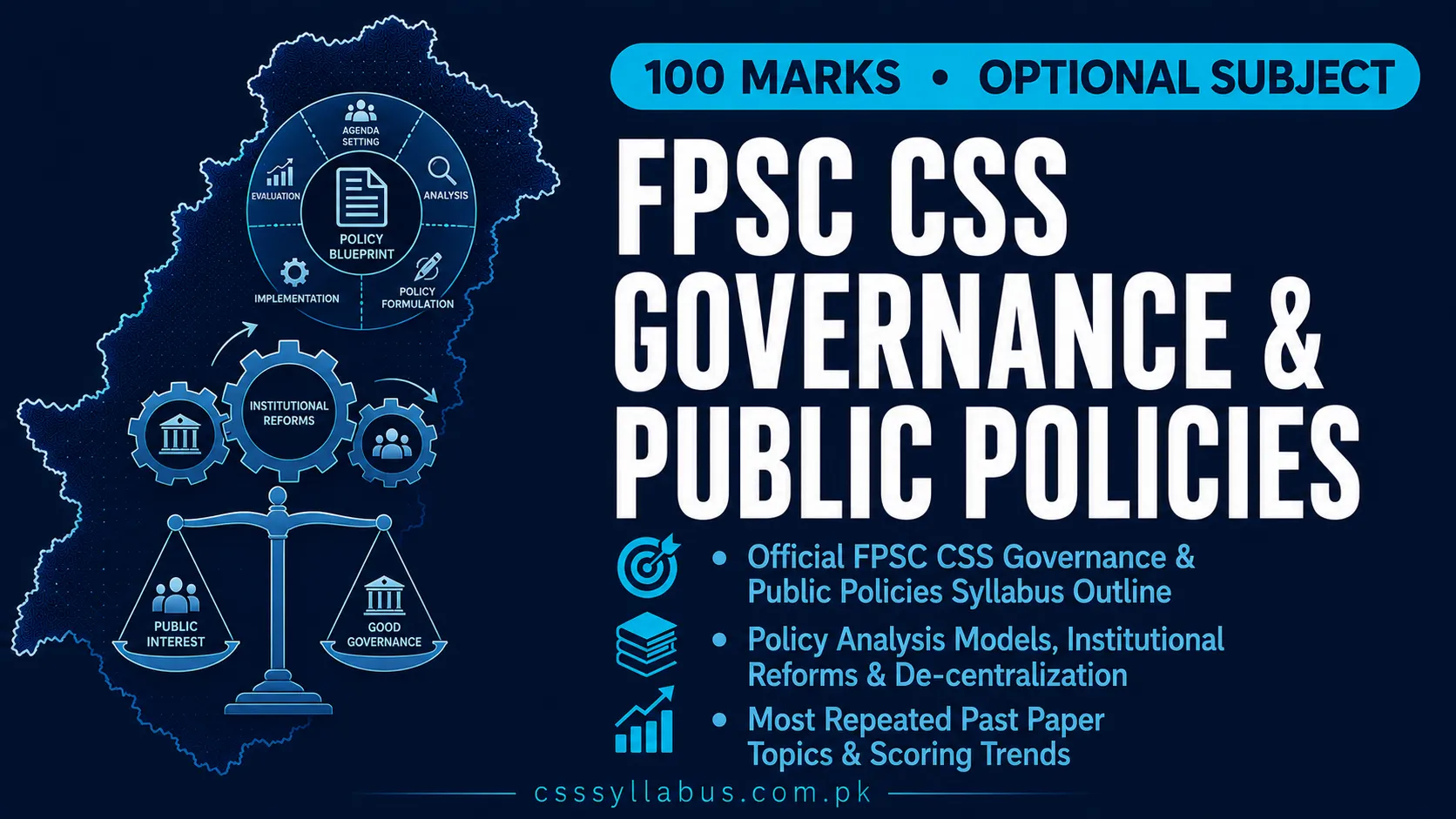
CSS Governance and Public Policies is a 100-mark optional subject in Group III of the CSS optional subjects — Administration and Governance of the Central Superior Services examination set by FPSC. Candidates select one subject from Group III — this subject sits alongside Business Administration, Public Administration, and Town Planning and Urban Management as the four available choices. The syllabus covers policy analysis, institutional governance, public sector reform, regulatory frameworks, and governance in Pakistan’s administrative context.CSS Aspirants finalizing their optional subject combination can review the CSS optional subjects syllabus for group requirements and combination rules before confirming Governance and Public Policies as a choice.
CSS Syllabus Governance & Public Policy (100 MARKS)
I. Basic Concepts of Governance: Origin of the term Governance Definition of Governance Definition of Good Governance Characteristics of Good Governance: Participation, Rule of law, Transparency, Responsiveness, Equity, Effectiveness and Efficiency, Accountability, Strategic Vision Collapse/Failure of Governance: its indicators diagnostic tools & Effects
II. Governance Theories: Communitarianism Decentered Theory Libertarian Socialism Institutionalism Marxism Neoliberalism Rational Choice Theory Regulation Theory
III. Governance Indicators laid by World Bank/IMF/UNESCO/UNDP/ADB, their Explanation & Application Level in Pakistan: Voice and Accountability Political Stability and Absence of Violence Government Effectiveness Regulatory Authorities & their Quality Rule of Law Control of Corruption
IV. Public Policy and Planning Institutions and their role in Planning Institutional Framework for Policy Coordination and Planning(ECNEC, Economic Coordination Committees of the Cabinet, The Federal Cabinet, The Secretaries Committee, The Prime Minister’s Secretariat, The Planning Commission, The Finance Division, The Cabinet Division, and all Federal Ministries for their respective subjects) Role of Planning Commission in Policy and Planning Strategic Planning in Federal Provincial Government and Local Government Role of International Donors in Policy Formulation (IMF Document “Memorandum on Economic and Financial Policies 2013/14–2015/16,” that underpins almost all public policies.) Public Policy and Implementation in Key Sectors (i.e., Health, Education).
V. Accountability: General Introduction to Accountability and its concepts(Standards, Symbolism, regional and country-wide comparisons, a Review of Contemporary Studies) Types of Accountability- Political Accountability, Legal/ Judicial Accountability, Administrative Accountability, Professional Accountability, Private vs. Public Accountability National Strategies against Corruption and remedial measures.
VI. Bureaucracy: Introduction to the Concept of Bureaucracy(History, Neutrality, Steel Frame of the State, Negative Connotations Associated with the term) Theories of Bureaucracy (Max Weber, Marx, John Stewart Mill, Woodrow Wilson) Role of Bureaucracy in Pakistan (British legacy, civil-military relations, neutrality, dilution of neutrality, political allegiance, power, corrupting the incumbent, institutional degradation, constitutional guarantees, indexing of salaries with the CPI or lack thereof.) Public Administration and Code of Ethics (Effectiveness of the Estacode and the Code of Ethics, Comparison with other countries)
VII. Public Policy Formulation and Implementation The Policy Making Process: How Policies are Made (Six including diagnosis and six stages with cautions to be exercise at each stage) Policy Implementation & Role of Bureaucracy (Training, Pervasive Inertia and how to break it, Lack of Decision Making, Culture of postponement and delays, Lack of resources, Political interference, Ability to say “No.”) Policy Analysis, The Quest for Solutions (Lack of research in policy analysis, Lack of coordination among departments, secrecy, openness) Policy Evaluation: Assessing The Impact of Public Policy, Program Evaluation- Success and failure of Govt.
VIII. Multi-level Governance in Pakistan: Legislature: National Assembly, Senate, Provisional Assemblies Judiciary: Supreme Court, High Courts, Lower Courts Functioning of the offices: President of Pakistan, Prime Minister of Pakistan Office of Governor, Office of Chief Minister, Federal Cabinet, Cabinet Committees, Federal Secretariat, Provincial Secretariat Local Government system: District Government, Zila Government, Tehsil Government, Union Administration, Its Efficacy, Performance & Causes of Success or Failure
IX. Federalism, Devolution and Decentralization Constituents participation in Federal Structure Principle of Subsidiarity in Public Service Delivery Decentralization Model of Kerala
X. Role of Citizens in Governance
XI. Good Governance in Islam Quranic Guidance on Good Governance Concept of Governance and its application in light of Quran; Sunnah and Fiqh.
SUGGESTED READINGS
| S. No. | Titles | Author |
|---|---|---|
| 1 | Governance | Anne Mette Kjær |
| 2 | Encyclopedia of Governance, Volume 2 | Mark Bevir |
| 3 | Implementing Public Policy: Governance in Theory and in Practice. | Hill M. and Hupe P. |
| 4 | Accountability: Managing for Maximum Results | Sam R LLyod |
| 5 | Guidance for Good Governance: Explorations in Qur’anic, Scientific & Cross-Cultural Approaches | Abdullah Ahsan & Stephen Bonsal Young |
| 6 | How Governments Work | Muzaffar A. Ghaffaar |
| 7 | Government and Administration in Pakistan | Dr Jamil-ur Rehman |
| 8 | Public Administration With Special Reference To Pakistan | Dr Sultan Khan |
| 9 | Constitution of Islamic Republic of Pakistan, | National Assembly of Pakistan |
| 10 | Pakistan: Beyond the Crisis State | Maleeha Lodhi |
| 11 | Power Dynamics, Institutional Instability and Economics Growth: The Case of Pakistan | Akmal Hussain |
| 12 | Federalism and Rights | Ellis Katz and G Allan Tarr |
| 13 | Local Government Reforms in Pakistan: Context, Content and Causes | Ali Chmeema, Asim Ijaz Khawaja and Adnan Qadir |
| 14 | Economics Democracy Through Pro Poor Growth | PonnaWignaraja, Akmal Hussain Susil Sirivardana |
| 15 | Governance: South Asian Perspective | Hasnat Abdul Hye |
| 16 | Governance, Economic Policy and Reform in Pakistan | Abdus Samad |
| 17 | “Pakistan—Problems of Governance,” 1993. | Hussain, M., Hussain. A. |
| 18 | “Pakistan’s Predicament: The Diagnostic and the Debates within,” Journal of Pakistan Vision, 13/1 (2012). | Racine, Jean-Luc. |
| 19 | The Culture of Power and Governance of Pakistan—1947-2008, Oxford, 2010. | Niaz, I. |
| 20 | “Legitimacy and the Administrative State: Ontology, History, and Democracy,” Public Administration Quarterly, UC Berkeley, 2013. | Bevir, M., |
| 21 | Handbook of Public Policy Analysis | Frank Fischer, Gerald J. Miller, and Mara S. Sidney, |
| 22 | Public Policy: Politics, Analysis, and Alternatives, 4th Ed., CQ Press, 2012 | Kraft, Michael E., Scott R. Furlong |
| 23 | Public Policy in An Uncertain World,: Analysis and Decisions, Harvard, 2013 | Manski, Charles F. |
Governance & Public Policy Frequency Analysis (2016–2025)
| Syllabus Topic | Number of Questions | Years Appeared | Percentage Weightage | Trend (High / Medium / Low) |
|---|---|---|---|---|
| I. Basic Concepts of Governance: | 11 | 2016, 2017, 2018, 2019, 2020, 2023, 2024, 2025 | 11% | High |
| Origin of the term Governance | 0 | None | 0% | Dormant |
| Definition of Governance | 3 | 2016, 2018, 2023 | 3% | Medium |
| Definition of Good Governance | 3 | 2016, 2023, 2024 | 3% | Medium |
| Characteristics of Good Governance: Participation, Rule of law, Transparency, Responsiveness, Equity, Effectiveness and Efficiency, Accountability, Strategic Vision | 5 | 2017, 2018, 2023, 2024, 2025 | 5% | High |
| Collapse/Failure of Governance: its indicators diagnostic tools & Effects | 0 | None | 0% | Dormant |
| II. Governance Theories: | 10 | 2017, 2018, 2020, 2023, 2025 | 10% | High |
| Communitarianism | 0 | None | 0% | Dormant |
| Decentered Theory | 1 | 2025 | 1% | Low |
| Libertarian Socialism | 0 | None | 0% | Dormant |
| Institutionalism | 1 | 2018 | 1% | Low |
| Marxism | 2 | 2025 | 2% | Low |
| Neoliberalism | 0 | None | 0% | Dormant |
| Rational Choice Theory | 5 | 2017, 2018, 2020, 2025 | 5% | High |
| Regulation Theory | 1 | 2025 | 1% | Low |
| III. Governance Indicators laid by World Bank/IMF/UNESCO/UNDP/ADB, their Explanation & Application Level in Pakistan: | 7 | 2016, 2017, 2020, 2023, 2025 | 7% | High |
| Voice and Accountability | 0 | None | 0% | Dormant |
| Political Stability and Absence of Violence | 0 | None | 0% | Dormant |
| Government Effectiveness | 1 | 2017 | 1% | Low |
| Regulatory Authorities & their Quality | 1 | 2016 | 1% | Low |
| Rule of Law | 1 | 2018 | 1% | Low |
| Control of Corruption | 4 | 2016, 2023, 2024, 2025 | 4% | Medium |
| IV. Public Policy and Planning Institutions and their role in Planning | 9 | 2016, 2017, 2018, 2023, 2024, 2025 | 9% | High |
| Institutional Framework for Policy Coordination and Planning (ECNEC, etc.) | 0 | None | 0% | Dormant |
| Role of Planning Commission in Policy and Planning | 3 | 2016, 2018, 2023 | 3% | Medium |
| Strategic Planning in Federal | 1 | 2018 | 1% | Low |
| Provincial Government and Local Government | 1 | 2017 | 1% | Low |
| Role of International Donors in Policy Formulation | 2 | 2023, 2024 | 2% | Low |
| Public Policy and Implementation in Key Sectors (i.e., Health, Education) | 2 | 2017, 2024 | 2% | Low |
| V. Accountability: | 6 | 2016, 2017, 2019, 2023, 2024, 2025 | 6% | High |
| General Introduction to Accountability and its concepts | 2 | 2017, 2019 | 2% | Low |
| Types of Accountability- Political Accountability, Legal/ Judicial Accountability, Administrative Accountability, Professional Accountability, Private vs. Public Accountability | 3 | 2017, 2019, 2025 | 3% | Medium |
| National Strategies against Corruption and remedial measures | 1 | 2024 | 1% | Low |
| VI. Bureaucracy: | 15 | 2017, 2018, 2019, 2020, 2023, 2024, 2025 | 15% | High |
| Introduction to the Concept of Bureaucracy | 3 | 2017, 2020, 2023 | 3% | Medium |
| Theories of Bureaucracy (Max Weber, Marx, John Stewart Mill, Woodrow Wilson) | 6 | 2017, 2020, 2024, 2025 | 6% | High |
| Role of Bureaucracy in Pakistan | 5 | 2017, 2018, 2020, 2023, 2025 | 5% | High |
| Public Administration and Code of Ethics | 1 | 2023 | 1% | Low |
| VII. Public Policy Formulation and Implementation | 19 | 2016, 2017, 2018, 2019, 2020, 2023, 2024, 2025 | 19% | High |
| The Policy Making Process: How Policies are Made | 6 | 2017, 2018, 2019, 2020, 2024, 2025 | 6% | High |
| Policy Implementation & Role of Bureaucracy | 4 | 2016, 2020, 2025 | 4% | Medium |
| Policy Analysis, The Quest for Solutions | 7 | 2016, 2017, 2020, 2023, 2024 | 7% | High |
| Policy Evaluation: Assessing The Impact of Public Policy | 2 | 2019, 2024 | 2% | Low |
| VIII. Multi-level Governance in Pakistan: | 10 | 2017, 2018, 2023, 2024, 2025 | 10% | High |
| Legislature: National Assembly, Senate, Provisional Assemblies | 2 | 2023, 2025 | 2% | Low |
| Judiciary: Supreme Court, High Courts, Lower Courts | 3 | 2024, 2025 | 3% | Medium |
| Functioning of the offices: President, Prime Minister, Governor, Chief Minister, Federal Cabinet, Cabinet Committees, Federal Secretariat, Provincial Secretariat | 2 | 2017, 2023 | 2% | Low |
| Local Government system: District Government, Zila Government, Tehsil Government, Union Administration, Its Efficacy, Performance & Causes of Success or Failure | 3 | 2017, 2018, 2023 | 3% | Medium |
| IX. Federalism, Devolution and Decentralization | 11 | 2018, 2019, 2020, 2024, 2025 | 11% | High |
| Constituents participation in Federal Structure | 5 | 2018, 2019, 2024, 2025 | 5% | High |
| Principle of Subsidiarity in Public Service Delivery | 1 | 2017 | 1% | Low |
| Decentralization Model of Kerala | 5 | 2018, 2020, 2023, 2025 | 5% | High |
| X. Role of Citizens in Governance | 5 | 2016, 2018, 2024 | 5% | High |
| XI. Good Governance in Islam | 5 | 2017, 2023, 2025 | 5% | High |
| Quranic Guidance on Good Governance | 1 | 2025 | 1% | Low |
| Concept of Governance and its application in light of Quran; Sunnah and Fiqh | 4 | 2017, 2023 | 4% | Medium |
Governance & Public Policy Top 5 Most Repeated Topics (2016–2025)
- VII. Public Policy Formulation and Implementation (19 appearances)
- VI. Bureaucracy (15 appearances)
- I. Basic Concepts of Governance (11 appearances)
- IX. Federalism, Devolution and Decentralization (11 appearances)
- VIII. Multi-level Governance in Pakistan (10 appearances)