
Home CSS Syllabus 2026–27 Compulsory Subjects
FPSC · CSS Examination 2026

CSS Compulsory Subjects Syllabus 2026 & 2027 — All 6 Papers

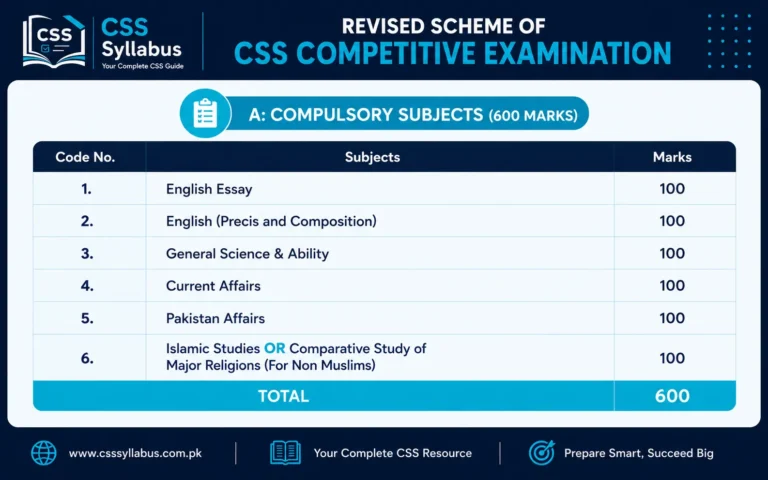
CSS has six compulsory subjects that every candidate must sit, regardless of their optional subject choices. These papers are English Essay, English Précis and Composition, General Science and Ability, Current Affairs, Pakistan Affairs, and Islamic Studies — together carrying 600 marks out of the total CSS written examination. This syllabus is set by FPSC and applies to the 2026 CSS competitive examination.

6 Papers
600 Total Marks
100 Marks Each
All Candidates Mandatory

What Are CSS Compulsory Subjects?

CSS compulsory subjects are the six papers every CSS candidate must appear in — there is no choice or exemption. These papers are fixed by FPSC and remain the same for all candidates regardless of which optional subjects they have selected.

CSS Compulsory Subjects Syllabus, Marks Breakdown & Passing Marks

The CSS compulsory subjects syllabus is issued by FPSC and covers six papers that carry a total of 600 marks in the CSS written examination — each paper allocated 100 marks. A candidate must secure the minimum passing marks in each compulsory subject to remain eligible for the CSS merit list. The passing marks for each compulsory paper are 40 out of 100, except for the three General Knowledge papers which follow a combined aggregate rule set by FPSC.

Paper 1

English Essay

Total: 100 marks Passing: 40 marks
Download Syllabus PDF
Paper 2

English Précis & Composition

Total: 100 marks Passing: 40 marks
Download Syllabus PDF
Paper 3 GK-1

General Science & Ability

Total: 100 marks Passing: 40 marks
Download Syllabus PDF
Paper 4 GK-2

Current Affairs

Total: 100 marks Passing: 40 marks
Download Syllabus PDF
Paper 5 GK-3

Pakistan Affairs

Total: 100 marks Passing: 40 marks
Download Syllabus PDF
Paper 6

Islamic Studies (Islamiat) / Comparative Religion

Total: 100 marks Passing: 40 marks

Muslim candidates

Islamiat Syllabus PDF

Non-Muslim candidates

Comparative Religion PDF
General Knowledge Group — Aggregate Passing Rule
GK-1: General Science & Ability GK-2: Current Affairs GK-3: Pakistan Affairs

A candidate must score a minimum of 120 marks out of 300 marks across all three papers to pass the General Knowledge Group. There is no individual passing marks per paper within this group — only the combined marks matter.
css compulsory subjects syllabus fpsc pdf
Paper 1 · Compulsory · 100 Marks

English Essay CSS Syllabus

The English Essay CSS syllabus requires candidates to write one structured, argued essay from a list of titles provided by FPSC in the examination. Topics are drawn from nine recurring theme clusters — governance, democracy, education, gender, economics, science and technology, environment, international relations, and society and philosophy. FPSC examiners assess argument depth, language accuracy, and structural coherence — not the number of points listed. This paper carries 100 marks with a passing mark of 40.

FPSC Essay Theme Clusters — Most Recurring Topics (2000–2026)

Democracy & Politics
Political polarization Dynastic politics National integration Future of democracy
Society, Culture & Philosophy
Justice delayed Tolerance Materialism Truth & knowledge
International Relations & Security
Terrorism Pakistan foreign policy Multipolar world UN & global peace
Economics & Development
Poverty alleviation IMF bailouts CPEC implications Globalization
Education & Literacy
Education reforms Higher education Online learning Youth & knowledge
Gender, Women & Social Justice
Women rights in Islam Feminism Gender equality Women universities
Science, Technology & AI
AI & creativity Social media Digital revolution Cyber security
Environment & Energy
Global warming Water crisis Energy crisis Reforestation
Governance & Public Service
Good governance Tax culture Bureaucracy reform Local government

How to Prepare for CSS English Essay

1
Read Dawn editorials daily without exception — the analytical register, argument structure, and vocabulary of Dawn editorials match exactly what FPSC examiners reward. This is non-negotiable preparation.
2
Build outlines for each theme cluster — for every cluster above, prepare 5–6 strong arguments with supporting evidence. In the exam you select a title and deploy your prepared framework — not improvise from scratch.
3
Write one full essay every week under timed conditions — 2.5 hours maximum, 2,500–3,500 words. Discipline and length control are as important as content quality.
4
Study FPSC past essay papers from 2000–2026 — recurring topics appear every 3–5 years. The theme cluster grid above is drawn directly from 209 FPSC essay titles across 26 examination years.
5
Get every essay assessed before the next one — writing without feedback is practice of mistakes, not preparation. See the assessment options below.

Get Your Essays Assessed

Writing without feedback is not preparation — it is practice of mistakes.

Every CSS essay you write must be assessed by someone qualified to judge it. There are two practical options for candidates preparing without a coaching institute:

Senior CSS qualifier or teacher
Claude AI — structural & argument feedback
ChatGPT — language & coherence review
CSS peer study group
Prompt to use with AI: “Review this CSS essay for argument structure, paragraph coherence, language accuracy, and FPSC examiner standards. Identify the three weakest areas and suggest specific improvements for each.”

Recommended Books for CSS English Essay

English Essay + Précis
Exploring the World of English
Syed Saadat Ali Shah
Builds awareness of writing structure, rhetorical organisation, and expository technique. Most useful in the early phases of preparation when essay architecture is being established — before moving to timed practice writing.
Daily Practice Source
Dawn Newspaper — Editorial Section
Daily · dawn.com
Not a book — a daily preparation discipline. The analytical register of Dawn editorials matches the FPSC essay register precisely. Reading the editorial page every day builds the argument vocabulary and analytical habit that no textbook can replicate.
Paper 2 · Compulsory · 100 Marks

English Précis and Composition CSS Syllabus

The English Précis and Composition CSS syllabus covers précis writing, reading comprehension, grammar, vocabulary, and translation from Urdu to English. FPSC uses this paper to assess whether a candidate can read with precision, write with accuracy, and communicate in the standard of English required of a civil servant. Précis and comprehension are fundamentally assessments of reading ability — the more you have read, the more naturally you perform. This paper carries 100 marks with a passing mark of 40.

Précis and Comprehension Are Assessments of Your Reading Habit
FPSC does not test your ability to memorise précis rules — it tests whether you can understand a complex passage and reproduce its essential meaning with accuracy. Candidates who read widely across newspapers, essays, and analytical writing consistently outscore those who only practice précis exercises. Reading more is the single most effective preparation strategy for this paper.

Full Topic List — FPSC Syllabus

Précis Writing
Reading Comprehension
Grammar & Syntax
Urdu to English Translation
Vocabulary & Idioms
Sentence Correction
Pairs of Words
Paragraph Writing
Expansion of Ideas

Marking Scheme Breakdown

Q1
Précis Writing
~20 marks
Reduce a 400–500 word passage to one-third its length without losing the original meaning or copying the original phrasing.
Q2
Reading Comprehension
~20 marks
Answer questions drawn directly from an unseen passage. Accuracy and conciseness are both marked.
Q3
Grammar & Composition
~30 marks
Sentence correction, pairs of words, idioms, fill-in-the-blank, and paragraph writing tasks drawn from FPSC past paper patterns.
Q4
Translation — Urdu to English
~30 marks
Translate a given Urdu passage into correct, formal, grammatically accurate English. Natural fluency is rewarded over literal translation.

How to Prepare for CSS Précis and Composition

1
Read extensively every single day — Dawn editorials, The News opinion pages, and analytical English writing. The comprehension and précis questions directly reflect the register of quality Pakistani English journalism. Reading breadth is your most valuable preparation asset for this paper.
2
Practice précis and composition 2 to 3 times every week — not once. Take any Dawn editorial, reduce it to exactly one-third its length, then verify no original phrasing was copied and no meaning was lost. Repetition is what builds the muscle.
3
Get every précis assessed — by a teacher, a senior CSS qualifier, or an AI tool. A précis you assess yourself will always seem correct. External feedback catches the errors you cannot see — misrepresented meaning, copied phrasing, grammatical slippage.
4
Master pairs of words and idioms from FPSC past papers — FPSC repeats these question types with high consistency. Solving the past paper compilations linked below is the most direct preparation for these marks.
5
Build Urdu-to-English translation fluency separately — read Urdu newspapers and translate full paragraphs into formal written English daily. Translation fluency cannot be built in the final weeks of preparation — it requires months of regular practice.
6
Revise grammar rules systematically from Wren & Martin — tenses, conditionals, subject-verb agreement, active and passive voice are tested every year. Do not assume grammatical competence — verify it against a standard reference.
Practice Discipline — Non-Negotiable

Practice précis and composition at minimum 2 to 3 times per week throughout your preparation period — not in the final month. Each session should produce a complete précis, one comprehension exercise, and one translation. Submit every session for assessment before beginning the next one.

Candidates who practice once a week score significantly lower than those who practice three times — not because of knowledge, but because the skill of condensing meaning accurately under time pressure only develops through consistent repetition. Frequency of practice matters more than duration of any single session.

CSS Past Papers Compilation — Précis & Composition

FPSC repeats question types across years with high consistency — especially idioms, pairs of words, sentence correction, and comprehension. Work through every resource below before your examination. These compilations are drawn from actual FPSC past papers and are the most direct preparation available.

Recommended Books for CSS Précis and Composition

English Essay + Précis
Exploring the World of English
Syed Saadat Ali Shah
Builds awareness of writing structure, rhetorical organisation, and expository technique. Use this in the early phase of preparation to establish the compositional habits that both the Essay and Précis papers reward.
English Précis
High School English Grammar & Composition
Wren & Martin
The standard reference for grammar, sentence construction, and vocabulary precision. Essential for the Précis paper, where grammatical accuracy directly affects marks. Pair with the past paper sentence correction and idioms compilations linked above for targeted practice.
Daily Practice Source
Dawn Newspaper — Editorial & Opinion Section
Daily · dawn.com
The analytical register of Dawn editorials matches the FPSC Précis register precisely. Read one editorial daily, then practice reducing it to one-third its length. The CSS solved précis compilation provides model answers to benchmark your reductions against.
Paper 3 · Compulsory · 100 Marks GK-1

General Science and Ability CSS Syllabus

CSS aspirants commonly refer to this paper as the GSA paper. The General Science and Ability CSS syllabus is divided into two parts — a science section covering physics, chemistry, biology, and everyday science, and a general ability section covering mathematical reasoning, logical thinking, and mental ability. FPSC structures the science section as questions with four parts (a, b, c, d) each carrying 5 marks. This paper carries 100 marks with the GK Group aggregate passing rule of 120 out of 300 across Papers 3, 4, and 5.

GSA Paper Structure — How FPSC Sets the Questions
Science Q1
Physics
a
b
c
d
4 parts × 5 marks = 20
Science Q2
Chemistry
a
b
c
d
4 parts × 5 marks = 20
Science Q3
Biology
a
b
c
d
4 parts × 5 marks = 20
Science Q4
Everyday Science
a
b
c
d
4 parts × 5 marks = 20
Ability Q5
General Ability & Maths
a
b
c
d
4 parts × 5 marks = 20
Each part (a, b, c, d) carries exactly 5 marks. FPSC expects a concise, focused answer of 2 to 3 pages per part — not a full essay. Longer answers do not earn more marks. Precision and accuracy within the required length is what the examiner rewards.
Answer Length Rule — 2 to 3 Pages Per Part Maximum
a
5 marks — write 2 to 3 pages maximum. Define the concept clearly in the first paragraph. Explain the mechanism or principle in the second. Conclude with one application or example. Stop there.
b
5 marks — same length discipline. Each part is an independent answer. Do not bleed content from part (a) into part (b). The examiner marks each part separately.
c
5 marks — focus on accuracy, not volume. A correct 2-page answer scores full marks. An inaccurate 5-page answer scores zero. Length beyond 3 pages adds no marks and wastes time you need for remaining questions.
d
5 marks — finish every question. Candidates who write 6 pages on part (a) and run out of time for part (d) lose 5 marks unnecessarily. Strict time management per part is as important as content knowledge.
Draw Diagrams — They Add Direct Value to Your Presentation
Atomic structure
Cell diagrams
Wave & motion
Chemical reactions
Human anatomy
Photosynthesis
Solar system
Electric circuits
For every science answer, ask yourself: can this concept be illustrated with a diagram? A labelled diagram of a plant cell, a human digestive system, or an electromagnetic wave takes 2 minutes to draw and communicates more than two paragraphs of text. FPSC examiners mark positively for well-labelled diagrams — they demonstrate understanding, not just memorisation. Keep diagrams neat, labelled in English, and directly relevant to the question part being answered. A rough but accurate labelled sketch scores more than a beautifully written paragraph that says the same thing.

Full Topic List — FPSC GSA Syllabus

Physics — Motion, Heat, Light
Chemistry — Organic & Inorganic
Biology — Cell, Genetics, Ecology
Everyday Science
Environmental Science
Science & Technology
Mathematical Reasoning
Logical Reasoning
Mental Ability
General Ability — Do Daily Maths Practice
The General Ability section of GSA is the most controllable section of the entire paper — it rewards practice, not background knowledge. Candidates without a science background can compensate for weaker science answers by scoring very high in the ability section. Practice mathematical reasoning problems every single day — percentages, ratios, averages, basic algebra, and number series. This section requires no memorisation. It only requires regular practice.
Percentages Ratios & Proportions Averages Basic Algebra Number Series Logical Sequences Speed & Distance Profit & Loss

GSA is Paper 3 in the GK Group alongside Current Affairs (Paper 4) and Pakistan Affairs (Paper 5). You need a combined 120 marks out of 300 across all three to pass the GK Group. A weaker GSA score can be compensated by stronger scores in Current Affairs or Pakistan Affairs — plan your preparation across all three papers together.

How to Prepare for CSS General Science and Ability

1
Cover the FPSC syllabus topic by topic in sequence — physics, chemistry, biology, everyday science, then ability. Do not prepare randomly. Each topic cluster maps to a specific question in the paper.
2
Practice writing 2 to 3 page answers per part strictly — set a timer for 10 minutes per part during practice. If you cannot answer a 5-mark part in 10 minutes, your answer is either too long or your knowledge is not consolidated enough.
3
Draw diagrams in every science answer where applicable — do not wait for the exam to start drawing. Practice labelling diagrams during preparation so your hand is trained to produce clean, accurate visuals under time pressure.
4
Do mathematical ability practice daily — 20 to 30 problems per day from the topic list above. This section is pure skill — it improves predictably with consistent practice and does not require background in science.
5
Solve GSA past papers under exam conditions — time yourself for the full paper. GSA is a time-pressure paper. Candidates who have not practiced under time conditions consistently run out of time on the ability section.

Recommended Books for CSS General Science and Ability

General Science & Ability
General Science and Ability
Mian Shafiq
Purpose-built for the CSS GSA syllabus. Covers all four science topic areas and the ability section in the format FPSC actually tests. Use alongside past paper MCQs to identify which topic clusters repeat most frequently across examination years.
General Science & Ability
Everyday Science
Kashmiri / Ilmi Edition
Covers foundational science concepts in a structured, exam-format layout. Most useful for candidates without a science background who need efficient coverage of physics, chemistry, and biology basics at the GSA level before moving to the ability section.
Paper 4 · Compulsory · 100 Marks GK-2

Current Affairs CSS Syllabus

The Current Affairs CSS syllabus covers national and international events, Pakistan’s foreign policy, global political developments, economic issues, and science and technology updates across a 12-month coverage window. FPSC tests whether a candidate understands events — not just knows they happened. This paper carries 100 marks with the GK Group aggregate rule of 120 out of 300 across Papers 3, 4, and 5.

Download Current Affairs Syllabus PDF
In practice, Current Affairs preparation must begin at least 12 months before the CSS examination. FPSC draws questions from events across the full preceding year — not just the months immediately before the exam. A candidate who starts reading in October for a February exam will always be under-prepared.
Know Your Maps — Pakistan Map & World Map Are Compulsory Knowledge
Current Affairs questions on foreign policy, regional conflicts, trade routes, and geopolitics require geographical awareness. A candidate who cannot locate countries, disputed regions, or strategic waterways on a map cannot write a complete Current Affairs answer. Draw the Pakistan map and World map from memory as part of your preparation — not just for context but because FPSC questions directly test locational awareness.
Pakistan Map — Must Know
  • All four provinces & capitals
  • FATA / KPK border regions
  • Gilgit-Baltistan & AJK
  • CPEC corridor route
  • Major rivers — Indus, Jhelum, Chenab
  • Borders with India, Afghanistan, Iran, China
World Map — Must Know
  • Middle East — Gulf states, Iran, Israel
  • South Asia — India, Afghanistan, Bangladesh
  • Central Asia — SCO member states
  • Strait of Hormuz, Malacca, Bab-el-Mandeb
  • Ukraine, Russia, NATO members
  • Africa — OIC & UN Security Council context

Topic Areas — FPSC Syllabus

Pakistan Affairs
Foreign Policy
International Issues
Economy & Finance
Science & Technology
Governance & Politics
Environment & Climate
Security & Defence
International Organisations

How to Prepare for CSS Current Affairs

1
Start 12 months before the exam — read Dawn daily without exception. Make weekly summaries of major national and international events. Frequency of reading matters more than volume in any single session.
2
Draw the Pakistan map and World map from memory every month. Update your maps with new conflict zones, trade routes, and geopolitical developments as they happen. Location awareness is directly tested in FPSC questions.
3
Keep a topic diary with separate sections — Pakistan foreign policy, economy, international organisations (UN, SCO, OIC, IMF), and science developments. Update it monthly. This diary becomes your revision resource in the final weeks.
4
Read The Economist or Foreign Affairs magazine — 3 to 5 articles per week, not exhaustively. These publications develop the analytical register — how to frame international events with causal reasoning — that separates high-scoring CSS Current Affairs answers from encyclopedic ones.
5
Solve CSS Current Affairs past papers — FPSC question patterns are consistent. Past papers reveal which topics repeat, how questions are framed, and what level of analytical depth is expected.

Recommended Books and Sources

Daily Source — Essential
Dawn Newspaper — Editorial & National Pages
Daily · dawn.com
The single most important source for CSS Current Affairs. Read the editorial, opinion, and national pages every day without exception. No digest or monthly publication replaces this.
Current Affairs
Current Affairs Digest
JWT / Caravan Monthly
Provides monthly consolidation of national and international events organised by theme. Useful as a supplement to daily newspaper reading — not a replacement. Candidates who rely only on digests build surface-level knowledge that does not hold up under FPSC’s analytical questioning style.
Analytical Reading
The Economist / Foreign Affairs Magazine
Weekly / Bi-monthly
These publications develop the analytical register — how to frame international events with causal reasoning and policy implication — that distinguishes high-scoring CSS Current Affairs answers. Select 3 to 5 articles per week rather than reading exhaustively.
Paper 5 · Compulsory · 100 Marks GK-3

Pakistan Affairs CSS Syllabus

The Pakistan Affairs CSS syllabus covers Pakistan’s history, constitution, political system, economy, foreign policy, and contemporary challenges. FPSC does not reward candidates who only describe — it rewards those who analyse critically. Understanding the gap between what Pakistan’s constitution says on paper and what actually happens in practice is the analytical depth this paper demands. This paper carries 100 marks with the GK Group aggregate rule of 120 out of 300.

Download Pakistan Affairs Syllabus PDF
What FPSC Actually Expects — Critical Analysis, Not Description
Pakistan Affairs is the paper where most candidates write what they were taught to say — not what they actually understand. Describing the 1973 Constitution as a “landmark document” without analysing why it has been abrogated, suspended, and amended 26 times earns average marks. FPSC examiners are serving or retired civil servants — they have lived through Pakistan’s constitutional crises, military interventions, economic failures, and foreign policy contradictions. They will not be impressed by textbook praise. They reward candidates who demonstrate they understand why Pakistan’s institutions work the way they do in practice — not just how they are supposed to work in theory.

Pakistan’s Constitutional History — Know the Full Reality

1956
First Constitution of Pakistan
Pakistan’s first constitution — declared an Islamic Republic. Lasted just 2 years and 3 months before Ayub Khan abrogated it in the 1958 coup.
Abrogated 1958
1962
Ayub Khan’s Constitution
Presidential system with Basic Democracies — designed to centralise power. Abrogated by Yahya Khan in 1969 as political crisis and East Pakistan tensions peaked.
Abrogated 1969
1973
Current Constitution — ZAB
Parliamentary system, unanimously passed. Suspended by Zia ul-Haq in 1977. Restored 1985. 26 amendments to date. PCO declared twice. Still in force — but heavily amended from its original form.
In Force — Amended 26 Times
1977–85
Zia ul-Haq — Martial Law
Constitution suspended. Governed by Provisional Constitutional Order. 8th Amendment inserted Article 58-2(b) — giving President power to dissolve National Assembly. Used 4 times between 1988–1993.
Constitution Suspended
1999–2008
Musharraf — PCO Era
Constitution suspended via PCO 1999. 17th Amendment gave President power to hold both offices — President and Army Chief simultaneously. Reverted by 18th Amendment in 2010.
PCO — Extra-Constitutional
2010
18th Amendment — Landmark
Transferred major powers from President to Prime Minister. Devolved 47 subjects to provinces under 4th Schedule. Abolished concurrent list. Most significant constitutional reform since 1973.
Fully Operational

Theory vs Reality — Critical Analysis FPSC Rewards

Rule of Law & Judiciary
On Paper
Constitution guarantees judicial independence. Article 175 establishes Supreme Court as the apex court with power of judicial review.
In Practice
Judges have been removed by PCO, forced to take fresh oaths under military governments. Doctrine of necessity — used in Maulvi Tamizuddin, Dosso, and Nusrat Bhutto cases — legitimised every military takeover. The judiciary has oscillated between independence and capitulation throughout Pakistan’s history.
Parliamentary Democracy
On Paper
Article 91 establishes parliamentary system with Prime Minister accountable to National Assembly. Elections every 5 years.
In Practice
Not a single elected Prime Minister has completed a full term in Pakistan’s history. Four military coups, three dismissals under 58-2(b), one assassination, and repeated use of articles 62/63 have made constitutional continuity the exception rather than the rule.
Federalism & Provincial Autonomy
On Paper
18th Amendment transferred 47 subjects to provinces. Federal Legislative List restricted. Council of Common Interests established for federal-provincial coordination.
In Practice
Provincial governments remain financially dependent on federal transfers (NFC Award). Provinces lack capacity to implement devolved subjects. FATA merger with KPK still incomplete on ground. Centre-province tensions over revenue sharing remain unresolved.
Economic Governance
On Paper
Article 38 directs the state to secure the well-being of the people by raising their standard of living. Planning Commission and ECNEC for economic coordination.
In Practice
Pakistan has entered 23 IMF bailout programmes — the most of any country. Tax-to-GDP ratio remains below 10%. Circular debt in energy sector exceeds Rs. 2.3 trillion. Elite capture of agricultural land and tax exemptions continues unchallenged constitutionally.
Civil-Military Relations
On Paper
Article 243 makes armed forces subordinate to civilian government. Prime Minister heads Defence Cabinet Committee. Parliament approves defence budget.
In Practice
Military has directly governed Pakistan for 33 of its 77 years. Defence budget is not subject to full parliamentary scrutiny. The army has shaped foreign policy, internal security, and political alignments continuously — in and out of direct power. No civilian government has ever controlled the military’s institutional interests.
Foreign Policy
On Paper
Article 40 directs Pakistan to foster fraternal relations with Muslim countries and strengthen international peace. Foreign policy set by civilian government.
In Practice
Foreign policy — especially towards India, Afghanistan, and the US — has historically been determined by GHQ, not the Foreign Office. The civilian government’s role in key strategic decisions (nuclear programme, Afghan policy, CPEC terms) has been consultative at best. The elected Prime Minister does not control Pakistan’s foreign policy in practice.

Key Constitutional Amendments — Must Know for FPSC

8th
1985 — Zia ul-Haq: Inserted Article 58-2(b) giving President power to dissolve National Assembly. Used to dismiss four governments (1988–1993). Repealed by 13th Amendment in 1997.
13th
1997 — Nawaz Sharif: Repealed Article 58-2(b). Removed presidential power to dissolve National Assembly. Strengthened parliamentary supremacy.
17th
2003 — Musharraf: Restored presidential power to dissolve assemblies. Allowed Musharraf to hold both President and Army Chief positions simultaneously. Partially reversed by 18th Amendment.
18th
2010 — Zardari era: Most significant reform since 1973. Devolved 47 subjects to provinces. Abolished concurrent list. Removed presidential discretionary powers. Restored 1973 parliamentary spirit.
25th
2018 — FATA Merger: Merged FATA into Khyber Pakhtunkhwa. Extended jurisdiction of Supreme Court and Peshawar High Court to tribal areas. Integration still incomplete on ground.
26th
2024: Restructured superior judiciary. Established Constitutional Bench separate from Supreme Court. Changed Chief Justice appointment process — removing seniority rule. Widely debated for its implications on judicial independence.

How to Prepare for CSS Pakistan Affairs

1
Read the actual Constitution of Pakistan 1973 — not a summary. Know Articles 1–40 (fundamental rights and directive principles), Article 58-2(b) history, Article 175 (judiciary), Article 243 (armed forces), and the 18th Amendment changes. Available free from the National Assembly website.
2
Prepare theory vs reality notes for every major constitutional institution — Parliament, Judiciary, Executive, Federalism, and Civil-Military Relations. The theory is in the Constitution. The reality is in Pakistan’s political history. FPSC rewards answers that engage both.
3
Build a chronological political timeline from 1947 to 2026 — marking every military coup, constitutional crisis, amendment, economic turning point, and foreign policy shift. FPSC questions trace patterns across this timeline.
4
Prepare CPEC, water crisis, energy crisis, and civil-military relations analytically — not descriptively. Know the causes, contradictions, and realistic solutions. These are the contemporary challenge questions FPSC has been asking consistently since 2015.
5
Link Pakistan Affairs with Current Affairs — both papers overlap significantly on foreign policy, economy, and governance. Notes prepared for one paper directly serve the other, saving preparation time.

Recommended Books for CSS Pakistan Affairs

Pakistan Affairs — Starting Point
Trek to Pakistan
Ahmed Saeed
Covers Pakistan’s political and constitutional history with clear chronological structure. The most accessible starting text for candidates building Pakistan Affairs from a low base. Covers the Partition framework, constitutional crises, and major political transitions FPSC past papers test most consistently.
Pakistan Affairs — Analytical Depth
Pakistan: A Modern History
Ian Talbot
The scholarly standard reference for Pakistan’s political, social, and economic history. Talbot’s analytical framing of civil-military relations, regional politics, and foreign policy provides the interpretive depth that moves Pakistan Affairs answers from descriptive to analytical — exactly what FPSC rewards at the top marking band.
Primary Source — Essential
The Constitution of Pakistan 1973
National Assembly of Pakistan · na.gov.pk
Read the actual document — not a summary. Free and available online. Every FPSC question on constitutional law, fundamental rights, federalism, and institutional powers requires familiarity with specific articles. A candidate citing “Article 10-A” (right to fair trial) or “Article 19-A” (right to information) immediately signals genuine knowledge.
Paper 6 · Compulsory · 100 Marks

Islamiat CSS Syllabus

The Islamiat CSS syllabus covers the Quran, Hadith, Fiqh, Seerah, Islamic political and economic systems, and contemporary challenges facing the Muslim world. FPSC examiners assess analytical depth — not memorisation alone. A candidate who understands Islamic principles well enough to apply them to modern problems will always outperform one who only lists definitions. This paper carries 100 marks with a passing mark of 40.

Why Most Candidates Lose Marks in Islamiat — Wrong Citations

The single most common reason candidates fail or score poorly in CSS Islamiat is incorrect citation of Quranic ayaat and Hadith. Writing a wrong Surah number, incorrect ayah reference, or fabricated Hadith — even unintentionally — is penalised heavily by FPSC examiners. A wrong citation does more damage than no citation at all.

The rule is simple: if you are fully confident in the Arabic text of an ayah or Hadith, write it in Arabic. If you are not completely certain, write the English translation with the correct Surah name and general reference. Never guess a citation number. An answer with accurate paraphrased references is far stronger than one with impressive-looking but incorrect Arabic that an examiner immediately identifies as fabricated.

How to Handle Citations Correctly in the Exam
If your Arabic is strong: Write the ayah or Hadith in Arabic, followed by its English meaning, Surah name, and ayah number. This is the highest-scoring approach and demonstrates genuine knowledge.
If you are not certain of the Arabic: Write the English translation and cite it as “Surah [Name], approximately” or reference the Hadith by its subject and narrator. Examiners respect honesty and accuracy over false precision.
Never do this: Do not write Arabic text you are not certain of. Do not invent ayah numbers. Do not attribute fabricated Hadith to Bukhari or Muslim without certainty. Examiners have memorised the Quran — they will identify errors immediately.
Download Islamiat Syllabus PDF

Non-Muslim candidates appear in Comparative Religion instead of Islamiat — both carry 100 marks and count as Paper 6. Download Comparative Religion Syllabus PDF →

Topic-wise Frequency & Repetition Analysis — FPSC Islamiat

Human Rights & Women’s Rights
18+ Years
Evolved from general “Rights” → “Veil in France” → “Feminist movement” → UDHR Comparison. The Last Sermon of Hajjatul Widah is the anchor document to master for every human rights question.
🔑 Master the Last Sermon in full — it is quoted in almost every high-scoring answer on this topic.
Seerah of the Prophet ﷺ
15+ Years
Shifted from general “Life as a Model” → specific roles: Strategist, Commander, Accountability model. Study the Prophet ﷺ through four lenses: military strategist, educator, administrator, peacemaker.
🔑 Prepare one structured answer per lens — examiners reward specificity over general praise.
Islamic Political & Economic Systems
14+ Years
From “Economic Responsibilities” → interest-free system → concentration of wealth. The Khulafa-e-Rashidin model is the recurring reference for all political system questions.
🔑 Prepare a detailed note on each Caliph’s governance model — cross-reference with modern institutional parallels.
Contemporary Challenges — Islamophobia & Extremism
15+ Years
From “Ummah’s problems” → Islamophobia → Sectarianism → Extremism in Pakistan’s context. Must link causes, motives, and Islamic solutions — not just descriptions.
🔑 Always provide an Islamic solution framework — examiners penalise answers that only diagnose without prescribing.
Ijtihad & Ijma — Sources of Shariah
12+ Years
From “Definitions” → Practicality in the modern era → Parliamentary legislation vs Ijtihad. Now demands application to complex contemporary legal problems — not just definitions.
🔑 Prepare one modern legal issue (e.g. fintech, bioethics) and apply the Ijtihad framework to it as a worked example.
Core Beliefs — Tauheed & Akhirah
10+ Years
From “Significance” → Impact on society → Rational arguments for Monotheism. Now requires philosophical defense of belief alongside Quranic citation.
🔑 Prepare both a theological and a rational/philosophical argument — examiners reward candidates who engage both registers.

How to Prepare for CSS Islamiat

1
Prepare topic by topic using the frequency analysis above — start with the six clusters that appear 10+ years. Human Rights, Seerah, and Contemporary Challenges alone account for nearly half of all FPSC Islamiat questions.
2
Build a verified citation bank — for each major topic, prepare 3–4 Quranic references and 2–3 Hadith references you are fully certain of. Only use citations from this personal verified bank in the exam. Never improvise a citation under time pressure.
3
Master the Last Sermon of Hajjatul Widah completely — this single document contains references to human rights, women’s rights, economic justice, racial equality, and Islamic brotherhood. It is the most versatile citation in the entire Islamiat paper.
4
Practice essay-style answers, not bullet lists — FPSC Islamiat answers should be 300–400 words of analytical prose. Candidates who write bullet lists of Islamic principles score far lower than those who argue a coherent position with evidence.
5
Study the evolution of each topic — FPSC questions do not repeat identically. They evolve. “Women’s rights” in 2000 was general. In 2024 it is comparative with UDHR. Prepare the contemporary application of each topic, not just its historical framing.
Add Value to Your Answers — Quotes That Distinguish Top Scorers
Allama Iqbal poetry
Sufi poets (Rumi, Bulleh Shah)
Western philosophers
Comparative religious thinkers
FPSC examiners read hundreds of answers on the same topic. Answers that only cite Quran and Hadith are correct — but not distinctive. The candidates who score 70+ in Islamiat do something additional: they open or close answers with a verse from Allama Iqbal that frames the Islamic argument in a poetic, memorable way. They cite Rumi or Bulleh Shah to anchor a point on Islamic spirituality or brotherhood. They quote a Western thinker — Bernard Shaw on Islam, Thomas Carlyle on the Prophet ﷺ, or Bertrand Russell on Islamic civilization — to show breadth and create contrast. This is not decoration. It signals to the examiner that the candidate reads widely and thinks independently. Prepare 8–10 high-quality quotes across these four categories and deploy them deliberately — one per answer at most.

Recommended Books for CSS Islamiat

Islamic Studies — Foundation
Towards Understanding Islam
Syed Abul Ala Maududi
Explains the foundational principles of Islam — Tauheed, Risalat, and Aakhirat — with clarity and analytical coherence. The most consistently recommended text for the conceptual foundation of the CSS Islamiat paper. Read this first before any other text.
Islamic Studies — Applied
Islami Nazria-e-Hayat
Khurshid Ahmad
Covers Islamic ideology, jurisprudence, and contemporary issues in a structured format suited to CSS answer writing. Complements Maududi’s conceptual foundation with more direct FPSC syllabus application. Together these two texts cover the full Islamiat paper with analytical depth.

Frequently Asked Questions — CSS Compulsory Subjects

13 questions drawn from Google PAA, FPSC official rules, and real CSS aspirant queries — verified against fpsc.gov.pk.

Structure, Marks & Passing Rules
CSS has six compulsory subjects that every candidate must sit regardless of their optional subject choices. These are English Essay, English Précis and Composition, General Science and Ability, Current Affairs, Pakistan Affairs, and Islamic Studies. Non-Muslim candidates appear in Comparative Study of Major Religions instead of Islamic Studies. All six papers are set by FPSC and apply to every CSS candidate without exception.
Source: FPSC CSS Syllabus Notification · fpsc.gov.pk
The six CSS compulsory subjects carry a combined total of 600 marks — 100 marks for each paper. The total CSS written examination carries 1,200 marks — 600 from compulsory subjects and 600 from six optional subjects chosen from FPSC-approved subject groups. The viva voce (interview) carries an additional 300 marks, bringing the total CSS selection process to 1,500 marks.
Source: FPSC CSS Examination Rules · fpsc.gov.pk
The passing marks for each CSS compulsory paper are 40 out of 100 (40%). However, General Science and Ability (GK-1), Current Affairs (GK-2), and Pakistan Affairs (GK-3) form the General Knowledge Group and are passed collectively. A candidate must score a combined minimum of 120 marks out of 300 across these three papers. There is no individual passing mark per paper within the GK Group — only the combined score matters. The overall aggregate passing mark for the full CSS written examination is 50%.
Source: FPSC CSS Competitive Examination Rules · fpsc.gov.pk
The GK Group in CSS consists of three compulsory papers: General Science and Ability (GK-1), Current Affairs (GK-2), and Pakistan Affairs (GK-3) — each carrying 100 marks, totalling 300. FPSC treats them as a single unit for passing purposes. A candidate must score a combined minimum of 120 out of 300 to pass the GK Group. A candidate scoring 30, 50, and 55 passes with 135 combined — even though GK-1 was below 40 individually. Conversely, scoring 45, 45, and 20 gives only 110 and fails the group despite individual scores above 40 in two papers.
Source: FPSC CSS Examination Rules, Rule viii · fpsc.gov.pk
Failing a CSS compulsory subject means the candidate is disqualified from the entire CSS written examination for that attempt — regardless of optional subject scores. According to FPSC rules, a candidate who does not appear in any compulsory or optional subject is also not allowed to continue the remaining papers. Failure in any compulsory paper — or failure to meet the GK Group aggregate of 120 — is a total disqualification. The candidate must re-appear in the full examination in a subsequent attempt.
Source: FPSC CSS Rules, Disqualification Criteria · fpsc.gov.pk
Each CSS compulsory paper is 3 hours long. Every compulsory paper — except English Essay — contains 20 MCQs as Part I (objective section). English Essay does not have MCQs because the entire paper is a written essay. The remaining papers consist of Part I (MCQs) and Part II (subjective written answers). Calculators are not permitted in General Science and Ability. All papers must be answered in English except Islamic Studies, which may be answered in Urdu or English.
Source: FPSC CSS Examination Instructions · fpsc.gov.pk
Subject-Specific Questions
Yes. Non-Muslim CSS candidates have the option to appear in Comparative Study of Major Religions instead of Islamic Studies. Both papers carry 100 marks and count as Paper 6 in the compulsory subjects. The passing marks are the same — 40 out of 100. Non-Muslim candidates are not required to study the Islamic Studies syllabus. The choice between the two papers is made at the time of CSS application submission to FPSC.
Source: FPSC CSS Examination Rules · fpsc.gov.pk
English Essay and Islamic Studies have the highest failure rates among CSS compulsory subjects. In English Essay, most candidates fail because they enumerate points rather than construct arguments — FPSC examiners reward analytical depth and language quality, not lists. In Islamic Studies, the most common reason for low marks is wrong citation of Quranic ayaat and Hadith — an incorrect or fabricated reference is penalised heavily by examiners. Current Affairs also has a high failure rate among candidates who start preparation late and lack 12-month coverage of events.
Based on FPSC annual result analysis and CSS examiner feedback patterns
Yes. CSS Islamic Studies is one of the few compulsory papers that can be answered in either Urdu or English — the candidate chooses. All other compulsory papers must be answered in English unless the question paper specifies otherwise. Candidates who are stronger in Urdu for religious content may choose Urdu for Islamic Studies without any penalty. However, the quality of the argument and accuracy of citations matter more than the language chosen.
Source: FPSC CSS Examination Instructions · fpsc.gov.pk
The CSS GSA paper is divided into a science section and a general ability section. The science section contains questions on physics, chemistry, biology, and everyday science — each question divided into four parts (a, b, c, d) with each part carrying 5 marks. Candidates must write 2 to 3 pages per part maximum. The general ability section tests mathematical reasoning, logical thinking, and mental ability. Candidates without a science background can compensate by scoring high in the ability section through regular maths practice.
Source: FPSC GSA Paper Pattern · fpsc.gov.pk
Preparation Questions
CSS compulsory subjects are six fixed papers every candidate must sit — no choice, no exemption. They carry 600 marks total and the passing threshold is 40% per paper (with the GK Group aggregate rule). CSS optional subjects are chosen by the candidate from FPSC-approved subject groups, also totalling 600 marks. The passing threshold for optional subjects is lower — 33 marks out of 100. Critically, failing a compulsory subject disqualifies the candidate entirely, while optional subject performance affects only aggregate rank, not qualification status.
Source: FPSC CSS Syllabus and Examination Rules · fpsc.gov.pk
Current Affairs preparation must begin at least 12 months before the CSS examination — FPSC draws questions from events across the full preceding year, not just the final months. English Essay and Précis and Composition require months of consistent writing practice — starting 6 to 8 months before is the minimum. Pakistan Affairs and Islamic Studies are knowledge-intensive and need 4 to 6 months of structured preparation. Candidates starting less than 3 months before the exam are almost always under-prepared for compulsory subjects.
Based on FPSC examination pattern and CSS qualifier preparation analysis
The official CSS compulsory subjects syllabus is issued by FPSC and available at fpsc.gov.pk. Individual subject syllabus PDFs — with topic breakdowns, paper structure, and recommended books — are available for each paper at csssyllabus.com.pk: English Essay, English Précis, GSA, Current Affairs, Pakistan Affairs, and Islamic Studies.
Official source: FPSC · fpsc.gov.pk