
CSS MPT Syllabus 2026 — Full Subject-Wise Breakdown
The CSS MPT syllabus covers seven subjects across 200 MCQs worth 200 marks. General Science and Ability carries the highest weight at 60 marks. English follows close behind at 50 marks. The remaining five subjects carry 20 marks each, except General Knowledge at 10. This structure is confirmed by FPSC’s official MPT Rules at fpsc.gov.pk. For the complete CSS syllabus and exam structure, visit the CSS MPT guide
What Is the CSS MPT Syllabus
The CSS MPT syllabus is the list of subjects FPSC tests in the screening exam held before CSS written papers. FPSC does not publish a detailed topic list the way it does for the main CSS syllabus. Instead, FPSC confirms subjects and marks weightage, and past papers reveal the specific topics tested. The breakdown below combines both sources into one complete picture.
CSS MPT Syllabus — Full Subject and Marks Breakdown
| Subject | MCQs | Marks |
|---|---|---|
| English (Grammar, Vocabulary, Comprehension) | 50 | 50 |
| General Science and Ability (Math, Logic, IQ) | 60 | 60 |
| Pakistan Affairs | 20 | 20 |
| Islamic Studies / Civics (Non-Muslims) | 20 | 20 |
| Current Affairs | 20 | 20 |
| Urdu (Grammar and Comprehension) | 20 | 20 |
| General Knowledge (Geography, History, Facts) | 10 | 10 |
| Total | 200 | 200 |
Time: 200 minutes. Passing marks: 66 out of 200 (33%). No negative marking.
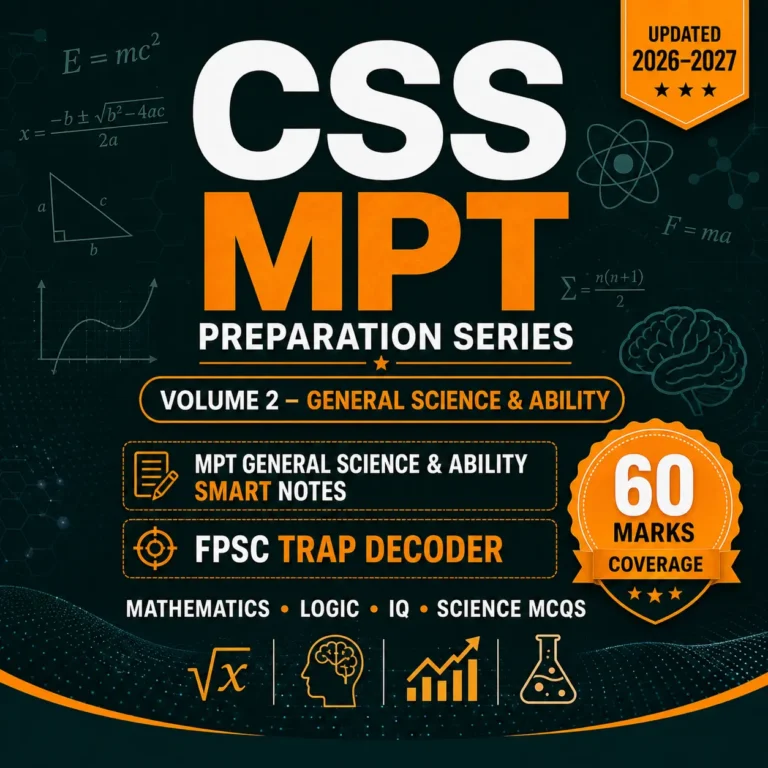
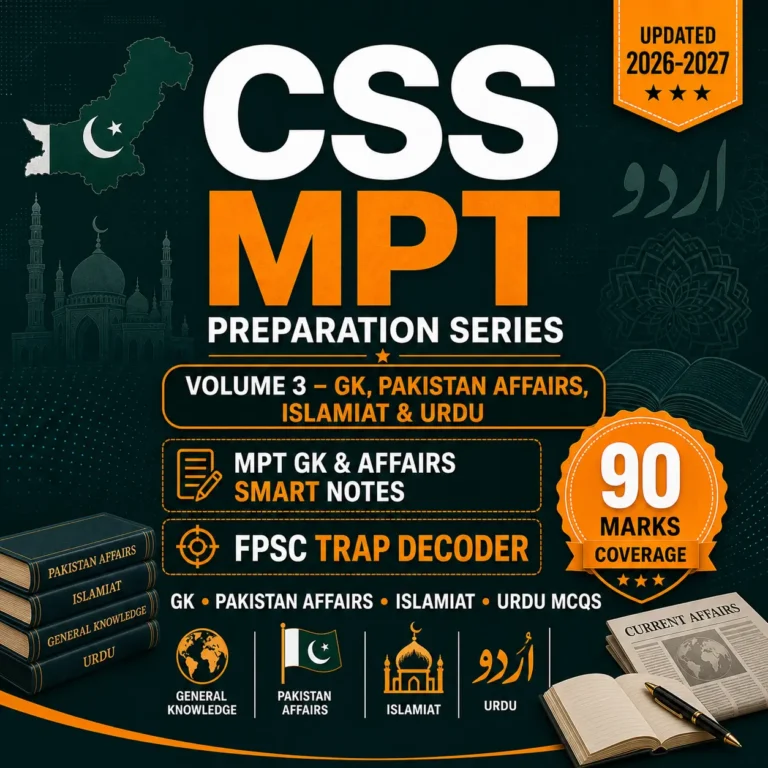
Recommended Books
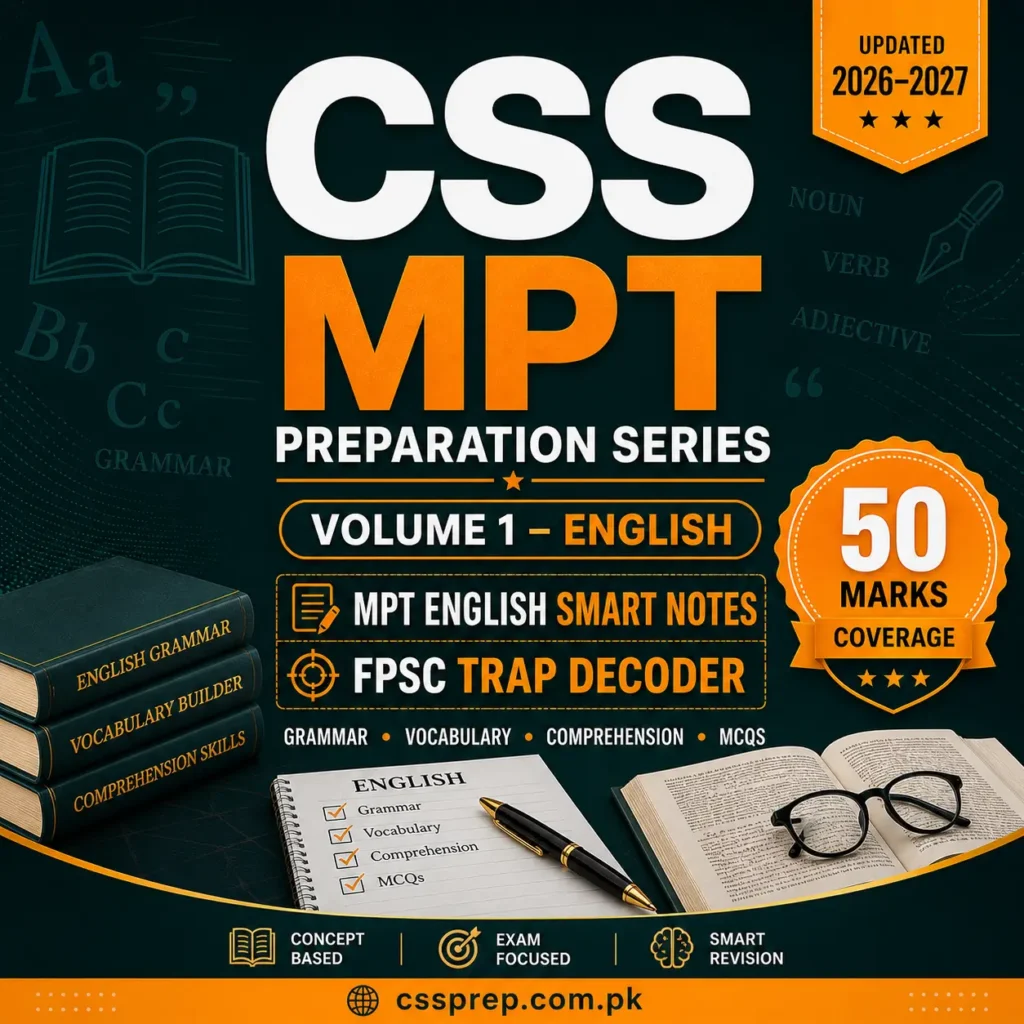
English — 50 MCQs, 50 Marks
English is the second-highest weight subject in the MPT. Many candidates treat it as easy and underprepare. Past papers show FPSC tests grammar rules under real time pressure, not just recognition.
Topics FPSC tests in English:
Sentence correction — picking the grammatically correct option from four choices
Grammar — tenses, subject-verb agreement, active and passive voice, direct and indirect speech
Vocabulary — synonyms, antonyms, fill-in-the-blanks, one-word substitution at an upper-intermediate level
Comprehension — short passages of 150 to 200 words, followed by 3 to 5 MCQs
General Science and Ability — 60 MCQs, 60 Marks
General Science and Ability is the highest-weight subject in the CSS MPT. At 60 marks out of 200, it is 30 percent of the entire paper. Many candidates underestimate it and focus time on content-heavy subjects like Pakistan Affairs and Islamic Studies. This is the most common strategic mistake in MPT preparation.
The section has three internal components.
Mathematical Ability — 15 to 20 Marks
Topics include arithmetic, ratio and proportion, percentage, profit and loss, basic algebra, geometry, and data interpretation. FPSC MPT mathematics is not advanced — it is the kind of arithmetic and reasoning found in NTS and PPSC papers. Speed matters more than depth here. A candidate who has practised these MCQ types under time pressure will perform significantly better than one who has studied the theory without timed practice.
Logical Reasoning and IQ — 10 to 15 Marks
This covers coding-decoding, number sequences, letter patterns, analogy MCQs, odd-one-out questions, and analytical puzzles. Past MPT papers confirm these question types repeat year after year. Working through previous years’ General Ability sections is more effective for this component than any textbook.
Everyday Science — 25 to 30 Marks
Topics include basic biology (human body systems, cell structure, diseases), basic chemistry (elements, compounds, common chemical reactions), basic physics (light, sound, electricity, units of measurement), and environmental science (climate, ecosystems, pollution). FPSC focuses on factual recall — common science facts every FSc-level candidate should know. Past papers confirm questions like: which vitamin is produced by sunlight, what is the chemical formula of water, which gas is most abundant in the atmosphere, and similar direct recall MCQs.
Pakistan Affairs — 20 MCQs, 20 Marks
Pakistan Affairs covers Pakistani history, constitutional development, geography, and national institutions. At 20 marks, it is a manageable section for candidates who have basic knowledge of Pakistan Studies at FSc level.
Topics FPSC Tests in Pakistan Affairs
History from 1947 includes events from partition and independence, major political developments, the 1965 and 1971 wars, constitutional history (1956, 1962, 1973 constitutions), major national events, and significant political figures.
Government and Constitution covers the federal structure, the role of parliament, the judiciary, fundamental rights under the 1973 Constitution, and provincial government. Questions from this area appear in almost every past MPT paper.
Geography tests knowledge of Pakistan’s provinces, major rivers, mountain ranges, neighbouring countries, agricultural zones, and natural resources.
National Institutions includes questions about the role and function of major bodies — State Bank of Pakistan, Election Commission, NAB, FPSC itself, Supreme Court.
Islamic Studies / Civics for Non-Muslims — 20 MCQs, 20 Marks
Islamic Studies covers Quranic knowledge, Hadith, Islamic history, and jurisprudence fundamentals. For non-Muslim candidates, FPSC substitutes this with a Civics paper.
Topics FPSC Tests in Islamic Studies
Holy Quran questions include the names and themes of important Surahs, significant verses and their context, Quranic commandments on major issues, and the chronological order of revelation. Past papers confirm Surah Al-Anfal, Surah Al-Baqarah, and Surah Al-Hujurat appear frequently in questions about specific rulings.
Hadith and Sunnah covers the major Hadith collections, the concept of Sunnah in Islamic jurisprudence, and famous individual Hadiths about specific acts of worship and conduct.
Islamic History includes the life of the Holy Prophet Muhammad (PBUH), the rightly guided Caliphs, early Islamic battles (Badr, Uhud, Khandaq), the spread of Islam, and major dynasties.
Fiqh and Pillars of Islam tests knowledge of the five pillars, obligatory acts of worship, zakat calculation basics, and key concepts in Islamic law.
Current Affairs — 20 MCQs, 20 Marks
Current Affairs covers national and international events from the twelve months before the MPT date. FPSC draws from the full year — not just the months immediately before the exam. A candidate who starts current affairs reading six months before the MPT will miss events from the six months prior to that. Start reading from the day you register.
Topics FPSC Tests in Current Affairs
Pakistan National Events includes major government decisions, economic developments, CPEC updates, natural disasters, major elections, and federal budget highlights.
International Affairs covers United Nations decisions, major international conflicts, bilateral relationships involving Pakistan, US-Pakistan relations, regional developments in Afghanistan and India, and decisions by major international bodies (IMF, World Bank, SCO, OIC).
Sports and Notable Achievements includes major international sports events, Pakistani sporting achievements, and record-breaking milestones that received national media coverage.
Awards and Appointments covers major Nobel Prize winners, major international appointments of Pakistanis, and significant national awards.
How to Prepare for Current Affairs
Read Dawn newspaper daily from the day you begin MPT preparation. Monthly current affairs summaries in JWT (Jahangir’s World Times) consolidate what you need without requiring you to memorise every daily headline. For the MPT, factual recall matters — who won, what happened, when, and which country or body was involved. Deep analytical understanding is for the CSS written papers, not the MPT.
Urdu — 20 MCQs, 20 Marks
The Urdu section is one of the most predictable in the entire MPT. FPSC tests the same categories of Urdu questions year after year. Candidates who prepare Urdu systematically from past papers consistently score close to full marks in this section.
Topics FPSC Tests in Urdu
Urdu Grammar (Qawaid) covers parts of speech in Urdu, correct sentence structure (jumla saazi), word classification (ism, fail, harf), and grammar rules tested through sentence correction MCQs.
Vocabulary (Alfaz) includes mushkil alfaz — difficult Urdu words with their meanings — synonyms and antonyms in Urdu, and choosing the correct word to complete a sentence.
Muhawaraat and Zarb-ul-Amsal — idioms and proverbs — appear consistently in past MPT papers. FPSC gives four options where you identify the correct meaning or the correct usage of a given idiom.
Comprehension includes a short Urdu passage followed by MCQs testing understanding. The passages are at FSc reading level.
How to Prepare for Urdu
Past MPT papers are the single best resource for Urdu preparation. The question categories repeat. Work through the Urdu sections of past papers from 2022 onwards, identify which muhawaraat and mushkil alfaz appeared, and build a vocabulary list from them. Standard Urdu Qawaid textbooks from Matric and FSc curriculum cover the grammar component completely.
General Knowledge — 10 MCQs, 10 Marks
General Knowledge carries 10 marks — the lightest section in the MPT. It tests geography, world history, and general factual awareness. Do not spend disproportionate preparation time here. One to two weeks of targeted MCQ practice is enough once the heavier sections are covered.
Topics FPSC Tests in General Knowledge
World Geography includes countries and capitals, major rivers, mountain ranges, continents and oceans, and the location of significant international landmarks.
World History covers major historical events — World Wars, formation of the United Nations, significant treaties, and major political developments in the 20th century.
International Organisations tests knowledge of the UN, its agencies (WHO, UNESCO, UNICEF, IMF, World Bank), OIC, SCO, SAARC, NATO, and their headquarters and purposes.
General Facts includes inventions and their inventors, scientific discoveries, the world’s largest and smallest countries, and notable world records of the kind that appear in standard general knowledge references.
H2: Solve — What to Do When Preparation Is Off Track
You Have Two Months Left and Have Not Started
Two months is workable if you are strategic. Drop General Knowledge from your study plan temporarily — 10 marks does not justify the time if you are behind. Focus your first four weeks entirely on General Science and Ability and English — together they are 110 marks. In weeks five and six, cover Urdu, Pakistan Affairs, and Islamic Studies using past papers only, not full textbooks. Spend the final two weeks on Current Affairs and full mock tests.
You Are Strong in Content Subjects But Weak in General Science and Ability
General Science and Ability is the section most candidates underperform in despite preparation, because they read theory rather than practise MCQs. Stop reading and start solving. Set a daily target of 30 GSA MCQs under timed conditions. After two weeks of daily practice, speed and accuracy both improve measurably.
You Cannot Find a Recommended Book in Your City
For candidates in smaller cities, Daraz stocks most standard CSS preparation books and delivers across Pakistan. For General Science and Ability and Urdu, past MPT papers are more useful than any book — and they are available on csssyllabus.com.pk.
The FPSC Syllabus Notification Shows Different Topic Areas
FPSC has the authority to revise the MPT structure with each annual notification. If the current FPSC notification on fpsc.gov.pk shows a different subject breakdown than the one in this article, the FPSC notification is the authoritative source. Always download and read the current notification before beginning preparation.
Closing
Download the official CSS exam notification from fpsc.gov.pk and confirm the MPT syllabus is unchanged for your examination year. Then begin preparation with the highest-weight subjects first: General Science and Ability at 60 marks, then English at 50 marks. If you have questions about the MPT structure that the notification does not answer, contact FPSC.
FAQs
What subjects are in the CSS MPT syllabus?
The CSS MPT syllabus covers seven subjects: English, General Science and Ability, Pakistan Affairs, Islamic Studies or Civics for non-Muslims, Current Affairs, Urdu, and General Knowledge. General Science and Ability carries the most marks at 60, followed by English at 50. The remaining five subjects each carry 20 marks except General Knowledge which carries 10.
How many marks does each subject carry in the CSS MPT?
English carries 50 marks. General Science and Ability carries 60 marks. Pakistan Affairs, Islamic Studies or Civics, Current Affairs, and Urdu each carry 20 marks. General Knowledge carries 10 marks. The total is 200 marks across 200 MCQs.
Is there negative marking in the CSS MPT?
No. There is no negative marking in the CSS MPT. A wrong answer scores zero — it does not reduce your total. Attempt every MCQ. Leaving any question blank guarantees zero on that question.
What is the passing mark in the CSS MPT?
The passing mark in the CSS MPT is 66 out of 200 — 33 percent. Candidates who score below 66 do not qualify for the CSS written examination. Verify this figure against the current FPSC notification on fpsc.gov.pk before your exam, as FPSC has the authority to revise the threshold.
Which subject should I prepare first for the CSS MPT?
Start with General Science and Ability — it carries 60 marks and requires the most practice time because it tests speed and reasoning, not just knowledge. Follow with English at 50 marks. These two subjects together are 55 percent of the total paper. Underperforming in either makes passing significantly harder.
Are Urdu MCQs really tested in the CSS MPT?
Yes. Urdu is a tested subject in the CSS MPT carrying 20 marks. The section tests grammar, vocabulary, idioms (muhawaraat), and comprehension. The question categories are highly predictable — working through past MPT Urdu sections from 2022 to 2026 covers most of what FPSC tests in this section.
How is the Current Affairs section prepared for the MPT?
Read Dawn newspaper daily from the day you begin preparation. Monthly current affairs summaries in JWT — Jahangir’s World Times — consolidate events without requiring you to memorise every headline. FPSC draws current affairs questions from the full twelve months before the exam, so start early. Last-minute current affairs cramming misses the earlier months.