Public Administration has one golden rule: every theoretical answer must land in Pakistan. Across twenty-three years of papers, classical and contemporary theories lead — Weber, Taylor, motivation theories, New Public Management — but the examiner isn’t testing whether you can recite Weber. They’re testing whether you can use him to illuminate the Pakistani bureaucracy: civil service reforms, the 18th Amendment, local government. An answer on bureaucratic theory that never touches Pakistan leaves half its marks on the table. Build a parallel file of Pakistani examples from day one and attach one to every theory you learn. Two warnings from experience: don’t pair this with Governance and Public Policies — the overlap means preparing the same content twice for no gain — and learn the vocabulary precisely. One strategic note: budgeting and financial management is rising, so don’t skip the numbers.
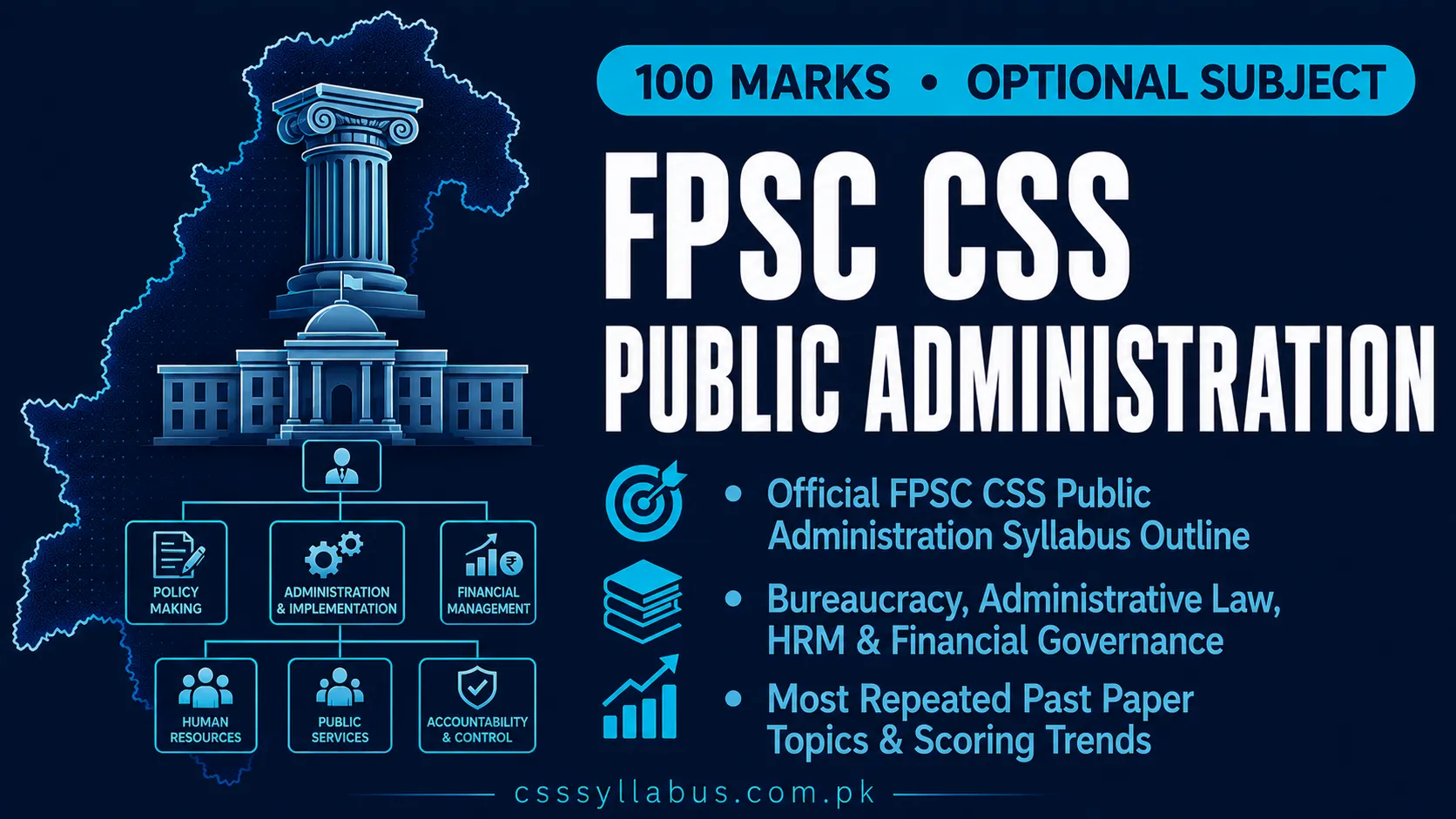
PUBLIC ADMINISTRATION CSS Syllabus (100 MARKS)
I. Public Administration: Concepts, Approaches and Context Definitions; Role and Scope of Public Administration in Society; Issues in Public Administration Theory and Practice: Democracy versus Bureaucracy, Politics versus Administration, Efficiency versus Equity; Core Values of Public Administration: Rule of Law, Efficiency, Equity and Fairness, Responsiveness; Traditional Public Administration; New Public Management; New Public Service; Governance Approach to Public Administration; Islamic Concept of Public Administration; Historical roots of Public administration in Pakistan.
II. Public Administration: Classical and Contemporary Theories and Concepts Bureaucracy; Scientific Management; Human Relations Approach; Leadership, Motivation, Network Governance; Strategic Management; Public Choice Theory; Types of Organizational Structure; Organization of Federal, Provincial, and Local Government in Pakistan; Administrative Culture of Pakistan; Inter-governmental Relations at Federal and Provincial level in Pakistan.
III. Public Policy Planning, Implementation and Evaluation Strategic Planning and Management; Planning Process; Policy Analysis; Policy Implementation; Program Evaluation; Planning Machinery; Role of Donors and International Institutions in Public Policy and Management; Policy making and implementation in Pakistan.
IV. Budgeting and Financial Management Budget as a Policy Tool; The Budget as a Managerial Tool; Principles of Budgeting, Audit and Accounting in Government; Line-Item Budgeting; Performance Budgeting; Program Budgeting; Zero-Base Budgeting; Outcome-Based Budgeting. Planning and Budgeting in Pakistan.
V. Managing Human Resources Spoil system versus Merit System in Public Employment; Personnel versus Human Resources Management; Close system versus Open System of Public Employment; Functions of Human Resources Management; Implementation of HRM in Public Sector: Key Issues and Challenges.
VI. Administrative Law Meaning; Scope and Significance; Nature and Contents of Administrative Law, Administrative Ethics, Delegation of Authority and Legislation, Administrative Tribunals; Administrative Law in Pakistan.
VII. Public Management Skills Planning; Decision Making, Conflict Management; Leading, Communication, Administrative Buffering; Managing Change; Managing Diversity; Stress Management; Delegation; Public Service Motivation; Creativity and Problem Solving; Issues of Public Management.
VIII. The Civil Service of Pakistan Historical Background of Civil Service, The Structure of civil Service; History of Civil Service Reform; Management of Civil Service; Institutional and Cultural Context of Civil Service; Role of Civil Service in Good Governance, Gender and Civil Service.
IX. Organization of Provincial and Local Government Governance Structure of Provincial Administration; Organization of Provincial Secretariat; Organization and Functions of Provincial Authorities and Agencies and their Relationship with Government Departments; Post-devolution Local Governance; Organization and Functions of District Government and Administration; Organization and Structure of City District Government; Issues and Challenges of Local Governance.
X. Governance and Administrative Reforms Theories of Administrative Reforms; Types of Administrative Reforms; Privatization; Regulation; De-regulation; Decentralization; Partnerships and Collaboration; Business Re-engineering, Quality Assurance; Administrative Reform in Pakistan.
XI. Public Administration Accountability & Control Bureaucratic Responsiveness; Representative Bureaucracy; Citizens Engagement in Public Service; Accountability & Control; Concept and Approaches to Public Accountability; Institutional Framework for Administrative Accountability; Legislative, Executive and Judicial Control over Administration; Administrative Corruption; Role of Civil Society in Good Governance; Media, Interest Groups and Civil Society Organizations; The Situation in Pakistan.
XII. Public Administration and Development Role of Public Administration in Development; Concept of Development Administration; Difference Between Development Administration and Development Management; Changing Role of Public Administration in Development, Issues and Challenges of Public Administration in Pakistan.
SUGGESTED READINGS
| S.No. | Title | Author |
|---|---|---|
| 1 | Public Administration 7th Ed | Denhardt Robert |
| 2 | Public Administration:Understanding Management, Politics and Law 8th Ed | David Rosenbloom |
| 3 | Public Administration 2nd Ed | Caiden, Gerald E. |
| 4 | Public Administration for the twenty first century | Cooper Et Al, |
| 5 | Organization Theory for Public Administration | Harmon Michael & Mayer Richard |
| 6 | Public Administration and Public Affairs 12th Ed | Nicholas Henry |
| 7 | Classics of Public Administration 7th Ed | Shafritz Jay |
| 8 | Reinventing Government | Osbourne D |
| 9 | Evolution of Pakistan’s Administration System | Braibanti, Ralph |
| 10 | Human Development in South Asia | Mahbub-ul-Haq |
| 11 | Bureaucracy, basic books | Wilson, James Q |
| 12 | Bureaucracy in Pakistan | Kennedy, Charles H |
| 13 | Public Administration and Law | Julia Beckett |
| 14 | Public Administration: A Comparative Perspective 6th ed. | Ferrel Heady |
| 15 | Public Administration and Public Management: The Principle- Agent Perspective | Jan-Erik Lane |
| 16 | Governance: South Asian Perspectives | Hasnat Abdul Hye |
| 17 | Governance, economic policy and reform in Pakistan:Essay in political economy | Abdus Samad |
| 18 | Government and Administration in Pakistan | Jameelur Rehman Khan |
| 19 | Public Administration with special reference to Pakistan | Sultan Khan |
| 20 | Public Administration in Asia Vol. I & II | Srinivasan Kalyanaraman |
| 21 | Organizational Theory and the Public Sector | Tom Christensen Per Laegreid |
| 22 | Public Administration in South Asia: India, Bangladesh and Pakistan | Meghna Sabharwal, Evan M. Berman |
Frequency Analysis — Past Papers 2000–2022
Years covered: 2000–2022, all 23 years with no gaps (205 question items). Counting: long questions + each short-note option = 1 item.
| Topic | Questions asked | % weightage | Trend |
|---|---|---|---|
| I. Concepts, Approaches and Context | 35 | 17.1% | Rising |
| II. Classical & Contemporary Theories | 44 | 21.5% | Stable |
| III. Public Policy (Planning, Implementation, Evaluation) | 12 | 5.9% | Falling |
| IV. Budgeting & Financial Management | 19 | 9.3% | Rising |
| V. Managing Human Resources (HRM) | 11 | 5.4% | Falling |
| VI. Administrative Law | 8 | 3.9% | Stable |
| VII. Public Management Skills | 26 | 12.7% | Stable |
| VIII. Civil Service of Pakistan | 5 | 2.4% | Stable |
| IX. Provincial & Local Government | 7 | 3.4% | Rising |
| X. Governance & Administrative Reforms | 15 | 7.3% | Stable |
| XI. Accountability & Control | 21 | 10.2% | Falling |
| XII. Public Administration and Development | 2 | 1.0% | Rising (small base) |
| Total | 205 | 100% | — |
Top-5 most-repeated topics: 1. Classical & Contemporary Theories (44) — Weber, Taylor, Hawthorne, motivation theories, NPM; 2. Concepts, Approaches and Context (35); 3. Public Management Skills (26) — decision-making, leadership, communication; 4. Accountability & Control (21); 5. Budgeting & Financial Management (19).
Preparation Strategy
Start with the theories, because classical and contemporary theory leads this paper across twenty-three years of papers. Work through Weber, Taylor, the motivation theories, and New Public Management in that order, and learn each theory as a tool: its core claim, its vocabulary, and the Pakistani setting where it applies. Learn the terms precisely, because loose vocabulary costs marks in a subject whose marking rewards exact usage.
Build a parallel Pakistan file from day one, and treat it as half the subject. The examiner tests whether you can use theory to illuminate the Pakistani bureaucracy, so attach one Pakistani example to every theory you learn: civil service reforms, the 18th Amendment and its effect on administration, and local government. An answer on bureaucratic theory that never touches Pakistan leaves half its marks on the table, and the example file prevents that loss.
Keep budgeting and financial management inside your plan rather than at its edge; that area keeps rising in recent papers, and candidates who skip the numbers donate easy marks. Practise by writing theory-plus-Pakistan answers under time pressure: one theory, one local application, one short judgement. Deprioritise pure theory revision in the final stretch and shift those hours into example drilling. Candidates who run theory and Pakistani practice side by side from the start find this paper rewards them steadily.
Update your Pakistan file as you study, not after. Every time a theory raises authority, incentives, or accountability, ask which Pakistani institution shows that idea in action and file the answer. By the final stretch you revise examples rather than theories, and your answers land on real institutions within the first lines.
Frequently Asked Questions
Q: Should I pair Public Administration with Governance and Public Policies?
No. The overlap means you prepare the same content twice for no gain. Pick one of the two and spend the saved hours on a subject that adds new material to your combination.
Q: Why do strong theory answers still score low here?
They ignore Pakistan. The examiner tests whether you can use Weber or Taylor to explain the Pakistani bureaucracy. A theory answer with no Pakistani example leaves half its marks on the table.
Q: Which theories should I learn first?
Start with Weber, Taylor, the motivation theories, and New Public Management. Theory leads this paper across twenty-three years of papers. Learn the vocabulary of each theory precisely, because exact terms earn marks here.
Q: Is budgeting worth serious time in this subject?
Yes. Budgeting and financial management keeps rising in recent papers. Candidates who skip the numbers lose ground every cycle. Give public finance a fixed slot in your plan rather than a final-week glance.
Q: What Pakistani examples should I prepare for theory answers?
Prepare civil service reforms, the 18th Amendment, and local government first. Attach one example to every theory as you learn it. A ready example file turns an average theory answer into a scoring one.