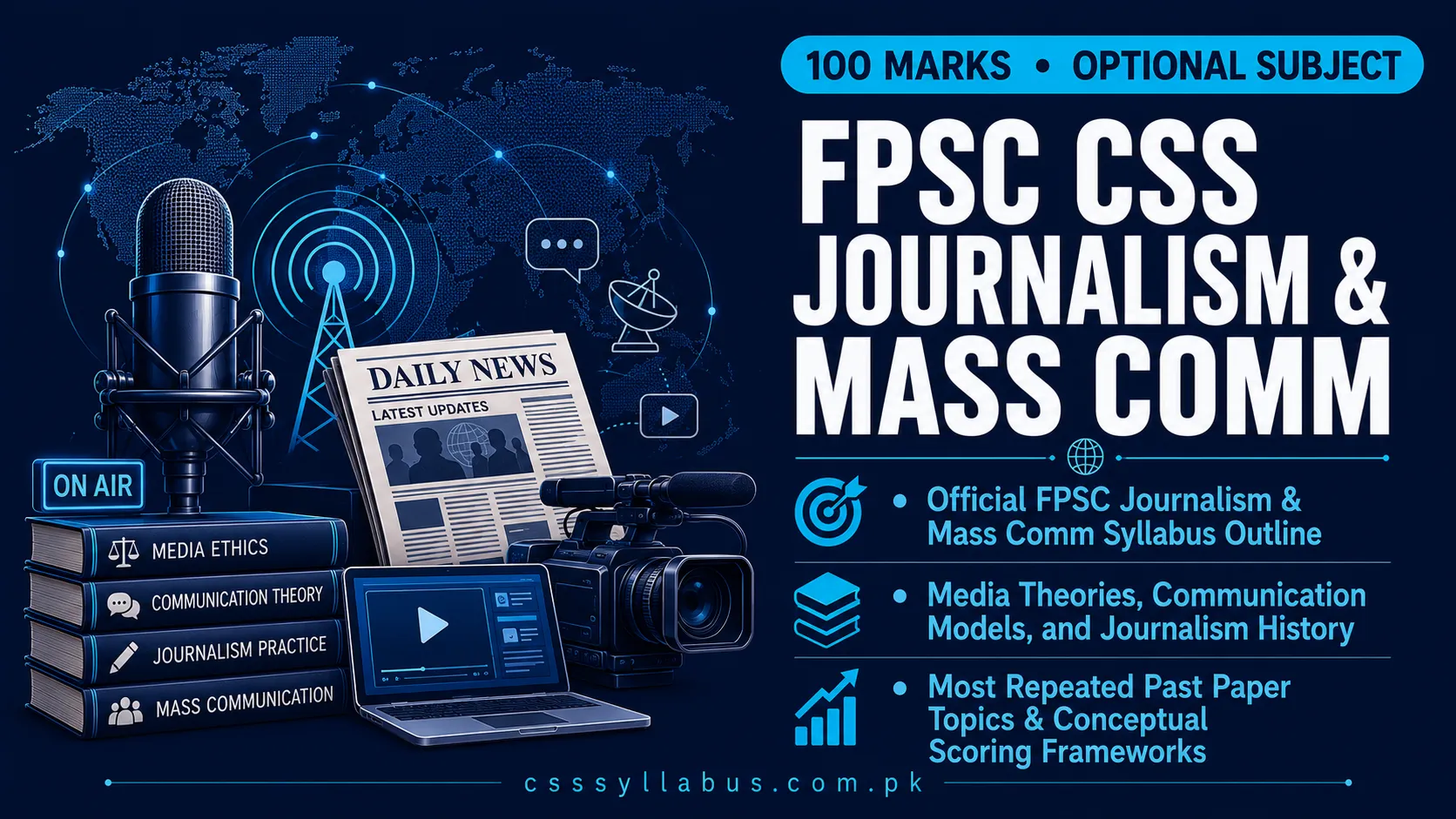
CSS Journalism and Mass Communication is a 100-mark optional paper under Group VII of the CSS optional subjects — Social Sciences and Languages — belonging to a group that includes Arabic, Persian, Balochi, Pashto, Sindhi, Punjabi, Anthropology, Sociology, Geography, and Psychology. FPSC sets the CSS Journalism and Mass Communication syllabus to cover mass communication theories, journalism ethics, print and broadcast journalism, media laws in Pakistan, digital media, public relations, and the role of mass media in society. Mass communication, journalism, and social sciences graduates select this subject for its direct alignment with their degree coursework and Pakistan’s evolving media landscape — Mehdi Hassan’s Journalism for All is the standard recommended text covering the full scope of media studies tested by FPSC. Review the CSS optional subjects syllabus for combination rules and group requirements before confirming Journalism and Mass Communication as your optional subject choice.
JOURNALISM & MASS COMMUNICATION CSS Syllabus (100 MARKS)
I. Introduction to Mass Communication Concept – Definitions, Need/Importance/Purposes, Types of Communication, Process of Communication, Basic Models. Functions of a model, Evaluation of a model Basic models in Mass Communication: o Lasswell’s Model (1948) o Shannon-Weaver model (1948) o Osgood,s model (1954) o Schramm’s model (1954) o Newcomb’s symmetry theory (1953) o Westley-McLean’s model (1976) o Gerbner model (1956)
II. Mass Communication Theories Normative theories of the press: Schramm’s four theories and criticism on these theories Media as agents of power The Spiral of silence Media Usage and gratifications Media hegemony Diffusion of innovations Powerful effects model: hypodermic needle, magic bullet theory. Moderate effects model: two-step and multi-step flow of communication. Powerful media revisited: Marshal McLuhan’s media determinism
III. Global / International Communication The Historical Context of International Communication Globalization, technology, and the mass media Communication and Cultural imperialism Communication Flow in Global Media: Imbalance in the flow of information between North and South McBride commission and its recommendations. International Communication in the Internet Age: the new social media and its effects on developing world
IV. Media and Society Mass media and social change Media as a social system: The balance between interrelation and interdependence Media freedom and its role for democracy, The functional approach to mass media: four social functions of the media Media as an awareness agent Mass media and social representation
V. Mass Media in Pakistan Media system in Pakistan: historical, chronological, and analytical review The system of journalism and the media system Employer-employee relations in Pakistani media Government-press relations Press in Pakistan: The newspaper industry, from mission to the market Electronic media: from total dependence to enormous power The new 24/7 television: uses and abuses The new radio: potential for change and the present performance. The question of freedom and responsibility
VI. Development Support Communication Theories of development support communication with specific focus on the developing world The dominant paradigm of development: historical, analytical perspective The Alternative paradigm of development Small is beautiful: community development as a snowball effect. Globalization vs Localization Glocalization Social Marketing: how to infuse new ideas into a developing population
VII. Public Relations Concept of Public Relations Historical development of public relations: from press agentry to PR Public relation in Pakistan Ministry of information Press Information Department (PID) Public relations and publicity PR as a tool for governance Private PR agencies and their structure Basic methods of PR: press release, press note, press conference PR Ethics
VIII. Media Laws and Ethics History of Media Laws in Pakistan Development of media regulations from British colonial era to independent Pakistan Libel, Defamation and relevant portions of PPC PPO, RPPPO PEMRA: establishment, development, and operational mechanisms Press Council of Pakistan (PCP) Citizens Media Commission: need, present status, and reasons for inactivity Press Code of Ethics Inability of the media to develop a code of ethics as an institution The media’s quest for freedom and its inability to self regulate.
SUGGESTED READINGS
| S No. | Title | Author |
|---|---|---|
| 1 | Broadcast Regulations: the German Example | Metzger, Herbert. FES 1993. |
| 2 | Communication Models for The Study of Mass Communication, 2nd Ed | McQuail, Dennis &Windhal, Swen, Longman, 1982. |
| 3 | Convergence Culture: Where old and new Media | Blackwell publishing Ltd, USA. |
| 4 | Communication Theories: Origins, Methods and Uses in the Mass Media 5th Ed | Werner J. Severin, James W. Tankard Jr. Longman, 1997. |
| 5 | Diffusion of Innovations 5th Ed | Rogers, Everett M. Free Press 2003 |
| 6 | Ethics in Journalism: A Reader on Their Perception in the Third World | Kunczik, Michael (Ed.). FES 1999. |
| 7 | Handbook of International and Intercultural Communication 2nd Ed | Gudykunst & Mody, Sage, 2001. |
| 8 | McQuail’s Mass Communication Theory, 4th Ed | Denis McQuail. Sage, 2000. |
| 9 | Media And Society into the 21st Century: A Historical Introduction | Blackwell publishing Ltd, USA. |
| 10 | “Media / Impact” | Wads Worth/ Thompson Learning, Belmont, CA |
| 11 | “Media Now: Communication Media in the Information Age” | Wads Worth/Thompson Learning, Belmont, CA |
| 12 | News Media and Journalism in Pakistan | Khan, Altaf. LAP Lambert Academic Publishing. June 2011. |
| 13 | News Media and Journalism in Pakistan and Germany (Ed.) | Khan, Altaf. Peshawar, 2003. |
| 14 | Participatory Development | Hasan, Arif, Oxford, 2010. |
| 15 | Political Communication in Britain: The Leader Debates, the Campaign and the Media in the 2010 General Election, (Ed) | Palgrave McMillan, UK |
| 16 | Political Communication in Asia, | Roultage, NY. |
| 17 | “Precision Journalism: A Reporter’s Introduction to Social and Science Methods”, 4th Ed | Rowman and Littlefield, Lanham, MD. |
| 18 | Report and Recommendations of the Media Commission, appointed by the Supreme Court of Pakistan, 2013 | FES, Islamabad, 2013. |
| 19 | Reporting the Frontier: Media Capacity Building for Peace in Pakistan’s Tribal Areas | Khan, Altaf VDM Verlag Dr. Müllere.K. June 2011. |
| 20 | “Writing, Directing, and Producing Documentary Films and Vidoes”,.3rd edition | Carbondale: Southern Illinois Press, 2002. |
| 21 | “Directing the Documentary”, 4th edition | Focal Press, 2004. |
| 22 | “Documentary Storytelling: Making Stronger and More Dramatic Nonfiction Films”, 2nd edition | Focal Press, 2007. |
| 23 | Principles of Editing | McGraw-Hill 1996 |
| 24 | Journalism–Principles and Practices | Vistaar Publications 2006 |
| 25 | The Hand Book of New Media | London: Sage |
| 26 | Applying Communication Theory for Professional Life: An Introduction (2nd Edition) | London: Sage |
| 27 | Controversies in Contemporary Advertising | Newbury Park: Sage Publications |
| 28 | “Public Relations-Writing & Media Techniques” | Harper Collins College Publishers, NY |
| 29 | Telecommunications Policy in Pakistan” | Telematics and Informatics |
| 30 | “Guaranteeing Copyright- Media Manager’s Guide to Pakistani Broadcast Law” | Media Manager Companion Series Internews Pakistan |
| 31 | “Model Freedom of Information Act”, 2001 | Consumer rights Protection Commission of Pakistan |